

What Is Anaerobic Threshold And How Can It Make You Faster?
Understanding what is anaerobic threshold is like finding your personal red line. It's the highest gear you can hold for an extended period before your body screams at you to slow down. It’s that make-or-break point in a race. Lactate starts flooding your system faster than you can clear it out. Fatigue hits you like a ton of bricks.
Unlocking Your Performance Ceiling
Have you ever been deep into a race, feeling powerful and dialed in, only to suddenly hit an invisible wall? One minute you’re cruising. The next, your legs are turning to cement and your breathing is out of control. That barrier you just slammed into? That's your anaerobic threshold (AT).
For any runner serious about getting faster, this is a critical physiological marker. It applies to the 5k warrior and the marathon veteran.

Build Your Running Performance System
Move from research to action with training, recovery, nutrition, pacing, and performance tools built for runners.
More Guides for This Runner Goal
Here's a simple analogy: imagine your body is a kitchen sink. When you run harder, your muscles produce lactate. That’s like turning on the faucet. Your body also constantly works to clear that lactate. This is the water going down the drain.
At easy to moderate efforts, the faucet and drain are in balance. But the anaerobic threshold is the exact point where you turn that faucet up too high. The water starts coming in faster than the drain can handle. The sink begins to overflow.
That "overflow" is the rapid accumulation of acid in your muscles. It's the source of that familiar burning sensation that forces you to pump the brakes.
Why Your Anaerobic Threshold Matters
Understanding your AT isn't just academic. It's the key to unlocking your true potential for speed and endurance. When you raise your AT, you can hold a faster pace for much longer. Fatigue won't crash the party as quickly. It's the physiological engine that powers your race day performance.
To help you grasp the core ideas quickly, here’s a simple breakdown.
Anaerobic Threshold At A Glance
| Concept | Simple Explanation | Why It Matters For Runners |
|---|---|---|
| Anaerobic Threshold (AT) | The tipping point where your body produces lactate faster than it can clear it. | A higher AT means you can sustain a faster pace for a longer time before fatiguing. |
| Lactate Production | A byproduct of intense exercise. Not the enemy, but an indicator of high effort. | It's a signal that you're working hard. Training teaches your body to use it for fuel. |
| Lactate Clearance | Your body's ability to remove and reuse lactate from the muscles. | Efficient clearance delays the "burn" and fatigue, letting you run harder for longer. |
| Training Impact | Specific workouts (like tempo runs) teach your body to become better at this balance. | Targeted training directly raises your AT, leading to new personal bests. |
Ultimately, training to improve this threshold is one of the most effective things you can do.
- Faster Sustainable Pace: You'll be able to lock into a harder effort and hold it. This applies to a 10k or the final miles of a marathon.
- Improved Lactate Clearance: Your body becomes more efficient at shuttling lactate out of your muscles. It can even use it as a secondary fuel source.
- Enhanced Running Economy: As your threshold fitness improves, your old race pace will feel more controlled.
The anaerobic threshold was formally defined in 1964. The renowned exercise physiologist Karl Wasserman made it a landmark moment for sports science. Wasserman's groundbreaking work established that the AT is the specific point where our aerobic energy system can no longer keep up. This forces anaerobic systems to kick in. You can learn more about the history of anaerobic threshold definitions.
The Science Behind Your Body's Performance Engine
To really get what the anaerobic threshold is, you have to look under the hood. Think of your body's performance engine like a hybrid car. You have two main systems working together to create energy. The aerobic system uses oxygen for long, efficient cruising. The anaerobic system kicks in for quick bursts of power when you need to floor it.
When you're out for a relaxed, conversational jog, you're running on that efficient aerobic system. It has all the oxygen it needs to convert fat and carbs into fuel. You can keep this process up for a very long time.
But what happens when you hit a steep hill or decide to unleash a finishing kick? Your muscles start screaming for energy far faster than the aerobic system can deliver. That’s the cue for your anaerobic system to jump in and save the day.
The Anaerobic System's Double-Edged Sword
The anaerobic system is all about speed. It rapidly breaks down glucose for a powerful shot of energy. It does this without needing oxygen. This is perfect for those all-out efforts, like sprinting for the finish line.
But this fast and furious energy production creates a byproduct: lactate.
For decades, runners got this wrong. They blamed lactate for that deep muscle burn and fatigue. We now know lactate isn't the enemy. In fact, it's a valuable fuel source. Your body can shuttle it to other muscles to be converted back into energy.
The real issue isn't lactate itself, but how fast it starts to pile up. At lower intensities, your body clears it as quickly as it's made. This keeps everything in balance. Push harder, though, and you'll eventually hit a critical tipping point.
This tipping point is your anaerobic threshold. It's where your body produces lactate faster than it can clear it. The burn you feel isn't from the lactate. It's from the buildup of hydrogen ions that come with it. This makes your muscles more acidic and forces you to dial back the intensity.
Thresholds Explained: Lactate vs. Ventilatory
In the running world, you'll hear a few similar terms. Let's break down the main ones: anaerobic threshold (AT), lactate threshold (LT), and ventilatory threshold (VT). They each measure a slightly different physiological response. However, they all happen at almost the exact same effort level.
- Lactate Threshold (LT): This is the gold standard, measured in a lab with blood samples. It pinpoints the exact moment lactate begins accumulating in your bloodstream.
- Ventilatory Threshold (VT): This one is all about your breathing. It’s the point where your breathing rate suddenly spikes and becomes much deeper. You go from being able to chat to only getting out a word or two.
- Anaerobic Threshold (AT): This is the more common, catch-all term. For our purposes, it describes that same performance redline as your LT and VT.
Diving into the general scientific principles of performance can give you a deeper appreciation. For runners, knowing your threshold is everything. Training right at this intensity teaches your body to get better at clearing lactate.
This is the key to raising your performance ceiling. It is a massive part of how to improve running endurance. You're upgrading your engine to run faster and harder for longer before you hit that wall.
How To Find Your Personal Anaerobic Threshold
Knowing your anaerobic threshold is one of the most powerful things you can do. It helps you train smarter, not just harder. A fancy lab test will give you the most precise data. But it's also expensive and out of reach for most of us. The good news? You can get incredibly close with a few practical tests.
These field tests help you nail down the specific heart rate, pace, or power output. This is where you hit that tipping point. Once you have these numbers, you can stop guessing. You can start building a training plan with laser-focused zones. Every workout suddenly has a purpose.
This infographic breaks down how your body's energy systems shift as intensity ramps up.
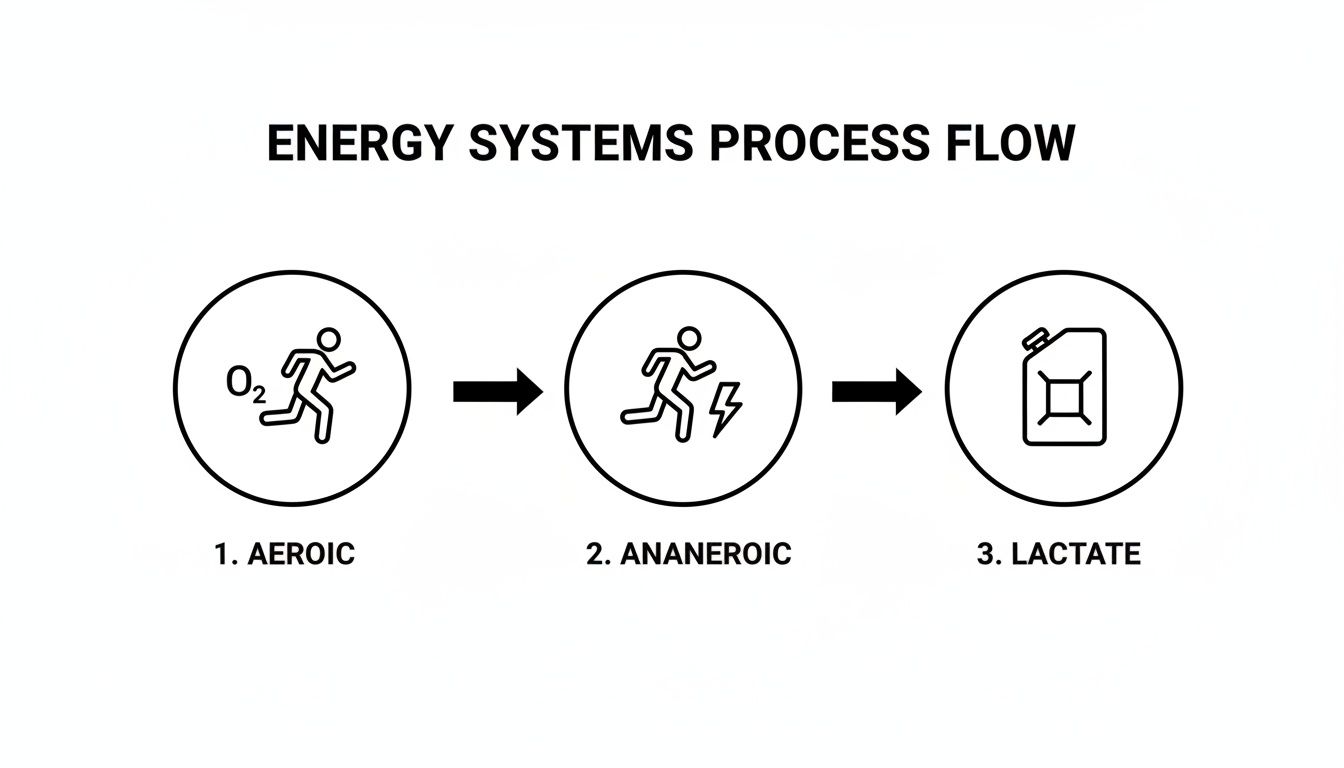
As you can see, the goal of smart training is to push that anaerobic tipping point further. This lets you hold faster paces for much longer before you have to slow down.
The 30-Minute Time Trial Field Test
The 30-minute time trial is the gold standard for finding your anaerobic threshold. It’s straightforward and doesn't require any special equipment. It perfectly mimics the kind of sustained effort that reveals your threshold. The mission is simple: run as hard as you can maintain for a full 30 minutes.
Here’s how to do it right:
- Find a Good Course: Pick a flat and predictable route, like a track. Consistency is everything for getting reliable pace data.
- Warm-Up Properly: Don't skip this. Spend 10-15 minutes jogging easy. Then move into some dynamic drills and a few short strides.
- Run the Test: Start your watch and settle into the fastest pace you believe you can hold. It should feel "comfortably hard"—a focused, challenging effort.
- Analyze the Data: When you're done, dive into the numbers. Your anaerobic threshold heart rate is your average heart rate from the final 20 minutes. Your anaerobic threshold pace is the average pace from that same window.
Why ignore the first 10 minutes? It takes time for your heart rate to ramp up and stabilize. The final 20 minutes give you a perfect snapshot of your body working at its limit. You can use our heart rate zone calculator to set up your training zones.
Using Recent Race Results
Don't have time for a test? Your recent race results are another fantastic way to estimate your threshold. The effort you can sustain for about an hour of all-out racing is a very close match.
- 10K Race: Your average pace and heart rate from a well-run 10K are often a direct indicator.
- Half Marathon: Your average pace and heart rate will be just a touch below your actual threshold. Estimate your threshold pace is about 10-15 seconds per mile faster.
- 5K Race: A 5K is run well above your anaerobic threshold. Your threshold pace is likely 20-30 seconds per mile slower than your 5K average.
For these estimates to be accurate, use results from a recent race. It should be from the last 4-6 weeks where you truly left it all out on the course.
Gauging Effort With RPE and Breathing
Finally, you can learn to find your threshold just by feel. This is where experience and body awareness really pay off. Using the Rate of Perceived Exertion (RPE) scale, your threshold effort should land around a 7 or 8. It's tough and you're focused, but you feel like you can hold on.
Your breathing is another dead giveaway. Physiology studies have shown a clear connection between breathing rhythm and intensity. At an easy pace, you might be breathing in a relaxed 4-in, 4-out pattern. As you approach your threshold, that shortens to a more urgent 2-in, 2-out rhythm. Push past it, and you’re forced into a frantic 1-in, 1-out gasp for air.
Learning to recognize this feeling is a skill that will serve you well. This internal gauge is a powerful tool for moderating your effort in workouts and on race day.
Turning Your Threshold Data Into Smart Training Zones
Once you've nailed down your anaerobic threshold, you've unlocked a powerful tool. Knowing your threshold heart rate and pace means you can finally stop guessing. You can start training with surgical precision.
This data becomes the blueprint for your training zones. It makes sure every run you do has a clear purpose.
You get to move beyond vague efforts like "hard" or "easy." You can start targeting specific physiological improvements. This is how you break the cycle of running your easy days too hard and your hard days too easy. That pattern leads straight to burnout and frustrating plateaus.
Building Your Five-Zone Training Model
The most common and effective way to use your AT numbers is to build a five-zone training model. Each zone is based on a percentage of your anaerobic threshold heart rate (ATHR) or pace. Each one delivers a unique training benefit. This framework is your key to a balanced training week. It covers everything from active recovery to building raw speed.
Think of it like having a full set of tools. You wouldn't use a sledgehammer for a delicate job, right? In the same way, you shouldn't be running at tempo pace on a recovery day. Matching the right zone to the right workout is how you maximize your gains.
The secret sauce to making this work is a concept called polarization. Most world-class runners spend about 80% of their training time at low intensities. They spend only 20% at high intensities. This builds a massive aerobic engine while keeping them fresh for key workouts.
So, let's look at how to set up and use these zones.
Runner Training Zones Based On Anaerobic Threshold
Here’s a breakdown of the five essential training zones. This table shows you how intense each zone is relative to your AT. It also shows what you’re trying to accomplish and how it should feel. Getting this right will completely change how you approach your training.
| Zone | Intensity (% of AT Heart Rate/Pace) | Primary Purpose | Feeling / RPE |
|---|---|---|---|
| 1 | Less than 85% of ATHR / Much Slower | Active Recovery & Warm-Up – Promotes blood flow and aids muscle repair. | Very easy, fully conversational. RPE 2-3. |
| 2 | 85-90% of ATHR / Slower | Endurance Building – This is the foundation of all your running fitness. | Easy, you can hold a conversation. RPE 4-5. |
| 3 | 91-99% of ATHR / Slightly Slower | Aerobic Power – The "gray zone," a moderately hard aerobic effort. | Comfortably hard, sentences start breaking up. RPE 6. |
| 4 | 100-105% of ATHR / At Threshold | Raise AT – The sweet spot for improving lactate clearance and speed endurance. | Hard, you can only speak a few words at a time. RPE 7-8. |
| 5 | 106%+ of ATHR / Faster | VO2 Max Development – Boosts maximal oxygen uptake and top-end speed. | Very hard, speaking is not an option. RPE 9-10. |
With this framework, your weekly schedule suddenly has structure and purpose. A typical week might involve a few runs in Zone 2 and a key workout in Zone 4. You could also have one session with intervals in Zone 5. Your other days would be for Zone 1 recovery or complete rest.
To get a better handle on these workouts, check out our guide on what a proper threshold pace feels like. This strategic approach ensures you’re getting the most out of every single mile.
Proven Workouts That Raise Your Anaerobic Threshold
Alright, so you've figured out where your current performance limits are. Now for the fun part: strategically pushing them higher. Training to raise your anaerobic threshold is one of the most effective ways to become faster. These workouts are designed to teach your body to clear lactate more efficiently. This is the secret to sustaining a harder pace for much longer.

The whole point is to spend quality time running right at or just above your current threshold. This specific stress is what triggers powerful physiological adaptations. Do it right, and you'll find your old race pace starts to feel significantly easier. Let's get into the two most effective workout structures for making this happen.
The Classic Tempo Run
The tempo run, often called a threshold run, is the cornerstone of building your AT. Think of it as a single, sustained effort at your threshold pace. You'll hold it for a solid chunk of time, usually between 20 and 40 minutes. This isn't just a physical test. It's a massive builder of mental toughness.
Here’s what a classic tempo workout looks like:
- Warm-Up: Always start with 10-15 minutes of very easy jogging. Follow that up with some dynamic drills like high knees and leg swings.
- Main Set: Now, settle in for 25 minutes at your pre-determined anaerobic threshold pace. The key here is consistency. Focus on a smooth rhythm and controlled breathing.
- Cool-Down: Finish it off with 10-15 minutes of easy jogging. This helps your body kickstart the recovery process.
This workout directly challenges your body’s ability to find that delicate balance. It makes it an incredibly powerful stimulus for improvement. You can dig deeper into the specifics in our guide on what is a threshold run.
Cruise Intervals For Pace Control
Cruise intervals offer another fantastic way to train your anaerobic threshold. Instead of one long, continuous effort, you break the work into shorter reps. These have brief recovery periods in between. This structure is brilliant. It often allows you to accumulate more total time at your threshold intensity.
A typical cruise interval session might be structured like this:
- Warm-Up: Begin with 10-15 minutes of easy jogging. Follow this with dynamic stretching and a few short strides.
- Main Set: Run 4 repetitions of 10 minutes each at your anaerobic threshold pace. In between each one, take a 2-minute easy jogging recovery.
- Cool-Down: Wrap it all up with 10-15 minutes of slow jogging to cool down properly.
Those short recovery jogs are just enough to let you catch your breath and regroup. They are not so long that your heart rate drops out of that crucial training zone.
A key to success with both workout types is consistency. You should feel challenged but not completely wrecked at the end. The goal is to finish feeling like you could have squeezed out one more rep.
Modifying Workouts For Your Experience Level
Not everyone should jump straight into a 40-minute tempo run. It's crucial to tailor these workouts to your current fitness. The principle of progressive overload is everything here. You want to gradually increase the difficulty as you get fitter.
Here are some smart ways to adjust these workouts:
- For Beginners: Start small. A newer runner might begin with a tempo run of just 15 minutes. Or, for cruise intervals, try 3 x 5 minutes with 3 minutes of recovery.
- For Intermediate Runners: You can start extending the duration. Progress your tempo run from 20 minutes up to 30. Or bump up your cruise intervals to 4 x 8 minutes while shortening the recoveries.
- For Advanced Runners: Experienced athletes can handle more volume and intensity. This could look like a tempo run of 40+ minutes. Or try a tough cruise interval session like 5 x 10 minutes with short recovery.
Your anaerobic threshold is directly tied to the pace you can sustain in a race. Research consistently shows that this intensity can be maintained for 30-60 minutes. Studies show that runners who train specifically at this intensity can see performance improvements. By consistently slotting these workouts into your plan, you are investing in faster race times.
Common Questions About Anaerobic Threshold Training
Even with a great plan, a few questions are bound to pop up. That's totally normal. Fine-tuning your training always involves a bit of trial and error. Getting straight answers to common sticking points can save you time and frustration.
Let's dive into some of the most frequent questions I hear from runners. You can then apply these concepts with confidence and get the most out of every workout.
How Often Should I Re-Test My Anaerobic Threshold?
This is probably the number one question people ask. You need to perform a field test every so often. This keeps your training zones accurate. After all, the whole point is to raise your threshold. The numbers you had six months ago are probably way off by now.
As a general rule, plan to re-test your anaerobic threshold every 4 to 6 weeks.
There’s a good reason for this specific timing:
- It allows for real adaptation: It takes a few weeks of consistent work for your body to make meaningful changes.
- It keeps your zones relevant: A 4-6 week window is short enough to ensure your paces and heart rate zones stay dialed in.
- It syncs with training cycles: This schedule fits perfectly into most 12-16 week race plans.
Don't think of the test as some pass/fail exam. It's just a progress check-in. It’s simply a tool to recalibrate your efforts. You'll always be training in the most effective zones for where you are right now.
Can I Trust The Threshold Data From My GPS Watch?
Modern GPS watches are amazing pieces of tech. Many now offer automated lactate threshold detection. It’s convenient, for sure. But you have to understand how it works and what its limitations are. Most watches estimate your threshold by looking at your heart rate and pace relationship.
While these estimates can be surprisingly accurate, they are far from perfect. The accuracy can get thrown off by a few things:
- Heart Rate Monitor Type: A chest strap is the gold standard. It will always give you more accurate heart rate data than a wrist-based sensor.
- The Terrain You Run On: If you're running a hilly route, the relationship between your pace and heart rate gets skewed.
- Not Enough Good Data: If all you do is easy jogs, the watch's algorithm doesn't have enough high-intensity data.
Your watch's data is a fantastic starting point. But always cross-reference it with how you actually feel. If your watch spits out a threshold pace of 7:30/mile but that feels unsustainable, trust your body.
What Is The Difference Between AT and VO2 Max Training?
It's easy to get anaerobic threshold (AT) training and VO2 max training mixed up. They both involve running hard. But they actually target very different physiological systems. They also give you distinct benefits. Nailing the difference is the key to building a well-rounded training plan.
| Training Type | Anaerobic Threshold (AT) | VO2 Max |
|---|---|---|
| Intensity | Comfortably hard (Zone 4) | Very hard, near max effort (Zone 5) |
| Duration | Longer efforts: 20-40 min sustained or long intervals | Shorter intervals: 2-5 minutes |
| Primary Goal | Improve lactate clearance and speed endurance. | Increase maximal oxygen uptake (aerobic power). |
| How it Feels | Controlled, sustainable discomfort. | Intense, breathless, and difficult to maintain. |
Here’s a simple way to think about it: AT training raises your sustainable cruising speed. VO2 max training raises your ultimate top-end speed. A marathoner will spend more time working on their AT. A 5K specialist will lean more heavily into VO2 max intervals. Both are critical, but the right balance really depends on your race goals.
Many athletes also look at supplements to support their training. For anyone focused on improving sustained effort, understanding how supplements can help is worth looking into. This includes things like Creatine for Endurance Athletes.
Is Threshold Training Only For Marathoners?
Definitely not. This is one of the biggest myths in running. While it’s absolutely essential for marathon success, improving your AT is a game-changer. It helps runners of every distance, from the mile all the way up to ultramarathons.
Think about it: a higher AT makes every pace feel easier.
For a 5K runner, a higher threshold means you can hold a more aggressive pace. You can do this without flooding your legs with lactate too early. This lets you save your true top-end speed for a monster finishing kick. For a 10K or half marathon runner, your threshold pace is a direct predictor of performance.
At the end of the day, a strong anaerobic threshold is the foundation of endurance speed. No matter what distance you love, putting in the time on these workouts will make you stronger.


