

train for 5k with Proven Plans and Tips
To successfully train for 5k is a fantastic goal. This is true whether you’re lacing up your first pair of running shoes or you’re a seasoned racer. A journey to the finish line is about smart, consistent training and listening to your body. It’s a process, and this guide will walk you through it.
Why Train for a 5k?

The 5K, or 3.1 miles, has become the quintessential entry point into running. It’s a distance that demands respect and dedication. But it’s also short enough that a beginner can prepare in just a few months. That blend of challenge and accessibility is a powerful motivator.
Over the last decade, the 5K has cemented its status as the world’s go-to “gateway race.” In the United States alone, more than 4 million Americans signed up for a 5K in 2023. There are around 14,000 official 5K events happening each year. These range from small town charity fun-runs to massive city races. This distance is a cornerstone of the running community. You can dive into the latest race trends to see just how massive the 5K boom has become.
Setting Realistic Expectations
One of the biggest hurdles for new runners is doing too much, too soon. I’ve seen it countless times. Real, sustainable progress is built on gradual improvement. It is not built on overnight heroics.
Build Your Running Performance System
Move from research to action with training, recovery, nutrition, pacing, and performance tools built for runners.
More Guides for This Runner Goal
Your first goal might simply be to cross the finish line. This might mean using a walk-run strategy. That’s a phenomenal achievement. For others, the aim might be to run the entire distance without stopping. Or you might chase a specific time. Whatever your target is, make sure your training plan reflects it.
The secret to a great race day isn’t speed—it’s consistency. The simple act of showing up for your runs, especially the short and slow ones, is what builds the strength and confidence you need.
Before we dive into specific plans, let’s nail down your starting point and goals. This table will help you identify the best path forward.
Choosing Your 5k Training Path
| Runner Profile | Primary Goal | Recommended Plan Length | Key Focus Areas |
|---|---|---|---|
| Brand New Runner | Finish the race feeling strong | 10–12 weeks | Building an aerobic base, walk-run intervals, consistency |
| Occasional Runner | Run the entire 5K without stopping | 8–10 weeks | Increasing endurance, introducing light speed work, proper pacing |
| Experienced Runner | Achieve a new personal best (PR) | 6–8 weeks | Advanced interval training, tempo runs, race-specific pacing |
| Coming Back from Injury | Rebuild fitness and finish safely | 12+ weeks | Gradual mileage increase, strength training, listening to your body |
Finding where you fit in this table is the first step toward a successful training cycle. It ensures your plan is challenging but, most importantly, achievable.
Key Components of a 5k Training Plan
A truly effective plan to train for 5k is more than just logging miles. It’s a holistic approach that balances stress and recovery. It makes you a stronger, more resilient runner. Here’s what every good plan should include:
- Consistent Running: Aim for 3-4 running days per week. This is the sweet spot for building endurance without overdoing it.
- Strength Training: Don’t skip this! 2-3 sessions a week will build a powerful chassis. This improves your form and drastically cuts your injury risk.
- Smart Nutrition: Food is fuel. Focus on a balanced diet with plenty of carbs for energy. Also include lean protein to repair your muscles.
- Active Recovery & Sleep: Your body adapts and gets stronger during rest, not during the run itself. Plan for rest days and prioritize 7-9 hours of quality sleep each night.
Building a Solid Running Foundation
Before we discuss specific workouts, let’s get one thing straight. A great 5K performance isn’t built on a few killer speed sessions. It’s built on a smart, consistent foundation. Think of it like building a house. You wouldn’t put up walls before pouring the concrete. Getting this right is about developing your endurance. It means layering in speed at the right time and respecting your body’s need to recover.
The cornerstone of any running plan is your aerobic base. This is your endurance engine. You build it with miles of easy, conversational-pace running. If you can’t chat with a buddy without gasping for air, you’re going too hard.
During these relaxed runs, your body makes incredible adaptations. Your heart gets stronger. Your muscles learn to use oxygen more efficiently. You build the stamina to not just finish 3.1 miles, but to feel strong doing it. I’ve seen many runners rush this part. It almost always ends in frustration, burnout, or injury.
The Art of Progressive Overload
To get faster and stronger, you have to challenge your body. But it has to be gradual. This concept is called progressive overload. It’s about slowly turning up the dial on your training over time. It is just enough to force an adaptation without breaking you down.
There are a few simple ways to apply this principle:
- Increase Mileage: Gently add more distance to your weekly total. A good rule of thumb is the 10% rule. Try not to increase your total weekly mileage by more than 10% from the week before.
- Boost Intensity: Start weaving in faster running. This could be as simple as adding a few short “strides” after an easy run. Or you can tackle your first structured interval workout.
- Extend Duration: Make one run a week your designated “long run.” Yes, even for a 5K! A weekly long run is a massive endurance builder.
Progressive overload doesn’t mean every single run needs to be harder than the last. The real goal is a small, manageable increase in your overall training stress week-over-week, always balanced with plenty of rest.
This patient approach is the safest and most effective way to build lasting fitness. It gives your muscles, tendons, and heart the time they need to adapt and grow stronger.
Balancing Effort with Smart Recovery
Hard workouts tear you down. That’s their job. But you don’t actually get fitter during the run itself. The real magic happens when you stop. Recovery is when your body repairs micro-damage and rebuilds itself stronger. If you skimp on recovery, you’re slowing your progress. You’re also fast-tracking your way to an injury.
Rest days are non-negotiable. Plan for at least one, maybe two, full days off from running each week. Your body is putting in serious work on these days, even if you aren’t.
And let’s talk about your secret weapon: sleep. It is the most powerful recovery tool you have. Aim for 7-9 hours a night. This is when your body releases growth hormone. It is critical for repairing muscle and locking in your fitness gains.
Don’t forget about active recovery, either. Light, low-impact activity on your off days can do wonders. It flushes out soreness and promotes blood flow. Many athletes I coach find that specific cross-training exercises for runners help them recover faster. They also build crucial supporting strength. Think swimming, cycling, or a light yoga session. It’s all fitness in the bank, without the constant pounding.
Actionable 5K Training Plans for Every Runner
Let’s be honest, winging it won’t get you to the finish line feeling your best. A good, structured plan is your roadmap. It takes the guesswork out of training. It builds your fitness week by week. This is true whether you’re lacing up for the first time or hunting a new personal best. The secret sauce is consistency and picking a plan that meets you where you are right now.
Getting fitter for running is a straightforward process. You have to build a solid aerobic base first. Then you strategically layer in speed work. And never, ever skimp on recovery. It’s a cycle. Respecting all three parts leads to real, sustainable progress without getting sidelined by injuries.
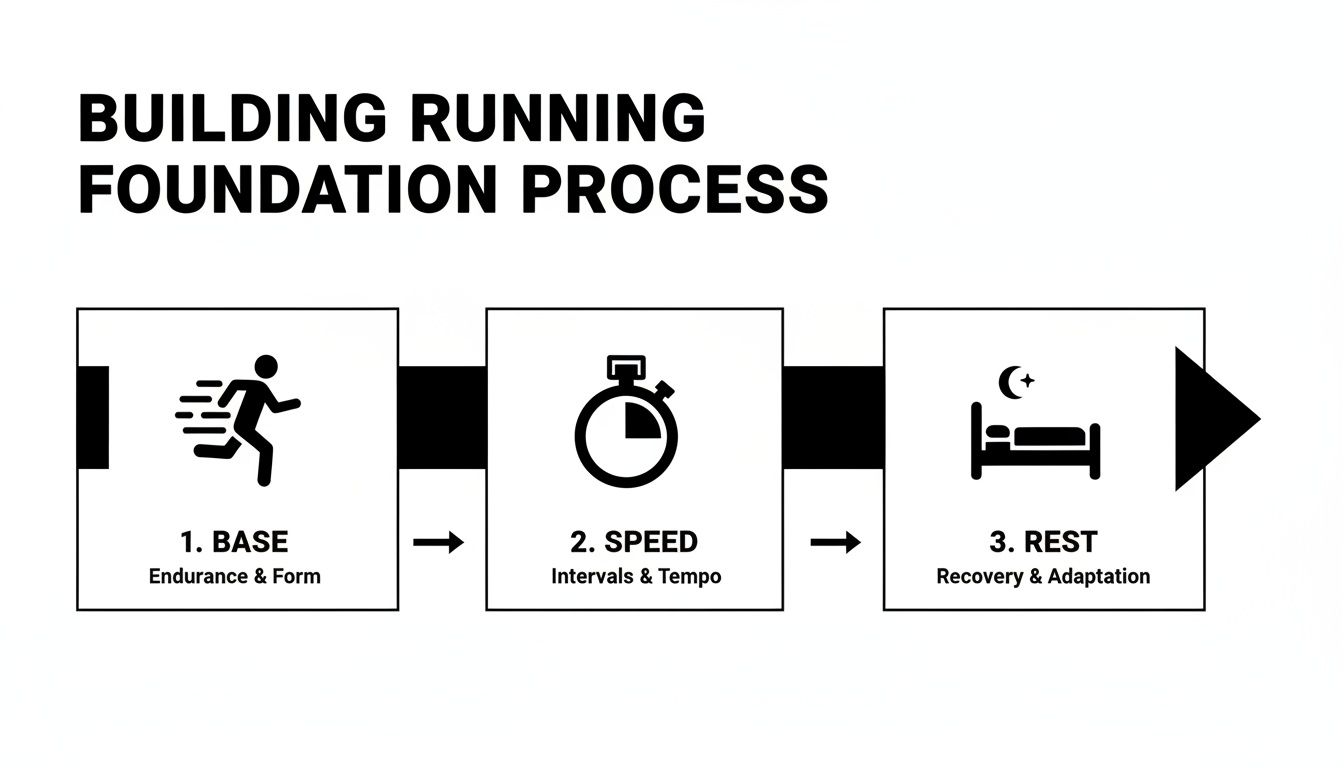
This diagram nails the fundamentals. You see the flow: start with your base, introduce speed, then prioritize rest. These aren’t just separate steps. They feed into each other. They create a powerful loop that will make you a stronger, more resilient runner.
Beginner 5K Training Plan (8 Weeks)
This plan is your perfect starting point. It’s for anyone whose main goal is to cross that finish line. We’ll use a walk-run approach to gently build your endurance. This will keep the risk of injury low. Forget about pace or distance for now. The focus is on time on your feet. This helps you build the habit without the pressure.
We’ll measure your effort using the Rate of Perceived Exertion (RPE) scale. This scale goes from 1-10. Your easy efforts should feel like a 3-4/10. This is a pace where you could comfortably chat with a friend.
Weeks 1-2: Finding Your Rhythm
- Day 1: 20 mins total: 1 min run / 2 min walk, repeat
- Day 2: Rest or light cross-training (walking or cycling is great)
- Day 3: 20 mins total: 1 min run / 2 min walk, repeat
- Day 4: Rest
- Day 5: 25 mins total: 2 min run / 2 min walk, repeat
- Day 6 & 7: Rest
Weeks 3-4: Building a Little Stamina
- Day 1: 25 mins total: 3 min run / 2 min walk, repeat
- Day 2: Rest or cross-training
- Day 3: 25 mins total: 3 min run / 2 min walk, repeat
- Day 4: Rest
- Day 5: 30 mins total: 4 min run / 1 min walk, repeat
- Day 6 & 7: Rest
As you move through the full eight weeks, the running chunks get longer. The walking breaks get shorter. By the end, you’ll have built the stamina to run for 25-30 minutes straight. This puts the 5K finish line well within reach.
Intermediate 5K Training Plan (6 Weeks)
Alright, so you can already run for 20-30 minutes without stopping. Now it’s time to get a little faster. This plan introduces more structure. It has a dedicated long run and a quality speed day each week.
By mixing up the types of runs, you challenge your body in new ways. This is exactly what you need to do to bust through a performance plateau.
A good training plan provides a balanced weekly structure. Below is a sample framework you can adapt. It shows how different ability levels can organize their week for optimal progress.
Sample Weekly Training Structure
| Day | Beginner Focus | Intermediate Focus | Advanced Focus |
|---|---|---|---|
| Monday | Rest | Rest or Cross-Train | Easy Run (4-5 miles) |
| Tuesday | Walk/Run | Intervals (e.g., 6 x 400m) | Interval Training (e.g., 5 x 1000m) |
| Wednesday | Rest or Cross-Train | Easy Run (30 mins) | Medium-Long Run (6-7 miles) |
| Thursday | Walk/Run | Rest | Threshold Run (e.g., 3 miles @ tempo) |
| Friday | Rest | Easy Run (35-40 mins) | Easy Run (4 miles) or Rest |
| Saturday | Walk/Run (Longest) | Long Run (Build from 3 miles) | Long Run (7-8 miles with strides) |
| Sunday | Rest | Rest | Rest |
This table illustrates how you can build a training week. A good week balances effort with essential recovery, no matter your current fitness level.
One of the most valuable workouts you can add is the tempo run. It is often called a threshold run. It’s that “comfortably hard” pace (about a 7/10 RPE). You can hold it for a sustained block, like 15-20 minutes. This workout trains your body to clear out lactic acid more efficiently. This is key to holding a faster pace on race day without blowing up.
Advanced 5K Training Plan (6 Weeks)
If you’re an experienced runner chasing a PR, we turn up the dial. This plan increases both volume and intensity. It assumes you have a strong aerobic base. It incorporates two quality workouts per week to sharpen your race-specific fitness.
To get the most out of this training, you might consider using tools. AI-powered workout applications can help personalize your plan and keep you on track.
A Typical High-Level Week:
- Monday: Easy Run (4-5 miles)
- Tuesday: Interval Training (e.g., 5 x 1000m at 5k race pace with 2-3 min jog recovery)
- Wednesday: Medium-Long Run (6-7 miles at an easy pace)
- Thursday: Threshold Run (1 mile warm-up, 3 miles at tempo pace, 1 mile cool-down)
- Friday: Easy Run (4 miles) or Rest
- Saturday: Long Run (7-8 miles, toss in some faster “strides” at the end)
- Sunday: Rest
With a bigger training load like this, recovery becomes non-negotiable. You also need a sharp understanding of your pacing. To master that, check out our in-depth guide. Learn what is a threshold run and how to nail it every time.
Interestingly, we’re seeing a major shift in who is training seriously for the 5K. The Road Runners Club of America shared data. The percentage of 5K finishers aged 20–29 shot up. It went from 12.3% in 2021 to 17.2% by 2024. That’s a nearly 40% jump in just three years. This shows a huge surge in interest from younger runners.
No matter which plan you choose, think of it as a framework. It is not a rigid set of rules. Listen to your body. Make adjustments when you need to. And remember that consistency will always beat cramming in a few super-hard workouts. The goal is to show up to the start line healthy, confident, and ready for a great race.
Fueling, Recovery, and Race Day Strategy
Training for a 5k isn’t just about logging miles. The real breakthroughs happen when you build a smart support system. What you eat, how you recover, and your game plan are vital. These are as important as your toughest interval session. These elements turn your hard work into real fitness gains. They get you to the start line strong, healthy, and ready to go.

Nutrition for Performance and Recovery
Think of your body like a high-performance engine. It needs premium fuel to run its best. Good nutrition gives you the energy to power through workouts. It also provides building blocks to repair muscle afterward. It’s a non-stop cycle: fuel up, perform, and refuel to recover.
Your pre-run snack is about topping off your glycogen stores. I always recommend eating something rich in carbohydrates. Eat it about 60-90 minutes before you head out. This gives your body enough time to digest. It makes that energy available. Simple options like a banana or a small bowl of oatmeal work perfectly. Toast with a little peanut butter is another good choice.
Post-run nutrition is where the recovery magic happens. You have a crucial window, ideally within an hour of finishing. Replenish your energy and kickstart muscle repair. This means getting in a mix of carbs and protein. For a deeper dive, check out our guide on finding the best recovery drink to help speed things along.
The golden rule I tell every athlete is simple but non-negotiable: “Nothing new on race day.” Use your training runs to figure out what pre-run meals and snacks sit well with you. The morning of your race is not the time to experiment with a new energy gel.
Building Strength to Prevent Injuries
Strength training isn’t just for bodybuilders. It’s absolutely essential for any runner. It’s for runners who want to perform well and stay off the sidelines. Running puts a lot of stress on the body. A stronger frame is better equipped to handle it. Aim for two to three sessions a week.
You don’t need a complicated gym routine. Focus on exercises that build functional, running-specific strength.
- Glutes: Squats, lunges, and glute bridges are your best friends. They build a powerful engine for hills and finishing kicks.
- Core: A stable torso improves running form and efficiency. Planks, bird-dogs, and Russian twists are fantastic for this.
- Legs: Don’t forget the smaller muscles. Calf raises and single-leg deadlifts help strengthen stabilizers. These are around your ankles and knees, which are common weak spots.
The best part? Bodyweight exercises are incredibly effective. They can be done right in your living room. This makes it easy to stay consistent.
The Critical Role of Active Recovery
Recovery isn’t just about sitting on the couch. It’s an active process. Rest days and quality sleep are the foundation. But other techniques can speed up your body’s ability to bounce back.
Foam rolling is a great way to work out tightness. It helps your quads, hamstrings, and calves. I also recommend light, dynamic stretching after your runs. This improves flexibility and blood flow. And never, ever underestimate sleep. Aim for 7-9 hours a night. This is when the most important repair work gets done.
If you want to give your body an extra edge, look into supplements. The best supplements for muscle recovery can support your efforts.
Crafting Your Race Day Plan
Walking into race day with a clear plan eliminates a ton of stress. It lets you focus purely on your performance. You need a strategy for everything. This starts from the moment you wake up to crossing that finish line.
Pre-Race Routine:
- Wake Up Early: Give yourself plenty of time to eat your practiced meal. Don’t feel rushed.
- Hydrate Smartly: Sip water in the hours before the race. Don’t chug a huge bottle right before the start.
- Warm-Up: Start a dynamic warm-up about 15-20 minutes before go-time. Use leg swings, high knees, and butt kicks to get your muscles firing.
Once the gun goes off, pacing is everything. It’s easy to get caught up in the adrenaline. Many runners go out way too fast. I’ve seen it ruin countless races before the first mile is even over.
Think of your 5k in three parts:
| Race Segment | Pacing Strategy | Mental Focus |
|---|---|---|
| The Start (First Mile) | Go out conservatively, even a touch slower than goal pace. | Stay calm and find your rhythm. Don’t waste energy weaving. |
| The Middle (Second Mile) | Settle into your goal 5k pace. | Lock in on consistent effort and efficient form. This is your cruise control. |
| The Finish (Final 1.1 Miles) | Start to gradually increase your effort. Empty the tank in the final stretch. | Stay tough. Pick off runners ahead of you and finish strong. |
By having a plan for fueling, recovery, and the race itself, you create the perfect environment. Your body can adapt and improve. This holistic approach is how you unlock your potential and crush your 5k goals.
Common Training Mistakes and How to Avoid Them
As you set your sights on a 5K, it’s easy to get caught up in the excitement. But even the most motivated runners can hit a wall. More often than not, these setbacks are caused by a few common training mistakes. These are totally avoidable.
Knowing these pitfalls is the first step. Learning to sidestep them is how you build a smarter, healthier training cycle. This gets you to the finish line feeling strong.
One of the biggest culprits? Running your easy days way too hard. I see it all the time. You feel good, the legs are fresh, so you start picking up the pace. But this is a classic trap that leads straight to burnout and fatigue.
It undermines the purpose of your key workouts. Worse, it skyrockets your risk of injury. Remember, recovery runs are for just that: recovery. They build your aerobic base, not chase a new Strava segment PR.
Pushing Mileage Too Quickly
Another classic mistake is ramping up weekly mileage too fast. Your muscles might feel like they’re adapting quickly. But your connective tissues are on a much slower timeline. This includes ligaments, tendons, and bones. Pushing them too hard, too soon is a direct path to issues. This can cause shin splints, runner’s knee, and other nagging injuries.
A good rule of thumb is the 10% rule. Try not to increase your total weekly distance by more than 10% from the week before. This gradual approach gives your body the time it needs. It can truly adapt to the new demands you’re placing on it. For a much deeper dive, our guide on how to prevent running injuries is a must-read.
“The single biggest mistake I see runners make is a lack of patience. They want results now and end up overtraining, which ironically slows their progress. True fitness is a long-term investment, built one smart, patient run at a time.”
Ignoring Your Body’s Signals
Your body constantly sends you feedback. The real skill is learning to listen. Too many runners try to push through persistent pain. They ignore nagging fatigue or a high resting heart rate. These are not signs of toughness. They’re clear indicators of overtraining.
You have to learn the difference between normal tiredness and a real warning sign.
Keep an eye out for these signals:
- Nagging Pain: Any ache that changes how you run is a red flag. If it gets worse during a run, stop.
- Poor Sleep Quality: If you’re suddenly struggling to fall asleep, your nervous system is likely overloaded.
- Lack of Motivation: A sudden, deep-seated dread for running isn’t just a bad mood. It can be a mental symptom of deep physical fatigue.
Neglecting the Complete Picture
Finally, many runners think running is the only thing that matters. They completely sideline other critical pieces of the puzzle. This includes strength training, proper nutrition, and quality sleep.
A strong core and powerful glutes make you a better runner. They’re also your best defense against injury. Fueling properly gives you energy to perform. It provides building blocks to repair muscle. And honestly, sleep is the most powerful recovery tool you have. It’s when your body does the real work of repairing tissue and getting stronger.
These aren’t optional add-ons. They are the foundation of any successful training plan.
It’s an interesting time in the running world. Elites are shattering records. But Running USA’s research shows average 5K finish times have slowed. For recreational runners, times have slowed by 2–3 minutes. This tells us the sport is growing and becoming more inclusive. That is fantastic. It also means that for the everyday athlete, a smart plan is more important than ever.
By steering clear of these common mistakes, you’re not just training harder. You’re training smarter. That’s what will make your journey to the 5K finish line effective, sustainable, and fun.
Your Top 5k Training Questions, Answered
Even the most detailed training plan can leave you with questions. That’s completely normal. As a coach, I’ve heard them all. Getting the right answers can be the difference between a frustrating cycle and a successful one.
Let’s clear up some of the most common questions runners have. This is for when they start training for a 5k. Getting these details right from the start builds confidence. It helps you trust the process.
How Long Does It Really Take to Train for a 5k?
If you’re starting with little to no running, give yourself 8 to 12 weeks. This isn’t just an arbitrary number. It’s the time your body needs to adapt. This includes your muscles, tendons, and heart. Rushing it is the fastest way to get sidelined with an injury.
Now, if you’re already active in other sports, you have a solid aerobic base. You could likely be ready in as little as 4 to 6 weeks. The real secret isn’t how fast you can get ready. It is how consistently you can train. A longer runway gives you more room to build that foundation without cramming.
What Pace Should I Be Running in Training?
This is where most new runners go wrong. The vast majority of your runs should feel easy. I’m talking 80% of your weekly mileage. You should be able to hold a full conversation without gasping for air. This is your aerobic zone. It’s where the real endurance magic happens.
The faster, harder workouts have their place. Intervals and tempo runs are a small, potent dose of your overall training. The biggest trap is running every day at a “kind of hard” pace. Slow down on your easy days. This way you have the energy to push on your hard days.
“One of the most common mistakes new runners make is trying to complete every training run as fast as they possibly can. We want to focus on running slower, so that we can build up our body’s endurance.”
What’s the Essential Gear I Need to Start?
You really don’t need a closet full of expensive gear. But there is one thing you absolutely cannot skimp on. Get a quality pair of running shoes. The single best thing you can do is go to a specialty running store. They’ll watch you run in a gait analysis. They will find a shoe that works for your specific foot and stride. It’s a game-changer.
After you have the right shoes, everything else is about comfort.
- Moisture-Wicking Clothing: Ditch the cotton. Synthetic fabrics pull sweat away from your skin. This will save you from painful chafing.
- Good Socks: It sounds minor, but a good pair of running socks can make a difference. It can be the difference between a great run and a blister-filled nightmare.
- GPS Watch (Optional): This is nice to have, but not a “need to have” when you’re starting out. Focusing on running for a certain amount of time and by feel is a fantastic way to build your internal sense of pace.
How Do I Stay Motivated When I Don’t Feel Like Running?
Let’s be real: motivation is fickle. It comes and goes for everyone, even elite athletes. The trick isn’t to rely on motivation. It is to build habits and have strategies for the tough days.
Focus on small, weekly wins. Just getting all your scheduled runs done for the week is a huge victory. It builds incredible momentum. Another great tactic is to find a running buddy or join a local group. It’s much harder to bail on a run when someone is waiting for you.
Finally, keep track of your progress. Realize that the loop that winded you a few weeks ago now feels comfortable. And always remember why you started this in the first place. Whether it’s for your health, for stress relief, or just to feel the buzz of crossing that finish line, hold onto that.


