

Trail Races in Nebraska: Prairie Singletrack and Pine Ridges
Nebraska trail running pairs wide-open prairie with wooded river valleys and rolling bluffs, where a short route can still bring steep climbs and uneven footing. That variety makes it possible to find a race that suits your distance, experience, and appetite for a challenge.
The right event also depends on the season and how far you’re willing to travel. Use this trail race guide to compare race settings and course conditions, choose an event that fits your plans, and prepare for the terrain and weather. Start by looking at what makes Nebraska’s trails distinct. Be sure to check out the RunDreamAchieve YouTube channel for weekly running tips.
Key Takeaways
- Trail races in Nebraska cross open prairie, wooded river valleys, and rolling bluffs, so expect varied footing and elevation.
- Choose an event by matching its distance, terrain, and difficulty to your experience, training, and travel plans.
- Before you register, review the course details and check current conditions; exposed routes and shaded trails can bring different demands.
- Explore Nebraska’s state park trails to get familiar with local terrain, then prepare for the race season and weather.
What Makes Trail Races in Nebraska Worth the Trip?
Nebraska trail races offer more variety than the state’s wide-open image might suggest. A route can cross prairie, slip beneath a leafy canopy, then climb toward a bluff with broad river views. That shift in scenery gives runners a strong sense of place, even on a shorter course.
From prairie grass to wooded bluffs
The setting can change sharply from one park to another. At Platte River State Park, forested hills and shaded paths bring a close, enclosed feel. Indian Cave State Park opens onto Missouri River views, with wooded slopes and trails that wind through a rugged stretch of southeast Nebraska.
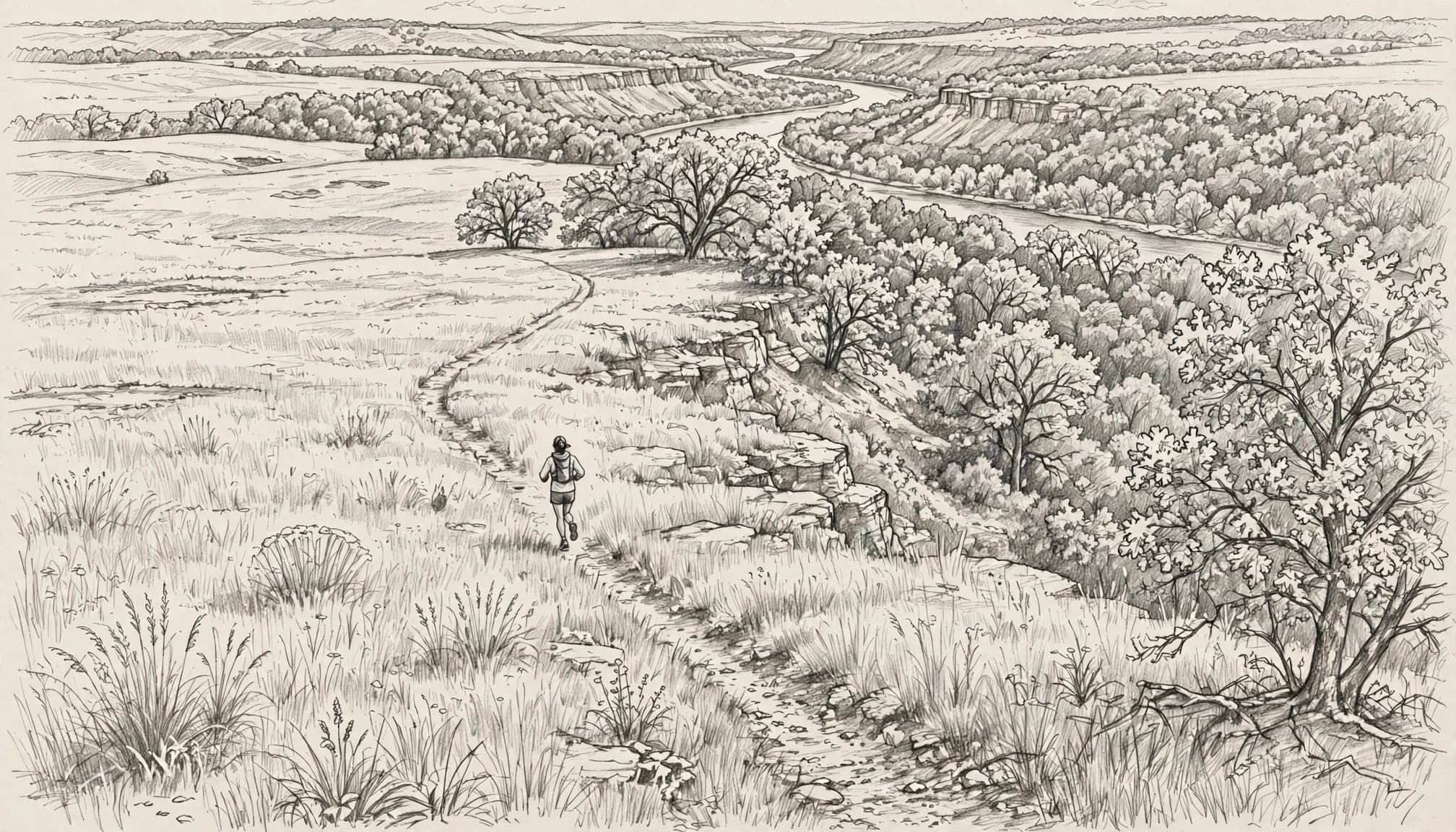
Ponca State Park adds wooded Missouri River bluffs and rolling trails. Farther west, Chadron State Park brings a drier, more open character, with rugged hills beneath the Pine Ridge. Wildcat Hills State Recreation Area has its own distinctive mix of grassland and rocky formations. Nebraska Game and Parks highlights these contrasts in its guide to outdoor settings across Nebraska.
Depending on the park and route, runners may encounter prairie paths, forest floor, sandy soil, or rocky sections. A race course does not necessarily cover every feature of its host park, however. Organizers choose specific routes, and those routes can vary even within the same trail system.
The challenge is in the footing and elevation changes
Nebraska doesn’t need high mountains to make a trail race feel demanding. Short climbs can arrive in quick succession, and repeated rises and descents may test the legs more than one long, steady hill. On a narrow path, uneven ground also asks runners to pay attention to each step.
Surface conditions add another layer. Loose dirt or sand can shift underfoot, while roots and rocks call for careful footing. After rain, low spots may turn muddy; on exposed stretches, sun and wind can make the course feel harder than a shaded section nearby.
These demands affect pace as much as distance does. A short course with frequent climbs or rough footing may take more effort than a longer route on smoother ground. Weather and park conditions can also change what a familiar trail feels like on race day.
Before choosing an event, read the organizer’s course description for surface details, elevation changes, and exposed sections. The park name gives a useful sense of the scenery, but the specific race route is the better guide to the experience.
Where to Find Nebraska Trail Races and Scenic Courses
Start with Nebraska’s state parks and recreation areas when you want to scout trails or find events tied to a specific landscape. Then check current race listings before you plan a trip, since event schedules, course layouts, and registration details can change.
Explore state parks and recreation areas
Platte River State Park, Indian Cave State Park, Ponca State Park, Chadron State Park, and Wildcat Hills State Recreation Area are useful places to explore when searching for Nebraska trail races or training routes. Each offers access to trails in a different part of the state, so you can get a feel for local terrain before choosing an event.
However, don’t assume every park hosts a race each year. Some trails may be open for personal training while an organized event follows a separate, permitted route. Check the park’s current rules and access conditions before heading out, and review Nebraska’s park permit information if you plan to organize an event. Park entry requirements, trail rules, and special event permits can differ.
Choose Your Distance, Duration and Goal Time
Make three quick selections and open the exact plan built for your race target.
Looking for a Fully Personalized Training Plan?
The training plans above are an excellent choice if they match your goal. However, if you’d rather train with a plan built specifically around your current fitness, goal race, preferred training days, weekly mileage, and target finish time, our RDA Custom Training Plans provide a personalized solution. We also have running courses available for runners seeking to run faster from the mile to the marathon.
Why Choose a Custom Training Plan?
| Standard Training Plan | RDA Custom Training Plan |
|---|---|
| Follows a fixed schedule | Built around your schedule |
| Standard weekly mileage | Peak mileage customized for you |
| Fixed workout days | Train on the days you choose |
| Same structure for everyone | Designed around your current fitness |
| Static plan | Updated as your fitness improves |
| One-time purchase | Ongoing personalized coaching and support |
What You’ll Receive
- A training plan built specifically for your goal
- Personalized training paces
- Long runs, tempo runs, threshold workouts, interval sessions, recovery runs, and easy runs
- Peak weekly mileage matched to your experience level
- Flexible training schedule that fits your life
- Ongoing plan adjustments as your fitness improves
Ready to Train Smarter?
Stop guessing and start following a plan built specifically for you, your schedule, and your racing goals.
Use current race calendars to confirm event details
Race calendars help you find possibilities, but the organizer’s site or registration page should be your final reference. Listings can linger after an event date passes, and details such as location, distance, or course may change. Check local running clubs and state or regional calendars as well, then follow their links to the current event information.
For example, Omaha Running Club lists a Nebraska Trail Run 12K at Platte River State Park for September 27, 2026. Confirm the date and course details on the organizer’s page before making travel plans. That extra check can prevent a mismatch between a calendar listing and the event’s latest instructions.
Choose a race distance that matches your goal
A 5K or 10K can be a practical first trail event. The shorter distance lets you learn how uneven footing, hills, and changing surfaces affect your pace without committing to hours on the course. Even so, review the elevation profile and route description rather than judging difficulty by distance alone.
For a half marathon or longer race, build more time on your feet into training and practice fueling before race day. Also research aid stations, cutoff times, surface conditions, and exposed sections. Some Nebraska events offer several distance options, but availability varies by race. Compare the actual course choices with your training and travel plans, then register only after confirming the latest event details.
Choose a Trail Race That Fits Your Experience and Plans
Advertised distance is only one part of choosing among trail races in Nebraska. Course difficulty, support, race-day rules, travel, and the kind of experience you want can shape your day just as much.
Read the course map, elevation profile, and race rules
Before registering, study the actual route rather than relying on the park name or distance. Check whether the course follows packed dirt, grass, sand, rocky paths, or a mix. Then review the total climbing and the elevation profile. Frequent short climbs can feel demanding even when the overall elevation gain looks modest.
Loop count matters, too. Repeating a short circuit may make aid stations easier to reach, while a single long loop can require more self-sufficiency. Check cutoff times so you know how quickly you need to cover the course, especially if you expect to hike steep sections.
Race rules can affect what you carry and how you run. Look for required gear, plus policies on headphones and trekking poles. If a key detail is missing or unclear, contact the organizer instead of guessing. A quick email can clarify whether a route is technical, what support is available, or whether a particular item is allowed.
Match the event to your comfort level
For a first trail race, a shorter distance can leave room to adjust to uneven footing and hills without adding hours on the course. Look for clear course marking and dependable aid support, and consider whether the start is easy to reach. A nearby event with straightforward logistics can make race morning less stressful.
Experienced runners may want more distance or tougher footing, but the elevation profile still deserves attention. Rolling terrain can disrupt a steady rhythm, so consider how you’ll manage effort on repeated climbs and descents. Technical sections may also call for a more conservative pace than you’d use on a road race.
There’s no single right level of challenge. Choose a race that fits your current training and the day you want, whether that means a relaxed outing or a demanding test. A well-supported event can be a smart choice for any runner, not just a beginner.
Plan for travel, fees, and race-day logistics
Build the full trip into your decision. Add registration fees to possible park entry or parking charges, lodging, meals, and fuel. Nebraska Game and Parks lists current park costs in its park pricing information, but confirm which charges apply to your event with both the organizer and park.
Next, check drive time and packet pickup details. Some races require pickup the day before, while others offer race-morning pickup with a limited window. Confirm the start time, parking location, restroom access, and how early you need to arrive. If you’re staying overnight, verify lodging availability and whether you can reach the start without a long pre-race drive.
Finally, make a simple race-morning plan. Leave room for traffic, parking, and warming up, and pack any required gear the night before. A course that suits your ability is a stronger choice when the travel and schedule work for you, too.
Train for Nebraska’s Hills, Weather, and Trail Surfaces
Training for trail races in Nebraska means preparing for more than distance. Rolling climbs, uneven footing, and exposed stretches can change the effort of a run, while weather can shift your comfort and safety. Build skills gradually, and adjust your plan to your fitness and health.
Build strength and comfort on uneven ground
Start with short, easy trail runs on forgiving paths. As your footing improves, add time or distance in small steps rather than changing everything at once. Look ahead for roots, loose soil, and turns, and shorten your stride when the ground gets rough.
Hill repeats can help you get comfortable climbing, but they don’t need to be all-out efforts. Run or walk uphill at a steady pace, then recover on the way down. If you’re new to hills, begin with a few repeats or brisk hill walks and add more only when you feel ready.
Simple strength work can support trail running. Exercises such as step-ups, calf raises, squats, and planks train the legs and core for uneven ground. Keep the movements controlled, and stop if you feel pain. On trails, focus on steady effort and safe footing, not matching your road pace. A slower pace is normal when climbs and rough surfaces demand more attention.
Practice with the shoes, layers, and gear you will race in
Test your trail shoes on terrain that resembles the event course. Check that they feel secure, leave room for your toes, and provide grip on the surfaces you’ll encounter. A shoe that works well on packed dirt may feel less stable on sand or slick ground, so no single pair suits every Nebraska course.
Practice with any gear you expect to carry. For longer outings or routes without convenient water access, bring water and learn how it feels to carry or wear it. Choose layers based on the forecast, and test them on training runs before race day. A light layer that works in cool morning air may feel too warm once the sun rises.
Gear needs vary by distance, course, and weather. Read the race instructions for required items, aid-station locations, and any restrictions. Then pack for the actual route instead of assuming one setup will work for every event.
Learn to pace hills and handle changing weather
On climbs, shorten your stride and judge effort by breathing and control rather than pace. Walking a steep section can save energy without compromising your race. On descents, take controlled steps and avoid chasing speed on loose or uneven ground. That approach helps you stay balanced and manage the impact on your legs.
Weather calls for its own adjustments. In warm conditions, slow down as needed, drink regularly, and protect your skin with sunscreen, a hat, or other sun protection. The National Weather Service offers outdoor heat safety guidance for planning activity in hot weather. Wind can make exposed routes feel colder, while rain may reduce traction and change the footing. Cold mornings and temperature swings also affect what layers feel comfortable.
Before race day, review the forecast and follow the event’s safety guidance. If conditions become unsafe or your health changes, adjust your plan rather than forcing the effort.
Make Race Day Safer, Smoother, and More Enjoyable
A good race-day plan helps you stay focused when the trail gets busy or conditions change. Before you leave home, review the organizer’s latest instructions, course map, aid-station locations, and required gear. Those details take priority over general advice because rules and support vary by event and park.
Follow course markings and respect other trail users
Watch for ribbons, signs, or other course markers, especially at turns and trail junctions. If a marker seems missing, slow down and check your map or ask race staff rather than guessing. Stay on the established trail to protect plants and prevent erosion, and carry out wrappers, cups, and other trash. The Leave No Trace principles offer clear guidance for reducing your impact outdoors.
Trail users and park rules vary by location. Follow posted rules and the race briefing, and yield when appropriate. When passing, give a calm heads-up, wait for room, and thank others for making space. Avoid abrupt moves or crowding on narrow paths. A courteous pass keeps the trail safer for runners, hikers, and anyone else sharing it.
Use aid stations and fueling plans wisely
Before race day, find out how far apart aid stations are and what each one provides. Some events offer water and sports drink, while others may have limited support or require runners to carry their own supplies. Plan accordingly, especially if the route includes long stretches without an aid station.
For longer events, practice your fueling and hydration plan on training runs. Try the products you expect to use, and note what feels manageable at your planned effort. Needs vary with pace, temperature, humidity, and the individual, so avoid treating a fixed intake schedule as universal. In warm conditions, adjust your effort and use the event’s safety guidance. The American College of Sports Medicine’s hydration guidance discusses fluid and electrolyte needs during exercise.
Know when to slow down or stop
Pain that changes your stride, dizziness, confusion, nausea, or unusual weakness calls for caution. Heat illness can worsen quickly, so stop, move to a safer spot, and alert race staff if you feel unwell. Also slow down or seek help if thunderstorms, high winds, or other worsening weather make the course unsafe. Don’t push through a problem to protect a finishing time.
Carry every item the organizer requires, such as a phone, whistle, or emergency layer, and know how to contact course staff. Share the event’s emergency plan and your expected finish time with a support person before the start.
After the race, keep moving gently if you feel steady, then change out of damp clothing and take in fluids and familiar food. Give your legs time to recover before returning to hard training.
Frequently Asked Questions
Even after comparing routes and preparing for the terrain, a few practical questions can affect your race-day plans. Check the organizer’s current instructions for event-specific rules, since policies and support vary across trail races in Nebraska.
Can I hike during a trail race?
Yes, many runners hike steep climbs or rough sections to manage effort and stay sure-footed. However, check the cutoff times before registering, especially if you expect to walk often or are entering a longer distance. Your pace needs to leave enough time to reach each cutoff.
Does every race require a hydration vest?
No. Some shorter events have frequent water access, while longer or more remote courses may require runners to carry fluids. Check the event’s gear list and aid-station details, then choose a setup you have tested during training.
Should I preview the course before race day?
If the route is open to the public and you can visit safely, a short preview can help you recognize turns, climbs, and tricky footing. First, confirm park access and trail rules, since the race route may differ from nearby paths. When an in-person visit isn’t practical, study the course map and organizer’s description.
Can I bring my dog to a Nebraska trail race?
Don’t assume dogs can join you, even if the park allows leashed pets on some trails. Race organizers may restrict pets for safety, crowding, or course-management reasons. Check the event rules before registering or bringing a dog to the start area.
What happens if weather changes the course or start time?
The organizer decides whether to delay, reroute, or cancel an event, so review its weather and refund policies before race day. Keep an eye on event updates and check the forecast for the race location, since conditions can differ across Nebraska. For a Lincoln-area event, use the National Weather Service forecast for Lincoln.
How can I find out about last-minute race changes?
Check the organizer’s website and the email account used for registration as race day approaches. Some events also share updates through their social media pages or registration platforms. Save the organizer’s contact information, and confirm the start location and any revised instructions before you leave.
Conclusion
Trail races in Nebraska offer more than a finish time. They give you a chance to experience prairies, forests, and river bluffs at a runner’s pace, with each course bringing its own footing, climbs, and weather demands.
Choose an event that fits your experience and goals, then confirm the organizer’s current course, rules, and race-day details. Build your training around the terrain and conditions you can expect, so you arrive ready to run or hike with confidence.
Whether you’re eyeing your first trail 5K or a longer challenge, a well-matched race is a rewarding place to start. Pick your goal, prepare for the course, and take the first step toward race day.


