

Tokyo Marathon Results: Find Runner Times, Rankings & Past Results
Race morning in Tokyo moves at a different pace: thousands of runners fill the streets while elite athletes fight for every second near the front. Once the finish line closes, runners, families, and fans turn to the same question: where can they find the latest Tokyo Marathon results?
The official Tokyo Marathon website is the best place to check verified results, but the race year matters because the event takes place annually. Depending on the year and category, the listings may show overall finishers, elite winners, age-group rankings, split times, and official finish times. You can use those numbers to confirm a performance, compare pacing across the course, or find practical lessons for your own marathon training. Next, we’ll show you how to locate the correct results and read the data with a runner’s eye.
Remember, be sure to book your Tokyo Marathon hotels well in advance so you are not paying more than you need to.
Key Takeaways
- Check the official Tokyo Marathon results for verified finish times, rankings, splits, and race-year details.
- Select the correct event year because Tokyo Marathon results change annually, including finisher totals and course statistics.
- Compare more than placement. Pace, halfway splits, and the gap between runners reveal how the race unfolded.
- Use the official 2025 past-race data to review completion rates and finishing-time trends.
- Apply those insights to your own pacing plan, especially if you’re targeting a personal best or first marathon.
Tokyo Marathon Results: Find the Latest Official Finish Times
The fastest way to find current Tokyo Marathon results is to start with the official race website, select the correct year, and then search the verified timing database. Results can change after officials review timing data, so a social media post or finish-line screenshot may not show the final record.
What to Check on the Official Tokyo Marathon Results Page
Use the official Tokyo Marathon website and open the relevant past-race or results page. Depending on the event year, you may see separate listings for the elite marathon, mass-participant marathon, wheelchair races, and team or charity categories.
Common result fields include:
- Place shows the runner’s position within the selected race or division.
- Bib number is the identification number assigned to the athlete.
- Name and nationality identify the finisher and their country or region.
- Division places the runner in the relevant category, such as men’s, women’s, age-group, wheelchair, or another event classification.
- Gun time starts when the race officially begins and ends when the runner crosses the finish line.
- Net time starts when the runner crosses the starting mat and ends at the finish. This is also called chip time.
- Status shows whether the result is official, provisional, disqualified, did not finish, or otherwise incomplete.
A runner near the back of the starting field may cross the start several minutes after the gun. As a result, their gun time can be longer than their net time. For personal pacing and training analysis, net time often gives the clearer picture. For official rankings, however, the race’s published rules determine which time controls placement.
Check the 2025 Tokyo Marathon race data for an official example of past finishers and winning times. Always compare the result with the official listing rather than relying only on posts shared by runners or spectators.
How to Search for an Individual Runner
First, choose the correct race year. Then use the results search field and enter one of the following:
- Search by bib number when you have it. This usually produces the quickest match.
- Enter the runner’s last name or full name if the bib is unavailable.
- Filter by category or division when the page offers separate race listings.
Names may appear differently because of spelling, spacing, initials, or the order of family and given names. Try a shorter name search if the full entry returns nothing. Results may also arrive with a delay while timing officials check missing reads or course records.
If the page labels a runner as provisional or unofficial, wait for the database to update before treating the time as final. A missing listing can mean a delayed update, an incorrect race year, or a timing issue. Contact the event’s official support channel if the runner finished but remains listed as missing. A disqualified or did-not-finish status should remain separate from confirmed finishers, even when a runner has a recorded split or finish-line photo.
Who Won the Tokyo Marathon and How Fast Did They Run?
Tokyo Marathon results need a race year attached to them. Winners, times, course records, and rankings can change with every edition, so avoid combining a recent winning time with an older record. For a reliable race report, use the official results page first, then compare major performances with World Athletics race coverage.
The Winning Times, Course Records, and Personal Bests
Start by listing the men’s, women’s, wheelchair, and other officially recognized winners separately. For each athlete, include:
- The winner’s full name and nationality.
- The official finish time.
- The margin over second place.
- Any decisive race moment, such as a late surge or a leading group breaking apart.
The latest World Athletics report identifies Ethiopia’s Tadese Takele as the men’s winner and Brigid Kosgei as the women’s winner in 2026. Kosgei ran 2:14:29, an Asian all-comers’ record. Confirm Takele’s exact time, the wheelchair winners, and each margin through the event’s official results before publishing a complete race table.
A course record is the fastest time recorded on the current Tokyo Marathon course. An event record can refer to the fastest performance in the race’s history, but the definition may depend on course changes and the governing source. A personal best belongs to the athlete, regardless of where that time was run.
Those terms describe different achievements. A runner can win with a personal best without setting the course record. Another athlete may run a world-class time that still ranks behind faster performances from earlier editions. Records can also change after later races, so verify claims through official Tokyo Marathon race records and World Athletics before calling a performance a record.
Why the Tokyo Course Can Produce Fast Results
Tokyo has a generally fast road-marathon profile, with long straight sections that allow elite runners to settle into an efficient rhythm. The course also includes major turns and crowded early miles, which can disrupt positioning before the field stretches out.
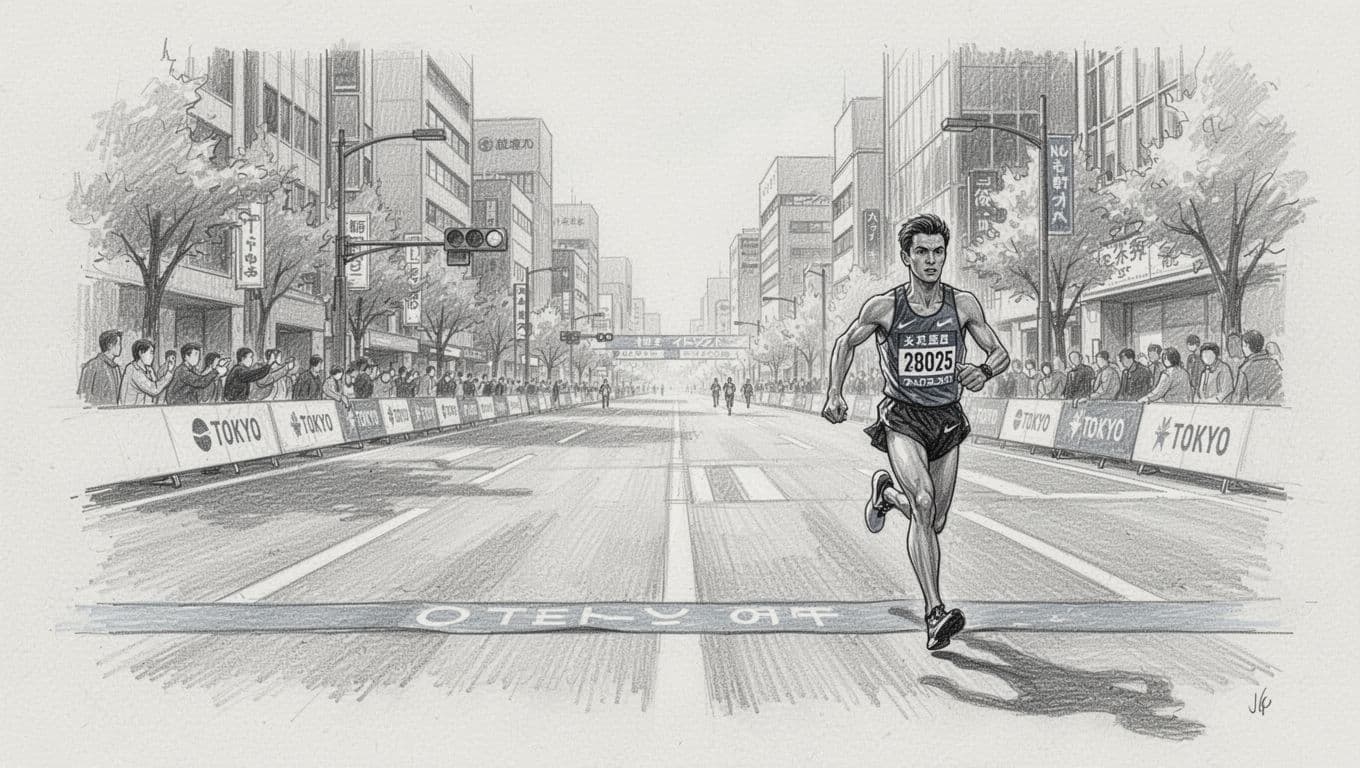
Weather adds another layer. Cool temperatures can support strong pacing, while wind can punish runners who spend too much time alone at the front. Rain, humidity, and changing conditions may affect the second half, even when the course itself is flat and quick.
As a result, a winning time tells only part of the story. Review halfway splits, pacing changes, pack size, and the final kilometer before judging the performance. Tokyo can create personal-best conditions, but no course guarantees one. Race tactics, preparation, weather, and competition still decide how fast an athlete can run.
How to Read Your Tokyo Marathon Result Beyond the Finish Time
Your Tokyo Marathon result tells more than whether you reached the finish line. Net time, five-kilometer splits, halfway pace, and final placement show how well you managed effort across 26.2 miles. Read the page as a race report, not just a scoreboard.
Gun Time, Net Time, and Chip Timing Explained
Gun time begins when race officials start the event and ends when you cross the finish mat. Net time, also called chip time, begins when you cross the starting mat and ends at the finish. In a large race such as Tokyo, runners near the back may wait several minutes after the gun before they can reach the start line.
For personal pacing, net time usually gives the fairest measure because it reflects the time you spent running. Rankings and qualifying standards often use gun time, especially for overall awards, but race rules differ by event, category, and qualification system. Check the official regulations before assuming one time controls your result. This gun time and chip time explanation offers a useful comparison of the two systems.
Use Splits to Spot Pacing Problems
Compare your first 5K split with every later split, then check your half-marathon time against your finish. Even pacing means your segments stay close in duration. That pattern usually points to controlled effort, steady fueling, and sensible hydration.
A positive split means you ran the second half slower than the first. For example, a sample 3:30 marathon might show 1:43 at halfway and 1:47 for the second half. A small difference can be normal, but a large gap often suggests that the early pace was too aggressive.
A negative split means the second half was faster. A sample runner could pass halfway in 1:46, then finish the second half in 1:44. That approach requires patience early, but it can leave you with strength for the final 10 kilometers.
Pay close attention to a sharp slowdown after 30 kilometers. If your early splits look quick and your pace falls apart late, you may have spent too much energy during the first 10K. Fatigue can also expose missed gels, poor hydration, inadequate long-run preparation, or a pace that exceeded your current fitness.
Choose Your Distance, Duration and Goal Time
Make three quick selections and open the exact plan built for your race target.
Looking for a Fully Personalized Training Plan?
The training plans above are an excellent choice if they match your goal. However, if you’d rather train with a plan built specifically around your current fitness, goal race, preferred training days, weekly mileage, and target finish time, our RDA Custom Training Plans provide a personalized solution. We also have running courses available for runners seeking to run faster from the mile to the marathon.
Why Choose a Custom Training Plan?
| Standard Training Plan | RDA Custom Training Plan |
|---|---|
| Follows a fixed schedule | Built around your schedule |
| Standard weekly mileage | Peak mileage customized for you |
| Fixed workout days | Train on the days you choose |
| Same structure for everyone | Designed around your current fitness |
| Static plan | Updated as your fitness improves |
| One-time purchase | Ongoing personalized coaching and support |
What You’ll Receive
- A training plan built specifically for your goal
- Personalized training paces
- Long runs, tempo runs, threshold workouts, interval sessions, recovery runs, and easy runs
- Peak weekly mileage matched to your experience level
- Flexible training schedule that fits your life
- Ongoing plan adjustments as your fitness improves
Ready to Train Smarter?
Stop guessing and start following a plan built specifically for you, your schedule, and your racing goals.
What a DNF, DNS, or Disqualification Means
DNF means “did not finish.” The runner started but stopped before completing the course. DNS means “did not start,” even if the athlete registered or received a bib. Disqualified means race officials removed the result because of a rule violation, such as course cutting or an incorrect category entry.
A missing finish time doesn’t always indicate a timing error. The runner may have withdrawn, missed a timing mat, or received a disqualification after review. If the listing appears wrong, compare the status with split records and race rules, then contact Tokyo Marathon event support for clarification. Use placement alongside time, since a slower finish with even pacing may reveal better marathon execution than a faster result followed by a late collapse.
Tokyo Marathon Age-Group Results and Runner Rankings
Tokyo Marathon results become more useful when you read each ranking beside the time that produced it. Overall place shows where you finished among eligible runners, while division, age-group, nationality, and qualification fields add the context that a large international race can hide.
Overall Place Versus Age-Group Place
A runner may finish 18,400th overall yet place 42nd in the women’s 50-54 age group. The overall field includes thousands of younger runners, international competitors, and athletes across every division. Her age-group result compares her with a much smaller group of runners who meet the same category requirements.
Age-group cutoffs usually depend on the runner’s age under the event’s published rules. Some races use age on race day, while others use age on a stated reference date. Categories may also differ by gender, wheelchair classification, elite status, or entry division. Check the Tokyo Marathon entry guidelines before interpreting a ranking, because those rules also explain how official time is measured and when course cutoffs apply.
Your result page may show several places:
- Overall place ranks you within the selected marathon field.
- Gender or division place compares you with runners in that classification.
- Age-group place ranks you among runners in your assigned age bracket.
- Nationality place appears only when the event publishes that comparison.
- Qualification status indicates whether your time meets a stated entry or performance standard.
A strong age-group finish often tells a recreational runner more than a distant overall place. It gives you a fairer comparison and a useful target for your next race. Save the official result certificate as a PDF or screenshot, including the race year, bib number, finish time, and ranking fields.
How International Runners Compare Their Performances
Percentile offers a clearer comparison than raw place when field sizes change. If you finish 2,000th among 30,000 runners, you placed ahead of about 93% of the field. Compare that figure with another race only after checking whether both rankings use the same category and timing method.
Pace adds another layer. Convert your finish time into minutes per mile and minutes per kilometer, then review the half-marathon split. A fast first half followed by a major slowdown tells a different story than an even race at the same final pace.
Age-grade scoring can also estimate how a performance compares with age-based standards. It helps runners across different age groups compare fitness, but treat it as a guide rather than an official Tokyo ranking. The Abbott World Marathon Majors age-group rankings use their own rules and qualifying-race structure.
Weather, course design, field size, and travel fatigue affect every comparison. A Tokyo result earned after a long international flight may not compare fairly with a local race on a familiar course. Use pace, splits, percentile, and age grade together, then check whether the race used gun time or net time before judging the performance.
What Past Tokyo Marathon Results Reveal About the Race
Past Tokyo Marathon results show how quickly elite marathon standards can shift. Winning times depend on more than fitness alone, so compare each edition with its field size, weather, pacing support, and race format.
Compare Results Across Different Race Years Carefully
A year-by-year snapshot provides useful context, but the numbers need careful reading.
| Year | Men’s winner | Women’s winner | Field and race context |
|---|---|---|---|
| 2023 | Deso Gelmisa, 2:05:22 | Rosemary Wanjiru, 2:16:28 | 36,751 marathon participants; 95.6% completion rate |
| 2024 | Benson Kipruto, 2:02:16 | Sutume Kebede, 2:15:55 | Kipruto set a course record in a fast elite race |
| 2025 | Tadese Takele, 2:03:23 | Sutume Kebede, 2:16:31 | 37,791 total participants; 36,204 marathon finishers |
The official past-race archive provides the correct place to check later updates, race statistics, and edition-specific records. You can also review the official 2023 race data and 2025 results and participation figures before drawing conclusions.
Weather can change the meaning of a finish time. Temperature, humidity, wind direction, and rain affect how much energy runners spend maintaining pace. Pacemakers also influence the race, especially when they help an elite pack reach halfway close to record pace.
Course changes require the same caution. A revised turn, altered start area, or different finishing layout can affect tangents and positioning. Starting waves matter for mass runners because the gun time may include time spent waiting behind the starting line.
Race restrictions can create an even larger gap between editions. Pandemic-era events may feature elite-only fields, reduced participation, altered qualification rules, or fewer pacing groups. Those results should not sit beside normal mass-participant years without an explanation.
A final clock time is only half the evidence. Read it beside the pace pattern and race-day conditions.
For your own analysis, record the winning pace, halfway split, final 5K, field depth, and weather. A slower winning time with strong headwinds may show better racing than a faster result produced by ideal conditions and uninterrupted pacing.
Notable Tokyo Marathon Performances to Verify
A strong historical section needs only a few carefully selected performances. Choose examples that show different types of achievement:
- A course record, such as Benson Kipruto’s 2:02:16 in 2024.
- A close finish decided in the final stages.
- A breakthrough personal best by an athlete entering the race with less recognition.
- A comeback performance after injury, illness, or a difficult previous season.
Check every athlete’s name, time, year, record status, and finishing margin against the official race archive or World Athletics race coverage. Avoid calling a run the “greatest” or “most impressive” unless the evidence supports that judgment.
Historical results can reveal deeper elite fields, smarter pacing, and stronger late-race execution. They can guide your expectations, but they cannot predict the exact winning time in a future Tokyo Marathon.
Turn Tokyo Marathon Results Into a Smarter Training Plan
Your Tokyo Marathon result becomes more useful after the excitement fades. Review the finish time, splits, race conditions, and your preparation before choosing the next goal. The clock tells you what happened, but your notes can explain why.
Build the Next Goal From Evidence, Not Emotion
Start with four comparisons:
- Did your finish time match your original goal?
- Did your pace remain steady through 30 kilometers?
- How consistent was your training during the final 8 to 12 weeks?
- Did you execute your race plan under real conditions?
A fast opening 10K followed by a major slowdown points to a different problem than a steady race that finishes slightly outside your target. Review fueling, hydration, sleep, weather, pain, and mental strength while the details remain fresh. A missed gel or poor night’s sleep may explain a difficult final hour better than a lack of fitness.
Separate current fitness limits from avoidable mistakes. If your training was consistent, your pacing was controlled, and your body held together, a modestly faster target may be realistic after proper recovery. However, an aggressive start, inadequate taper, missed fluids, or a preventable sleep loss should become a correction before you add more intensity.
For example, a beginner who wanted to finish under five hours but ran evenly and finished in 5:08 may need more consistent weekly mileage, not a complete overhaul. An intermediate runner who missed a personal best after fading at 35 kilometers should examine pace and fueling before assuming fitness declined. Someone chasing a qualifying standard needs tighter execution across every detail, including travel, sleep, nutrition, and pace control.
Your next goal should answer the evidence in your result, not your disappointment on race day.
Training Lessons From a Strong or Difficult Race
An even-paced Tokyo Marathon result often supports a faster goal. After recovery, build that progress with regular easy mileage, long runs, and occasional marathon-pace sessions. Strength training can support durability, while rest days and lighter weeks help you absorb the work. Guidance on marathon fueling and recovery can help you review the basics without adding needless complexity.
A late fade needs closer inspection. If your pace dropped while your effort rose, extend long-run durability and practice fueling at race effort. If the slowdown began soon after an early surge, work on restraint and marathon-pace control. Persistent pain deserves attention from a qualified professional before hard training resumes.
Mental skills matter, too. Note when doubt appeared, how you responded, and whether you followed the plan under pressure. A shorter race may provide a useful reset before another marathon block. Otherwise, choose targeted endurance or pacing work, then return to demanding sessions only when normal movement, sleep, and easy running feel settled. Recovery is the first training decision after every marathon.
Frequently Asked Questions
Tokyo Marathon results can answer more than one question, especially when you need proof of performance or notice a detail that looks unusual. These answers cover the practical issues runners often face after checking the official database.
When do official Tokyo Marathon results become available?
Preliminary results typically appear on race day, while the official results follow after timing officials complete their checks. The Tokyo Marathon official FAQ states that final listings may take a few days after the event. Wait for the official version before using the result for a qualifying application or formal record.
Can I download a Tokyo Marathon finisher certificate?
Many runners can access a digital finisher certificate after the event through the race’s results or participant services. The exact process can change by year, so check the instructions attached to your event listing. Keep the certificate with your result page because some races and qualifying programs request both the finish time and race details.
Why does my finish time differ from a race-tracking app?
Fitness watches and tracking apps estimate distance and time from GPS data, while the official race uses timing mats and finish-line records. Your device may show a longer route because you ran around other competitors or missed the ideal line through turns. For rankings, certificates, and official Tokyo Marathon results, use the race timing record rather than your watch.
Can an official result change after it first appears?
Yes. Officials may correct a missing timing read, adjust a classification, or remove a result after reviewing a possible rule violation. That is why a preliminary listing should not be treated as permanent. Save the final result after the race website updates its database.
What should I do if I need proof of a fast time?
Download the official result certificate and record the race year, bib number, finish time, and course name. If you’re applying for an entry standard, review the Tokyo Marathon entry guidelines because documentation rules can depend on the declared finish time and application category. A screenshot from a tracking app usually won’t replace an official race record.
Can I compare my Tokyo result with another marathon?
You can compare finish time and pace, but the comparison needs context. Check course measurement, weather, elevation, field size, pacing, and whether both races use gun time or net time for rankings. A slower Tokyo Marathon result may still show stronger execution if difficult weather caused a late pace drop across the field.
Conclusion
The official Tokyo Marathon results tell the full story behind race morning. Start with the correct race year and verify your finish through the event website. Then read your net time, placement, age-group ranking, and split pattern together. Those details show how you managed the course, not simply how long you took to finish.
When comparing editions, account for weather, field size, course changes, pacing support, and timing rules. A winning time or personal result only has meaning beside the conditions that shaped it. Your result is also a record of preparation, decision-making, pacing, and resilience under pressure.
Use that record to choose your next target with clear evidence. You may need steadier pacing, stronger late-race endurance, better fueling, or more consistent training. Whether you’re chasing your first marathon finish, a personal best, or a stronger return to Tokyo, the next breakthrough begins with understanding the performance you already created.


