

Suunto Vertical vs Fenix 8: Which Adventure Watch Should You Buy?
When you’re staring down long runs, rough weather, and trails that punish weak gear, the wrong watch starts to feel expensive fast. The Suunto Vertical vs Fenix 8 debate comes down to more than specs on a page, because you need reliable data, strong battery life, and a watch that can keep up when the route gets messy.
Both models target athletes who expect more from their wrist than pace and time. If you care about trail durability, navigation, and training feedback that you can trust mile after mile, the details matter, and so does the way each watch fits into your routine.
The best choice is the one that stays useful when conditions get hard, not the one that looks best in a product photo.
If you want a broader look at how this class of watch performs on trails, GPS watch guide for trail runners is a good place to start before comparing the two head to head.
Build a Smarter Running Watch Setup
Compare the right watch, understand the training data that matters, and choose a model that fits your workouts, racing, recovery, and long-term goals.
More SUUNTO and Running Watch Guides
Design Philosophy and Build Quality
The clash between these two watches isn’t just about software features or tracking metrics. It is a fundamental difference in how they approach the wrist. Suunto focuses on a utilitarian, no-nonsense aesthetic that prioritizes pure function for ultra-endurance athletes.
Meanwhile, the Fenix 8 presents itself as a high-end tool, packed with technology and a premium finish that transitions comfortably from a rugged mountain ascent to a boardroom meeting. Choosing the right device means deciding whether you prefer a minimalist, tool-like experience or a high-performance, feature-dense companion.
Materials and Toughness
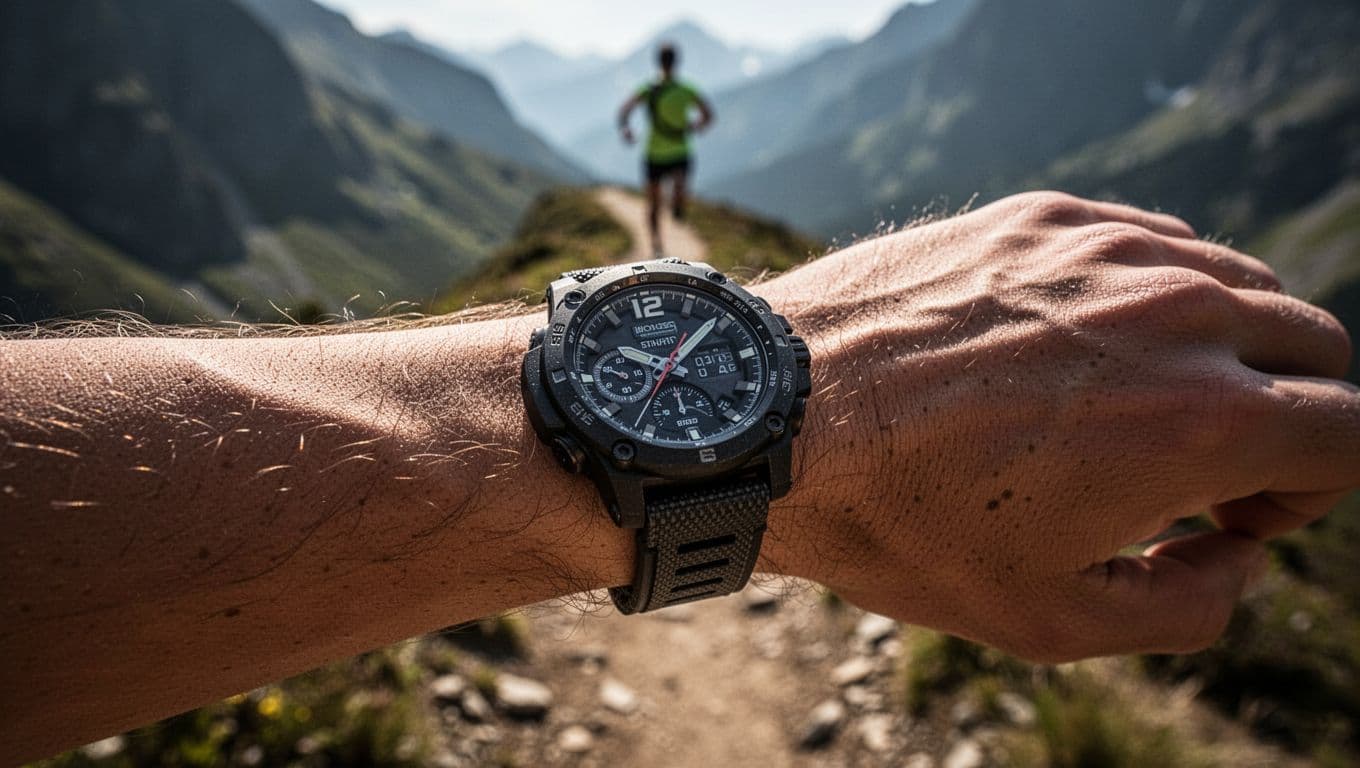
Durability is the primary requirement for anyone spending hours on rocky, exposed terrain. The Suunto Vertical uses high-grade stainless steel or titanium, matched with scratch-resistant sapphire glass to keep the face clear of debris and rock scrapes. It feels noticeably lightweight on the wrist, which is a major advantage during 50-mile efforts where every gram counts. Suunto designs this watch to disappear while you run, acting less like a piece of jewelry and more like a permanent extension of your gear kit.
On the other hand, the Fenix 8 leans into a more modular, robust build. You get a variety of bezel options, including diamond-like carbon-coated titanium, which offers extreme resistance to impact and corrosion.
Garmin prioritizes a “premium feel” in its engineering, resulting in a watch that has more weight and substance than the Suunto. For athletes who demand high water resistance, both models handle deep immersion well, though the Fenix 8 includes updated leak-proof buttons that elevate its dive-readiness beyond standard trail use.
When you look at how these units perform under pressure, the detailed look at the Garmin Fenix 8 highlights just how much tech is squeezed into that chassis. The Suunto, by comparison, avoids the bulky complexity of extra sensors to maintain a lower profile. This physical difference matters if you wear your watch for 24 hours a day; the leaner frame of the Suunto is often less intrusive under a long-sleeve base layer or during sleep.
Display Differences
Screen technology dictates how you interact with your data in the heat of a race. The Suunto Vertical relies on a sunlight-readable memory-in-pixel (MIP) display. This tech is legendary for efficiency, as it consumes almost no power while remaining perfectly visible under the harsh glare of a high-altitude sun. You don’t need a backlight to check your splits on a bright afternoon, which keeps the watch running for weeks rather than days.
Garmin has shifted the Fenix 8 toward vibrant, high-contrast AMOLED displays, though they still offer MIP options in certain configurations. The AMOLED screen is a visual upgrade, providing rich colors and deep blacks that make maps and training graphs much easier to read at a quick glance.
The catch is battery consumption. A bright, high-resolution screen drains more power, forcing the software to work harder to optimize usage. If you want to compare the specific trade-offs between brands, Garmin Fenix 7 running performance analysis offers a great look at how these display choices impact long-term trail reliability.
Ultimately, your preference depends on your priorities. Do you want the battery longevity of a passive display that stays on 24/7 without sacrifice, or do you prefer the modern, crisp interface of a high-definition screen? You can find more opinions on these trade-offs by checking Garmin Fenix 8 Solar vs Suunto Vertical: What is the difference? to see how the market stacks up these two philosophies against each other.
Battery Performance in the Real World
The true test of a multisport watch happens far away from a power outlet. When you spend ten hours on a trail, the difference between a device that keeps pace and one that dies in the wilderness is everything. The Suunto Vertical vs Fenix 8 comparison highlights two distinct philosophies on how a watch survives the long haul.
Suunto leans heavily on solar-charging efficiency and massive internal capacity to keep you moving without checking your percentage. Garmin instead relies on aggressive power management modes and a robust ecosystem that lets you toggle sensors on or off to save juice. Your choice hinges on whether you want a set-it-and-forget-it workhorse or a granular command center that demands active input to maximize its lifespan.
GPS Accuracy and Mapping Features
Signal reception in remote canyons or dense tree cover defines how useful your map actually is when things get tough. Both watches utilize multi-band GNSS, which means they talk to multiple satellite systems simultaneously to pinpoint your location. This technology minimizes the “drift” that often plagues cheaper units in deep valleys.
The Suunto Vertical excels at keeping a track lock even when the terrain gets rugged. Its antenna design works in harmony with the power-efficient processor to provide long-lasting location data.
For trail runners who venture into unknown territory, the offline map interface on the Suunto is intuitive. You get clear topo lines and high-contrast paths that show your route clearly against the background. It is a straightforward experience meant to keep your eyes on the trail rather than your screen.
Reliability
Reliability in the backcountry often comes down to how well you can trust the signal. Garmin offers extensive tools to calibrate the altimeter and barometer, which adds accuracy to your vertical gain metrics. The Suunto prioritizes steady, reliable tracking that requires less tinkering before you start your run.
You should consider which style of navigation suits your habits. If you enjoy digging into map layers, the Fenix 8 is a powerful companion. If you want the most reliable line on the screen with minimal configuration, the Suunto Vertical is a consistent performer. You can read more about selecting gear for mountain runs in this trail running gear guide.
When you compare these tools during a long day on the mountain, keep in mind how much time you spend checking your watch. A device that shows you exactly where you are without draining your battery in the process is the goal. Both watches succeed here, but their path to that success shows the split between Suunto’s focus on endurance longevity and the feature-rich capability of the Fenix 8.
Fitness Tracking and Training Insights
Tracking your physical output is more than just watching numbers climb on a screen. When you compare the Suunto Vertical vs Fenix 8, you are choosing between two sophisticated systems designed to map the hidden stresses and recovery cycles of your body.
Both devices act as daily monitors that translate sweat, heart rate, and movement into actionable feedback. By understanding these metrics, you can fine-tune your approach to training and ensure that your daily habits align with your long-term goals.
Health Monitoring Beyond the Run
Modern watches reach far beyond simple step counting. These devices now function as continuous health dashboards that provide a snapshot of your physical readiness each morning. Heart rate monitoring is the cornerstone of this data, as it tracks both your active intensity and your resting state. A lower resting heart rate is often a primary indicator of improved aerobic fitness, while significant fluctuations can signal impending fatigue or illness.
Sleep tracking rounds out this monitoring suite by breaking down your rest into light, deep, and REM cycles. You cannot perform at your peak if your body does not recover properly, and these watches show you exactly how well you are sleeping.
If you notice your sleep quality dipping, it is often a sign to dial back the intensity or focus more on your nightly habits. Consistent monitoring creates a feedback loop, allowing you to see how your daily choices, such as hydration or nutrition, influence your overall health.
By focusing on these metrics, you develop a better sense of when to push hard and when to pull back. It is this balance that prevents overtraining and keeps you healthy over the long term. Rather than guessing how your body feels, you have concrete data to inform your decisions, ensuring that every session adds value to your growth as an athlete. Finding the right tools to manage this information is essential, and you can explore more about how to structure your training in this running training guide.
User Experience and Smart Features
Technology in a watch should work for you, not against you. When you compare the Suunto Vertical vs Fenix 8, the differences in their interfaces reveal how each brand views the athlete. A watch that requires too much menu-diving during a rainy trail run is a liability, while one that anticipates your needs makes a long day in the mountains much easier. You want to focus on your pace and the path ahead, rather than fighting with complex software or struggling to sync your data.
Navigating the Interface
The Suunto user interface is built on simplicity and rapid access. You will find that the menu structure is flat and predictable, which helps when your brain is tired and your hands are cold.
Icons are large and clear, and the overall interaction feels responsive even if you are moving quickly through a technical descent. It is a no-nonsense design that gets the job done without cluttering your view with unnecessary distractions or overly nested settings.
Garmin takes a more expansive approach with the Fenix 8. The menus are deep, packed with features, and highly customizable to match your personal training style.
While this provides an immense amount of control, it also carries a steeper learning curve. If you appreciate having every possible metric and setting at your fingertips, you will likely prefer the depth of the Garmin ecosystem. However, if you just want to lace up your shoes and go, you might find the sheer volume of choices a bit overwhelming at first.
Syncing and App Connectivity
Your training data is only useful if it moves from your wrist to your digital library without friction. The Suunto app mirrors the watch’s clean aesthetic, offering a fast and efficient way to review your sessions. Syncing is typically quick and reliable, providing a clear dashboard of your recent efforts and long-term trends. It is an intuitive tool for athletes who prefer to track their progress and recover without constant fuss.
Garmin Connect functions more like a massive command center. It offers a staggering array of data points, social features, and training programs that go far beyond simple activity tracking. Because it connects with almost every third-party fitness platform, it is incredibly powerful for those who like to tinker with their data. You will spend more time setting up preferences, but you gain a granular level of insight that few other platforms can match.
- Suunto Vertical: Best for athletes who value a minimalist, fast, and distraction-free workflow.
- Fenix 8: Ideal for those who thrive on deep customization, complex metrics, and a connected social ecosystem.
Ultimately, the choice comes down to your personal appetite for management. If your primary goal is to train, recover, and keep your focus on the trail, the simple, focused experience of the Suunto is a strong asset. If you prefer to analyze every detail of your health and fitness in an interconnected system, the Fenix 8 provides the tools to do exactly that.
Making Your Final Choice
Selecting between the Suunto Vertical and the Fenix 8 is a matter of identifying where your priorities lie on the trail. Both devices represent the current pinnacle of wearable technology for endurance athletes, yet they speak different languages. Your decision should align with how you prefer to interact with data and what you value most during your time outdoors.
Evaluating Your Personal Needs
If you identify primarily as an ultrarunner, your needs lean toward simplicity and longevity. You likely prefer a device that functions as a reliable, unobtrusive partner during long training blocks and race efforts.
The Suunto Vertical shines here because its interface avoids unnecessary complexity. You get a massive battery and an intuitive map display that stays visible in harsh light without requiring constant backlight adjustment. It is a tool designed for those who want to set their watch and forget it while they cover miles in the mountains.
On the other hand, the multi-sport enthusiast often wants a device that acts as a comprehensive command center. If you regularly switch between trail running, mountain biking, strength training, and open-water swimming, the Fenix 8 provides a depth of data that feels unmatched.
The sheer range of activity profiles and the ability to customize almost every screen allows you to fine-tune your performance tracking. You gain access to a complex ecosystem that offers insights into every aspect of your physical output and recovery.
The Decision Matrix
To simplify the choice, consider which of these scenarios best fits your typical week. If you value a minimalist workflow and extended battery life for self-supported adventures, the Suunto Vertical is a strong companion. It excels in environments where you want to minimize distractions and rely on a consistent, rugged tool. If you instead thrive on high-resolution displays, granular data analysis, and a device that integrates into a broader smart ecosystem, the Fenix 8 is likely your better match.
| Feature Priority | Suunto Vertical | Fenix 8 |
|---|---|---|
| Battery Longevity | Exceptional | Excellent (Adjustable) |
| Data Customization | Moderate | High |
| Interface Focus | Simplicity | Complexity |
| Display Style | MIP (Passive) | AMOLED (Vibrant) |
Choosing the right watch ultimately depends on your relationship with data. You might find it helpful to look at your past training habits to see if you frequently tweak settings or prefer a static, reliable configuration. If you spend most of your time on long, remote efforts, prioritize the endurance of the Suunto.
If you enjoy the process of managing your metrics and experimenting with new training features, you will likely appreciate the flexibility of the Garmin. Either way, both watches are capable of supporting your goals, provided you match the tool to your specific style of movement.
Conclusion
Choosing between the Suunto Vertical vs Fenix 8 depends on the specific demands of your training cycle. The best watch is the one that removes friction from your routine so you can focus entirely on the miles ahead.
Both devices provide the data necessary to track your progress and manage your recovery. Investing in a tool that matches your activity style helps you maintain consistency over the long term. If you are looking to refine your approach, exploring proper recovery techniques will complement the metrics your watch provides.
Commit to your training with confidence. Reliable gear allows you to push toward your next personal best while staying aware of your body’s limits.


