

Suunto 9 Peak Pro vs Garmin 965: Which GPS Watch Should You Buy?
Choosing between the Suunto 9 Peak Pro vs Garmin 965 gets interesting fast, because these watches chase different kinds of athletes. One is slim, rugged, and built for people who want a clean tool on the wrist, while the other packs a deeper performance stack for runners, hikers, and triathletes who want more data at a glance.
If you care about display quality, battery life, GPS accuracy, training tools, comfort, and value, the differences matter more than the brand names on the box. The right pick depends on whether you want a watch that stays out of the way or one that gives you more to work with on every workout.
Below, the strengths and trade-offs come into focus so you can see which watch fits your training and your everyday wear.
The quick answer: who should buy the Suunto 9 Peak Pro, and who should buy the Garmin 965?
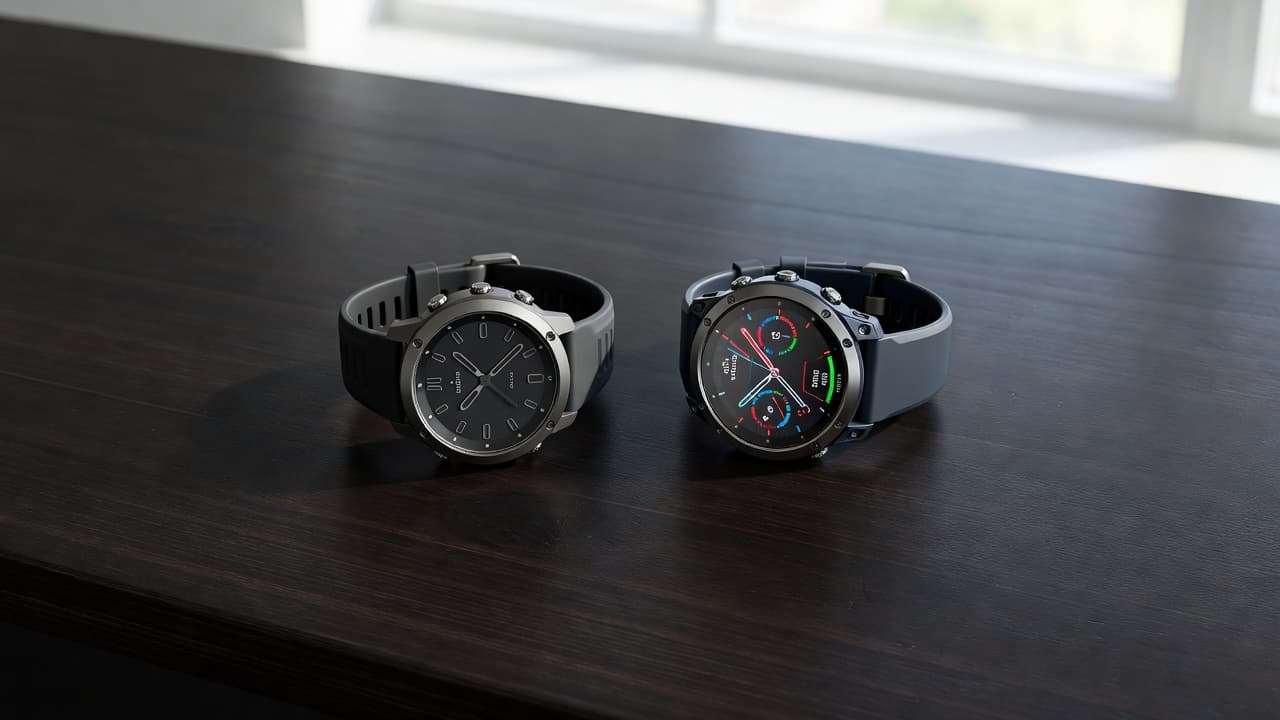 If you want the short version, buy the Suunto 9 Peak Pro if you care most about a light, understated watch with strong battery life and a serious outdoor feel. Buy the Garmin 965 if you want the brighter AMOLED screen, richer training data, and the extra polish that makes it easier to live with every day.
Build a Smarter Running Watch Setup
Compare the right watch, understand the training data that matters, and choose a model that fits your workouts, racing, recovery, and long-term goals.
More GARMIN and Running Watch Guides
The Suunto feels like a compact trail tool. The Garmin feels like a full training dashboard on your wrist.
Who should buy the Suunto 9 Peak Pro?
The Suunto 9 Peak Pro fits runners, hikers, and outdoor athletes who want a watch that stays out of the way. It’s slimmer, lighter, and more subtle on the wrist, so it works well for long days, travel, and sleep tracking too.
Choose it if you value:
- Battery life first, especially for outdoor use
- A low-profile design that doesn’t shout for attention
- Simple, focused sports tracking without extra clutter
- Adventure and navigation basics over flashy screen effects
Who should buy the Garmin 965?
The Garmin 965 is the better pick for athletes who want more data and a richer display. Its AMOLED screen looks vivid indoors and outdoors, and Garmin’s training features go deeper for structured workouts, recovery, and multisport training.
Choose it if you want:
- A bright AMOLED display
- More advanced training metrics
- A smoother smartwatch experience
- A better fit for triathlon and performance-focused training
Quick decision by sport
For runners, the Garmin 965 is the better match if you track workouts closely. For hikers, the Suunto 9 Peak Pro makes more sense if you want comfort and endurance. For multisport athletes, the Garmin 965 wins on training depth and day-to-day flexibility.
Design and comfort: slim titanium simplicity versus big-screen performance
The physical presence of your watch often dictates how much you enjoy wearing it, especially when you track your activity around the clock. When comparing the Suunto 9 Peak Pro vs Garmin 965, the design philosophies diverge immediately. One prioritizes a low-profile, almost invisible feel, while the other leans into a larger screen that commands attention for data-heavy workouts.
If you have slender wrists or simply dislike the feeling of a heavy gadget tugging at your arm, the Suunto 9 Peak Pro is arguably the better companion. It sits flush against the skin, and its slim 10.8mm profile means it rarely snags on shirt sleeves or jacket cuffs. You might even forget you have it on during a long hike or a quiet night of sleep tracking, as it is designed to disappear on the wrist.
The Garmin 965 takes a different approach. Because it houses a large, vibrant AMOLED display, the chassis is naturally wider and occupies more real estate on your arm. While it is impressively light for its size, you will notice the bulk during high-intensity intervals or while trying to rest. It is a fantastic tool for those who prioritize a big, clear interface above all else, but it certainly carries more physical weight than the minimalist Suunto alternative.
- Suunto 9 Peak Pro: Ideal for those who value a subtle aesthetic and comfort during sleep.
- Garmin 965: Best for those who want maximum screen area for data, even if it means a larger footprint.
Build quality and durability in the real world
Durability is where these two heavyweights prove their worth outside of the lab. Both watches use high-quality materials, yet they handle the rigors of the trail differently. The Suunto 9 Peak Pro often features a titanium bezel in its premium versions, which balances weight with incredible scratch resistance. It survives granite scrapes, mud, and intense humidity without showing much wear. It feels like a dedicated tool meant for harsh environments.
The Garmin 965 is equally tough, though it trades that raw, utilitarian look for a more refined finish. It uses a titanium bezel to provide strength, and the display is protected by reliable Corning Gorilla Glass DX. This screen glass is engineered to resist scratches while remaining readable under direct sunlight, which is essential if you spend your weekends on trails or traveling.
Both devices are water-rated for swimming and heavy downpours, so you do not need to worry about them during wet-weather training. While the Suunto may feel slightly more “hard-coded” for rugged adventures, the Garmin is no slouch. It holds up exceptionally well to daily abuse at the gym or on the road.
Your final choice depends on whether you prefer the rugged, understated nature of the Suunto build or the polished, expansive hardware found in the Garmin ecosystem. For more on the technical refinements of the Suunto design, you can review this Suunto 9 Peak Pro In-Depth Review.
Display and everyday usability: always-on MIP or bright AMOLED?
Choosing between the Suunto 9 Peak Pro vs Garmin 965 forces a decision between two distinct display technologies. Your choice depends on whether you prefer the reliable, power-sipping nature of memory-in-pixel (MIP) tech or the punchy, high-contrast clarity of an AMOLED screen. These differences shape how you interact with your metrics every single day, whether you are checking a pace at a sunny intersection or reviewing map details on a technical descent.
Sunlight, darkness, and battery drain
The Suunto 9 Peak Pro uses a traditional MIP display. This screen technology thrives in direct sunlight; in fact, the brighter the sun shines, the more readable the screen becomes. It does not require a backlight to be visible during the day, which keeps it permanently on without sapping your battery.
If you train in bright conditions, you will appreciate how the information stays fixed on your wrist, ready to read at a moment’s notice. However, in dim settings, the display feels slightly muted and relies on a backlight that lacks the pop of modern alternatives.
The Garmin 965 moves in the opposite direction with a vibrant AMOLED screen. This display looks sharp, saturated, and rich in almost every environment.
Colors stand out, making maps and charts much easier to interpret at a glance. Even so, AMOLED screens require more power. While the 965 offers an always-on mode, using it consistently will accelerate your battery drain compared to the Suunto. If you prioritize visual flair and deep contrast for your training data, the trade-off in battery life is often acceptable.
Buttons, touch, and workout control
Physical interaction is equally vital when your hands are slick with sweat or covered by gloves. The Suunto 9 Peak Pro relies on a combination of a responsive touchscreen and three large physical buttons.
The buttons have a satisfying mechanical click that makes navigating menus simple even when the watch face is wet. Because the interface is stripped down, moving through screens during a workout feels quick and intuitive. You rarely find yourself fumbling through layers of settings to find what you need.
The Garmin 965 also supports touch and button input, though its operating system carries more complexity. You have five physical buttons to control the device, which provides a level of precision that touch alone cannot match. This layout is especially helpful when you are running hard or dealing with cold-weather gear.
The touch sensitivity is impressive, but you can easily disable it during training to prevent accidental swipes. Ultimately, the Garmin offers more depth for power users who want to customize every data field, while the Suunto provides a more immediate, “set it and forget it” experience for athletes who prefer simplicity during their sessions.
Battery life and charging: one watch lasts longer, the other charges more often
The battle between the Suunto 9 Peak Pro vs Garmin 965 highlights a fundamental split in how these devices manage power. The Suunto prioritizes raw efficiency and endurance, catering to those who want a set-it-and-forget-it experience. Conversely, the Garmin relies on a vibrant screen that demands more frequent attention from the charger, offering a trade-off between visual richness and longevity.
How long each watch can last on a training week
If you are training for a full Ironman or simply stacking miles for a weekend hike, the difference in how these watches handle a week of activity becomes obvious. The Suunto 9 Peak Pro is built for efficiency. Its battery often stretches across an entire week of moderate to heavy training without needing a tether to the wall. You can comfortably track your morning runs, gym sessions, and evening walks while keeping the battery level healthy.
The Garmin 965 delivers excellent performance, but that gorgeous AMOLED display pulls more power. During a busy week, you will likely find yourself reaching for the charging cable a few days earlier than you would with the Suunto. If you use features like continuous pulse ox tracking or high-accuracy GPS modes for every session, the gap widens.
- Daily use: The Suunto easily handles a full week of activity tracking, whereas the Garmin typically needs a mid-week charge for heavy users.
- Weekend hikes: On long days on the trail, the Suunto provides peace of mind with its conservative power consumption.
- Multisport builds: For athletes pushing 10 to 15 hours of training per week, the Suunto remains the more resilient choice, while the Garmin requires closer monitoring of battery levels.
What changes battery life fastest?
Several factors push these devices to their limits. The biggest culprit is the screen technology. The Garmin 965 uses a bright, high-resolution AMOLED display that consumes significant power, especially when set to always-on mode. If you prefer to see your data without flicking your wrist, you should expect to charge the device more often.
GPS modes and secondary sensors also play a huge role in how quickly you drain your battery. Choosing dual-band or all-system GNSS tracking significantly boosts accuracy, but it forces the battery to work much harder. Furthermore, features like music playback directly from the watch, continuous heart rate monitoring, and constant map usage on the Garmin will accelerate drain.
The Suunto 9 Peak Pro maintains an advantage here by using a memory-in-pixel display that thrives without a constant, battery-hungry backlight. While the Garmin offers a richer visual experience, the Suunto stays cooler and lasts longer during extended, high-intensity efforts.
If your training involves ultra-distance events, the efficiency of the Suunto setup provides a reliable baseline that is difficult to beat. For those interested in maximizing their device longevity, tips for extending GPS battery life can help you squeeze every bit of juice out of your watch during long adventures.
Ultimately, your choice rests on your priorities. Do you value the vivid screen and deep feature set of the Garmin 965, even if it means keeping a charger nearby, or do you prefer the rugged, long-lasting simplicity of the Suunto 9 Peak Pro?
GPS accuracy, heart rate tracking, and training data you can trust
Getting accurate data on your wrist depends on how a watch interprets signals from satellites and monitors your body’s effort. When you compare the Suunto 9 Peak Pro vs Garmin 965, you see two different ways of building a training companion. One relies on a refined, stripped-back approach to sensors, while the other leans into a massive ecosystem of metrics and multi-band tracking.
GPS performance on roads, trails, and mountains
GPS lock speed is often the first thing you notice when stepping out the door. The Garmin 965 uses multi-band GNSS technology, which tracks multiple frequencies simultaneously to combat interference from tall buildings or dense tree cover. This leads to extremely fast satellite acquisition and reliable tracks even in deep canyons.
In contrast, the Suunto 9 Peak Pro focuses on a singular, highly optimized GPS chip that is remarkably consistent. While it might take a few seconds longer to lock in than the Garmin in tricky urban environments, its pathing remains steady and smooth during long runs.
When you hit the trails, the difference in how each watch handles twisty, technical routes becomes apparent. The Garmin excels at minimizing drift on tight switchbacks, keeping your distance totals precise even if you double back or scramble through rocky terrain.
The Suunto prioritizes a clean, readable track that rarely jumps around, providing confidence that your pace matches the actual terrain beneath your feet. Both models effectively filter out “noise,” so your GPS log shows a realistic path rather than a jagged mess of errors.
Heart rate, recovery, and workout insights
Optical heart rate sensors are the foundation for every other metric, and both companies have invested heavily in their hardware. The Garmin 965 utilizes the latest Elevate sensor, which offers a fast response to spikes in intensity. This makes it a strong choice for interval training where your heart rate changes rapidly.
It captures those quick shifts in effort well, giving you immediate feedback that aligns with your perceived exertion. The Suunto 9 Peak Pro provides a similarly steady reading, though it can occasionally lag behind by a second or two during explosive, high-intensity intervals.
For most athletes, the real value lies in what the watch does with that pulse data. Garmin provides a deeper dive into your training status, offering specific insights into load, aerobic and anaerobic benefits, and projected recovery times. It acts like a personal coach that tracks your cumulative fatigue over months.
Suunto takes a more minimalist approach, showing you the intensity of your current session and your immediate recovery status without overwhelming you with constant notifications. If you want a dashboard that monitors every aspect of your fitness trend, the Garmin is hard to beat. If you prefer to listen to your body and just need a reliable pulse reading to track effort, the Suunto provides exactly what you need without the data noise.
Elevation, pacing, and the small details that matter
Accurate elevation data is essential for anyone who spends time climbing. Both watches use barometric altimeters to track changes in pressure, which is far more reliable for mountain terrain than GPS-based elevation alone.
The Garmin 965 excels at displaying real-time grade-adjusted pace, which helps you maintain an even effort on steep ascents even when your speed drops. It makes managing long mountain efforts much simpler, as you can see exactly how much work you are putting into a climb.
The Suunto 9 Peak Pro is no slouch here, as it offers intuitive displays for vertical speed and cumulative gain that stay easy to read during heavy exertion. It excels at simplicity, giving you the information you need without cluttering the screen with excess variables.
For athletes who want to train with discipline, the Garmin offers advanced features like PacePro, which creates a strategy for your races by adjusting targets based on the elevation profile of the course. If you want to refine your training with data-driven precision, the Garmin ecosystem offers more ways to control your variables. Meanwhile, the Suunto works best for those who want an honest, responsive tool that reports your effort accurately so you can focus on the path ahead.
Training features: Garmin 965 goes deeper, Suunto keeps it clean
Training ecosystems define your daily experience with these watches. Whether you want a partner that acts like a data-driven coach or a minimal companion that tracks your effort without the noise, the Suunto 9 Peak Pro vs Garmin 965 comparison shows how different design philosophies influence your path.
Structured workouts, coaching, and race prep
Garmin provides a comprehensive suite for those who love to plan. The 965 integrates with the Garmin Connect ecosystem to allow you to build custom workouts and sync them directly to your wrist.
If you are training for a marathon or triathlon, the Daily Suggested Workouts feature adapts based on your recent load and sleep quality. You can also utilize the Race Widget to input your upcoming event and receive tailored training cycles that count down to your specific race day.
Suunto follows a different logic. It offers interval support and basic training guidance, but the interface remains uncluttered. You will find that Suunto does not bombard you with daily suggestions or predictive finish times. Instead, the focus remains on the training you perform in the moment. For athletes who already follow a specific coaching plan or simply enjoy running by feel, this lack of constant alerts is a welcome reprieve.
- Garmin 965: Best for athletes who benefit from structured, automated guidance and deep performance tracking.
- Suunto 9 Peak Pro: Ideal for those who value a distraction-free experience and prefer to manage their own training intensity.
Recovery, load, and readiness tools
Managing the balance between strain and rest is where the two systems diverge most noticeably. Garmin offers Body Battery, Training Readiness, and Load Focus. These metrics pull from heart rate variability (HRV), sleep, and activity history to provide a numerical score of how prepared you are for a hard session. It is a data-rich approach that leaves little room for guesswork.
Suunto uses a simpler set of recovery metrics. It tracks your training load and recovery time after each session, keeping you informed on whether you are pushing too hard. However, it does not attempt to predict your energy levels or readiness for the day. If you find data-heavy feedback anxiety-inducing, the Suunto approach is refreshing. If you prefer to have a clear, quantified readiness score before heading out the door, the Garmin system is the superior choice.
Sport profiles and multisport use
Athletes who frequently transition between sports will find both watches capable, though the user experience differs. The Garmin 965 includes dedicated profiles for almost every sport imaginable, including specialized modes for cycling, open-water swimming, and multisport events. Switching between these modes during a transition is quick, and the watch manages the transition data automatically.
Suunto excels in its simplicity. Its sport profiles are clean and focus on the data that matters most, such as heart rate, duration, and pace. For multisport enthusiasts, the device handles transitions reliably, yet it does not offer the same level of granular customization as the Garmin.
If you thrive on deep-diving into your cycling power metrics or swimming stroke efficiency after a session, the Garmin 965 provides the necessary depth. Conversely, if you prioritize a fast, responsive interface during your workout, the Suunto 9 Peak Pro delivers a streamlined experience that keeps your focus on the movement itself.
Maps, navigation, and outdoor features for real adventures
Moving off the beaten path requires confidence in your tools. When you compare the Suunto 9 Peak Pro vs Garmin 965, you notice how each watch handles the wilderness differently.
One leans into simplicity and battery-sipping efficiency, while the other offers a rich, detailed visual experience. Whether you prefer a quick reference on your wrist or a full map to guide your stride, both devices offer distinct advantages for hikers, trail runners, and cyclists.
Offline maps and route following
The Garmin 965 provides a significant edge for those who rely on visual feedback. It includes full-color, routable maps that let you see streets, contour lines, and points of interest right on your wrist. You can load a GPX file, and the watch displays your path overlaid on a topographic map.
If you take a wrong turn, the watch detects your deviation and provides clear instructions to get you back on track. The vibrant AMOLED screen makes these map details pop even in varied light, which is useful when navigating technical terrain.
Suunto takes a different path by focusing on breadcrumb navigation. While it does not offer the same detailed base maps as the Garmin, the Suunto 9 Peak Pro is incredibly effective at keeping you on your pre-planned route. You upload a route, and the watch shows a clear, high-contrast line on a simple background.
As you move, the watch alerts you to turns and provides elevation profiles to help you prepare for upcoming climbs. It is a no-nonsense approach that reduces screen glare and preserves battery life. If you primarily follow established trails, this method is often more than enough.
Backcountry confidence and safety tools
Safety in the backcountry starts with reliable data. Both watches act as a digital tether to your surroundings. The Suunto 9 Peak Pro uses a highly accurate barometric altimeter to track your elevation changes in real time. This helps you monitor your ascent rate, which is vital during steep climbs.
You also get a digital compass that is easy to calibrate. If you get turned around, the “back to start” feature provides a clear, simple path to retrace your steps. It is a rugged, dependable tool designed to withstand harsh environments without needing a constant signal.
The Garmin 965 adds more depth to your outdoor planning. It calculates climb data through features like ClimbPro, which breaks down every ascent into manageable chunks. You can see the grade, distance remaining, and total vertical gain for every hill ahead. This allows you to pace yourself throughout a long day on the trail.
Beyond that, the Garmin includes incident detection and live tracking, provided you have your phone nearby. These features give your family peace of mind and provide you with an extra layer of security when you are deep in the mountains.
Which watch is better when you are lost, tired, or off course?
Field performance is about how the watch helps you recover from a mistake. When you are physically exhausted, the Garmin 965 is the better companion for quick decision-making. Seeing a map with nearby intersecting trails helps you choose the safest way down or toward help. The added visual context reduces the mental effort required to orient yourself. You can zoom in on the map, look for landmarks, and adjust your plan immediately without digging out your phone.
The Suunto 9 Peak Pro wins on pure focus. When you are tired, the simplicity of its interface is a benefit. There are fewer menus to dig through and fewer choices to make while you are low on energy. It points you toward your planned route with a steady, unflinching line.
If you are an athlete who values a tool that avoids distractions and keeps your eyes on the trail, the Suunto is a dependable partner. It does not provide the expansive map view of the Garmin, but it provides the essential data you need to reach the trailhead safely. Your choice depends on whether you find comfort in having a detailed map on your wrist or if you prefer a clean, reliable compass and path tracker that never loses focus.
Smartwatch features, apps, and music: convenience versus focus
Modern sports watches often pull double duty as both training tools and lifestyle assistants. Deciding between the Suunto 9 Peak Pro vs Garmin 965 means choosing how much intelligence you want on your wrist beyond basic tracking. One watch emphasizes a quiet, distraction-free environment, while the other offers a expansive ecosystem meant to keep you connected to your data and your digital life.
Music, payments, and app support
The Garmin 965 operates like a true extension of your smartphone. It supports offline music storage from services like Spotify, Deezer, and Amazon Music, allowing you to leave your phone at home during runs without losing your playlist.
Garmin Pay adds another layer of utility, letting you tap your watch at a terminal for a post-run coffee or a quick errand. The Connect IQ store also provides a massive selection of custom data fields, watch faces, and third-party apps that can change how your watch functions.
Suunto takes a strictly utilitarian path. The 9 Peak Pro does not support onboard music storage, and it lacks a contactless payment system. You control music playback on your phone from your watch, but you cannot download tracks directly to the device.
The Suunto app environment is functional but avoids the complexity of a third-party app store. This approach keeps the operating system fast and stable, ensuring the watch never suffers from software bloat. For athletes who want their watch to be a distraction-free data collector, this restraint is a benefit.
Notifications and phone pairing
Garmin provides a rich notification experience that feels native to your phone. You can view full text messages, reply with pre-set responses, and see images from notifications on the vibrant screen. The pairing process is rock solid, and the watch manages background syncs with your phone without noticeable battery drain. It works perfectly for people who need to stay updated during the workday or while traveling.
The Suunto 9 Peak Pro handles notifications with simplicity. It displays alerts for incoming calls, texts, and app updates, but it does not let you type replies or interact deeply with the content. You see who is messaging and what the notification is about, which helps you decide if it requires immediate attention.
If you value focus and want to keep your wrist quiet, this implementation is a massive plus. The sync process is consistent, and the Suunto app provides a clean overview of your health metrics once the data transfers from the watch. If your daily life requires constant connectivity, the Garmin 965 is the more versatile partner, but the Suunto 9 Peak Pro keeps your training hours sacred and free from digital noise.
Price, value, and which watch makes more sense for your budget
Choosing between these two watches often comes down to how much you value data depth versus operational simplicity. While both trackers deliver reliable metrics for your daily activity, the price difference reflects distinct approaches to hardware and software. You are paying for a specific user experience, and your decision should hinge on what you expect from your gear during a long training block.
When the Garmin 965 is worth the extra cost
The higher price of the Garmin 965 buys you a complete performance suite that goes far beyond basic tracking. If you are a data-driven athlete, the cost is justified by the vibrant AMOLED display and the ecosystem of training metrics that live on your wrist. You get instant access to advanced features like real-time stamina tracking, load focus, and hill scores that help you visualize your progress without needing to open an app after every session.
Garmin also builds in a level of smartwatch polish that makes daily life easier. You can load offline maps, use contactless payments, and sync your music playlists directly to the watch. These perks add significant convenience if you want to leave your phone behind during long training runs.
For athletes who demand a sharp, high-resolution screen to view complex map data on the go, the visual upgrade alone makes the investment feel worthwhile. If you want a device that serves as a wrist-worn training dashboard and a lifestyle assistant, the Garmin 965 delivers a level of depth that justifies the premium price.
When the Suunto 9 Peak Pro is the smarter buy
The Suunto 9 Peak Pro represents the smarter value if you prefer a tool that disappears on your wrist while keeping your focus locked on the trail.
By cutting away the complexity of third-party apps and high-drain displays, Suunto provides a rugged, highly efficient watch that lasts significantly longer between charges. You save money by opting for a device that focuses on the core essentials of outdoor navigation and activity tracking rather than lifestyle features you may never use.
This watch is built for the minimalist who values build quality and comfort over flashy graphics. Because it features a lower-profile design, it stays out of your way during technical climbing or while you sleep. The software interface remains clean and responsive, which is a major advantage when you are tired and just need to check your current pace or distance.
If you prioritize reliability, battery endurance, and a design that feels like a classic piece of field equipment, the Suunto 9 Peak Pro offers a better return on your investment. Remember that frequent sales and bundle deals can make the price gap even wider, so keep an eye out for discounts that might make the Suunto even more attractive for your budget.
Conclusion
The choice between the Suunto 9 Peak Pro vs Garmin 965 comes down to how you prefer to interact with your data. If you want a slim, durable partner that avoids distractions and lasts through long mountain days, the Suunto 9 Peak Pro is the superior tool. Its understated design and battery efficiency make it a reliable companion for those who prioritize the trail over the screen.
On the other hand, the Garmin 965 thrives for athletes who demand a rich, data-dense experience. You get a vivid AMOLED display, comprehensive training metrics, and full-color maps that provide a complete picture of your fitness and location. It is the better pick if you want a versatile dashboard that manages your workouts and your daily schedule with equal precision.
Ignore the longest spec sheet and focus on your most common training environment instead. Pick the device that feels like a natural extension of your own rhythm. The right watch is the one you will actually enjoy wearing every single day.


