

Philadelphia Marathon Results: Find Runner Times, Splits & Rankings
The finish line on Benjamin Franklin Parkway tells only part of the story. After the medal is around your neck, you may search Philadelphia Marathon results to find your official time, see how your pace changed across the course, or compare your performance with other runners.
You’ll find where to locate official results, how to read finish times and splits, and how to check past Philadelphia Marathon race data. You’ll also learn how to use those numbers to set smarter training targets, whether you’re chasing your first marathon finish or a new personal best. Confirm current-year times, rankings, and awards on the official race website, since results can change after review. Next, we’ll start with the best place to find the latest results.
Remember, be sure to reserve your Philadelphia Marathon hotels early to save on costs.
Key Takeaways
- Find current Philadelphia Marathon results through the official marathon results page, where times remain unofficial until finalized.
- Compare gun time, chip time, pace, age-group placement, overall rank, and gender ranking to understand your performance.
- Review mile or 5K splits to see where you held pace, slowed down, or finished with strength.
- Use Athlinks’ Philadelphia Marathon leaderboard to compare runners and locate past race data.
- Check results again after race officials resolve questions, corrections, or disqualifications.
Philadelphia Marathon Results: Latest Finishers, Times, and Race Data
The official results page is the safest place to find the newest Philadelphia Marathon finishers, times, splits, and rankings. Before searching, select the correct race because Marathon Weekend includes the full Philadelphia Marathon, the Philadelphia Half Marathon, and other events with separate result lists.
How to Search by Name, Bib Number, or Finish Time
Start with the official Philadelphia Marathon results page, then confirm the race year and event name. If you ran the full marathon, choose that listing instead of the half marathon or another weekend race. Results pages often include overall place, gender place, age-group place, bib number, finish time, pace, splits, gun time, chip or net time, and race status.
Searching by bib number is usually fastest because it avoids spelling problems. If you don’t have your bib number, enter your first and last name instead. Try small variations if the database returns no match:
- Check common spelling differences and remove punctuation.
- Search only your last name, then narrow the list manually.
- Try the name format used during registration, such as a shortened first name.
- Look for a middle initial, missing suffix, or reversed first and last name.
A runner may appear under a shortened name or a different registration format. For example, “Michael” could appear as “Mike,” while a hyphenated surname may display with a space or without punctuation.
Some platforms also let you search by finish-time range, pace, age group, gender, or place. Those filters help when you want to study a group of runners rather than find one person. Searching for a runner gives you an individual result page, while browsing the full finishing list lets you compare everyone who finished the selected event.
Check the page label before treating a time as final. The Philadelphia Marathon states that results remain unofficial until officials finalize them, so a displayed place or time can change after review.
What to Check When a Result Looks Wrong
A result can look unusual for several timing or registration reasons. Missing splits may indicate that a timing mat didn’t record a runner’s crossing, while a delayed update can leave the finish time visible before intermediate data appears.
First, confirm that you opened the correct event and race year. Then compare the result with your watch, tracking app, finish-line photo, and any messages from the race. An incorrect age group may come from an outdated birth date or registration detail. A course timing mat issue can also create an incomplete split record without changing the finish time.
Pay close attention to status codes:
- DNF means the runner did not finish the event.
- DNS means the runner did not start.
- A blank, pending, or unofficial status may indicate that officials have not completed their review.
If the discrepancy remains, contact the timing team through the official support channel listed on the results page. The race directs participants with questions to results@runfarusa.com, with the event, bib number, and time included in the message. The race FAQ also points runners to the official Solution Center for corrections. Avoid relying on unofficial reposts, since copied results may preserve errors after the official database changes.
How to Read Philadelphia Marathon Results Without Missing the Important Details
A marathon result contains more than one number. To understand your Philadelphia Marathon performance, read the time, pace, splits, and rankings together. Each field answers a different question about what happened on race day.
Gun Time, Chip Time, and Pace Explained in Plain English
Gun time starts when the race officially begins, when the starting signal sounds. It includes the minutes you spend waiting in the starting area before reaching the line. Chip time, also called net time, starts when you cross the start timing mat and ends when you cross the finish mat.
For example, if the gun sounds at 8:00 a.m. but you reach the start mat at 8:07, your gun time includes those seven minutes. Your chip time measures only the time you spent running between the two mats.
That difference matters when you compare your personal performance with another runner. However, official rankings and awards may use different times. The Philadelphia Marathon’s official results information states that Open Division awards use gun time, while age-group awards use chip time. Always check the rules for the race year you entered.
Pace is your average time per mile. Results platforms usually calculate it from the official finish time and the marathon distance, which is 26.2 miles. A finish of 4:22:00 produces an average pace of roughly 9:59 per mile. Small differences can appear because the displayed pace is rounded, and the official course distance may measure slightly longer than 26.2 miles on your watch.
Splits show how that average developed. Check your:
- 5K and 10K splits to see whether you opened at a controlled pace.
- Halfway split to compare your first and second halves.
- Final 10K to identify late fatigue or a strong finish.
Suppose a runner reaches halfway in 1:55 but finishes in 4:10. The second half took 2:15, a 20-minute slowdown. That pattern points to an aggressive start, even if the final pace looks respectable.
Overall, Gender, and Age-Group Rankings
Your overall place compares you with every listed finisher in the marathon. Your gender place compares you with runners in the same gender category, while your age-group place compares you with runners in your assigned category.
These rankings help put your finish time into context. A 4:00 marathon might place differently depending on the size and strength of the field. Age-group results also help you measure progress against runners in a similar age range rather than against the entire race.
Check whether the result page lists finishers, official finishers, or only ranked participants. A runner with a missing split, rule violation, or later disqualification may affect the displayed order after officials review the data.
Qualifying standards require another careful check. The organization accepting your qualifying time may specify gun time, chip time, or additional eligibility rules. Age-group categories, award policies, and qualification requirements can change by race year, so use the official Philadelphia Marathon FAQ and current race guide before assuming you earned an award or standard.
Where to Find Official and Historical Philadelphia Marathon Finish Lists
The official Philadelphia Marathon website should be your first stop for current results and race information. For older finish lists, you may need to combine archived race pages, the event’s timing provider, race recaps, and established running databases. Each source adds context, but none should automatically replace the official record.
How to Compare Results Across Different Race Years
Year-to-year comparisons need more than a quick look at finishing times. Philadelphia weather can change the race entirely. Temperature, wind, humidity, and rain affect pacing, especially on exposed sections of the course. A cool, calm morning may produce faster times than a warm or windy year, even for runners with similar fitness.
Course details also matter. Check whether the route changed, whether the course remained USATF certified, and whether officials measured it under the same standards. The official Philadelphia Marathon website identifies the event’s courses as USATF certified, but certification alone doesn’t make every historical comparison equal.
Start procedures can affect the numbers, too. Wave starts, altered corrals, and changes in timing mats may create different gaps between gun time and chip time. Field size changes the competitive setting as well. A larger field may offer more pacing groups, while a smaller or stronger field can change where a particular time ranks.
Your own preparation belongs in the comparison. Training volume, long-run consistency, injury history, sleep, and race strategy can matter more than a few seconds on the clock. Compare your splits and placing, not only your final time. A slower finish with an even pace and a stronger second half may show more progress than a faster time built on an unsustainable opening pace.
Finding Winners, Course Records, and Notable Performances
For winners and elite results, begin with the official results for that exact race year. The event website, official timing provider, and verified race communications are stronger sources than a recap written from early or incomplete data. Name a winner and finishing time only after checking the finalized listing.
Archived pages can help when the current website no longer displays older races. Race recap articles may provide useful details about weather, tactics, and lead changes, while MarathonGuide’s race-results search can help locate historical finishers and winner lists. Treat third-party databases as research aids, not unquestioned records. They may omit runners, preserve an early result, or copy an error from another page.
Keep these terms separate when reviewing notable performances:
- A course record is the fastest official time recorded on that course under the race’s recognized conditions.
- A personal best is an individual runner’s fastest marathon time, regardless of where it happened.
- An age-group record applies to a defined age category and event.
- A qualifying performance meets another race’s stated standard, which may depend on gun time, chip time, age, and verification rules.
Use a simple check before saving a historical result: confirm the race year and event, compare the finish time across two reliable sources, and verify that the listing is final. That process protects your records whether you’re researching a champion, checking a qualifying time, or finding your own Philadelphia Marathon result from years ago.
What Philadelphia Marathon Results Reveal About the Race and the Course
Philadelphia Marathon results tell you more than who crossed the finish line first. They show how runners handled city streets, historic landmarks, long uninterrupted stretches, weather, crowd energy, and the difficult final miles. Read the results beside the course context, and a finish time becomes a useful performance record rather than a single number.
Using Splits to Spot Strong and Uneven Pacing
Start by comparing your first-half time with your second-half time. If both halves are close, you ran an even-paced marathon, which usually shows disciplined effort and good control early. A controlled negative split means your second half was faster, even if only by a small margin. That pattern often reflects conservative pacing, steady fueling, and enough endurance to press late.
A large gap between the halves tells a different story. For example, a 1:55 first half followed by a 2:15 second half points to a 20-minute slowdown. The final 10K deserves special attention because fatigue becomes harder to hide after 20 miles. A sharp drop there may indicate that your opening pace was too ambitious, that you delayed fueling, or that your long runs did not prepare you to hold form under fatigue.
Use your Philadelphia Marathon results to shape the next training block:
- Start long runs and races conservatively, especially during the first 5K.
- Practice marathon pace during extended sections of long runs.
- Take fluids and carbohydrates early, before fatigue affects your judgment.
- Build endurance with consistent weekly mileage and carefully paced long runs.
- Review the final 10K separately instead of judging the entire race by average pace.
The Philadelphia course can reward patience. Runners move through city streets and past historic landmarks before facing long stretches where rhythm matters more than excitement. Crowd support can lift your focus, but it can also tempt you to run faster than planned. A strong final 10K usually begins with restraint during the first half.
Choose Your Distance, Duration and Goal Time
Make three quick selections and open the exact plan built for your race target.
Looking for a Fully Personalized Training Plan?
The training plans above are an excellent choice if they match your goal. However, if you’d rather train with a plan built specifically around your current fitness, goal race, preferred training days, weekly mileage, and target finish time, our RDA Custom Training Plans provide a personalized solution. We also have running courses available for runners seeking to run faster from the mile to the marathon.
Why Choose a Custom Training Plan?
| Standard Training Plan | RDA Custom Training Plan |
|---|---|
| Follows a fixed schedule | Built around your schedule |
| Standard weekly mileage | Peak mileage customized for you |
| Fixed workout days | Train on the days you choose |
| Same structure for everyone | Designed around your current fitness |
| Static plan | Updated as your fitness improves |
| One-time purchase | Ongoing personalized coaching and support |
What You’ll Receive
- A training plan built specifically for your goal
- Personalized training paces
- Long runs, tempo runs, threshold workouts, interval sessions, recovery runs, and easy runs
- Peak weekly mileage matched to your experience level
- Flexible training schedule that fits your life
- Ongoing plan adjustments as your fitness improves
Ready to Train Smarter?
Stop guessing and start following a plan built specifically for you, your schedule, and your racing goals.
How Weather, Crowds, and Course Changes Affect Times
A slower finish doesn’t automatically mean a poor race. Heat and humidity raise cardiovascular strain, while cold temperatures can make muscles feel stiff before they warm up. Wind creates another problem, especially on exposed roads, and rain can affect footing, clothing, and the pace you can hold comfortably.
Crowds also shape the numbers. Congestion near the start, turns, narrow sections, and aid stations can cost time or force repeated pace changes. A runner may record a slower clock time while producing a stronger effort than someone who raced in cooler, calmer conditions with open space.
Course modifications require the same caution. Changes to turns, timing mats, street access, or the route itself can affect split comparisons between race years. Confirm the course and checkpoint layout for the specific event before comparing historical times. The race identifies checkpoints at locations including 5K, 10K, 15K, 20K, halfway, 25K, 30K, and 40K, which gives you several points for studying how the race unfolded.
Look at the full results list as well. Field size, finishing-rate changes, and the time spread between front, middle, and back-of-pack runners can reveal how competitive or demanding a race became. If many runners slow sharply late, conditions may have played a role. Your best comparison combines effort, splits, placement, and race conditions, not the finish clock alone.
How to Use Your Philadelphia Marathon Result to Train for a Faster Next Race
Your Philadelphia Marathon result is more than a finish time. It is a record of how well your pacing, endurance, fueling, recovery, and race-day decisions worked together. Review those details within a few days, while the race is still fresh, then wait until your body recovers before starting hard training again.
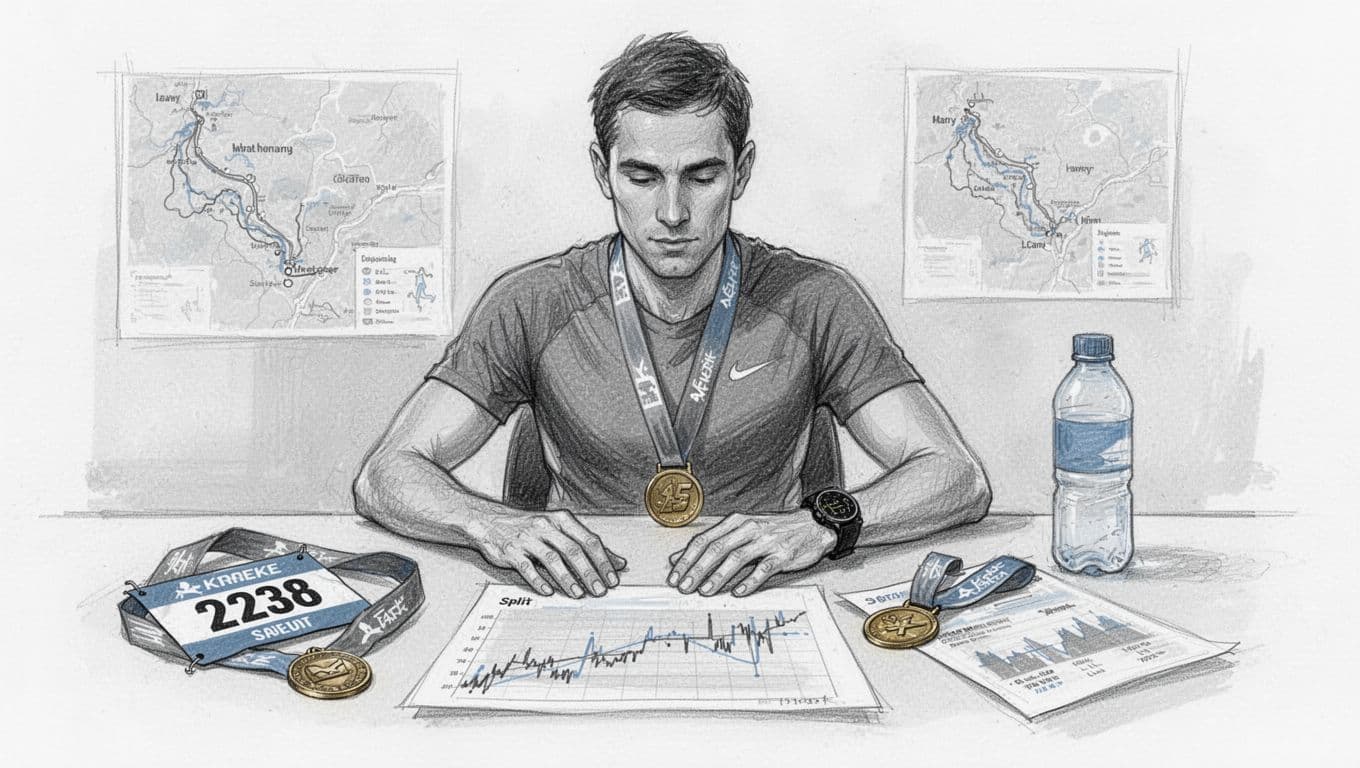
Turn Your Finish Time Into a Smarter Goal Pace
Begin with your official finish time and average pace, then compare them with your splits. A single number cannot tell you whether you ran within your ability. Recent long runs, shorter race results, marathon-pace workouts, heart-rate data, weather, and perceived effort provide the missing context.
Suppose your Philadelphia Marathon time was 4:22:00. Divide 262 minutes by 26.2 miles, and your average pace was about 9:59 per mile. That calculation describes what you achieved. It doesn’t promise that you can immediately train for a 9:30 pace or a new personal best.
Your next goal pace should reflect the full record:
- Recent long runs show whether your endurance supports a faster finish.
- A 5K, 10K, or half marathon reveals your current speed.
- Marathon-pace workouts show whether you can hold effort for extended periods.
- Heart rate and perceived effort help explain whether the pace was controlled.
- Heat, wind, rain, hills, and congestion can make the same pace feel very different.
Use a pace range instead of treating one exact split as mandatory. If your evidence supports 9:50 to 10:00 per mile, begin future marathon training around that range. A training plan, coach, or reliable race pace calculator can help turn those observations into realistic workout and race targets.
Common Lessons From a First Marathon Result
Review your race day like a coach, not a critic. Write down when you took fluids, when you consumed carbohydrates, how you slept during race week, and when fatigue first changed your stride or focus. Also record the weather and your effort at 5K, halfway, 20 miles, and the finish.
A sharp late-race slowdown may point to an aggressive opening pace, weak endurance, missed fueling, or too little marathon-pace practice. Experienced runners should study these late split changes just as carefully as beginners. A strong finish may show that you started too cautiously, while a fading final 10K often identifies the main limiter more clearly than the overall time.
Fuel before fatigue appears, and practice the same routine during long runs. The Korey Stringer Institute’s marathon fueling guide covers practical approaches to eating and drinking during marathon training.
Protect sleep before and after the race, especially when soreness remains. For several days, prioritize walking, gentle mobility, fluids, regular meals, and easy recovery rather than hard intervals or heavy mileage. Once your legs feel normal and your recovery is complete, choose one main improvement for the next cycle.
Your next target should come from repeated training evidence, not one ambitious number on a results page.
If pacing caused the fade, practice controlled starts. If endurance limited you, build consistent mileage and long-run strength. If fueling failed, rehearse your race nutrition until it feels routine. Then use a structured plan or personalized coaching to build the next cycle with enough recovery between demanding sessions.
Frequently Asked Questions
Philadelphia Marathon results can answer most race-day questions, but a few details often require extra checking. These answers cover result updates, certificates, qualifying times, and records that runners commonly need after finishing.
When are Philadelphia Marathon results posted?
Initial results usually appear soon after runners begin crossing the finish line. Timing officials may continue updating the list throughout race day as data from course checkpoints is processed.
However, early listings are not always final. Check the official race page again after the event, especially if your place, split, or status looks unusual. The Philadelphia Marathon FAQ provides current event information, including details that may affect result questions.
Can I use my Philadelphia Marathon time as a Boston qualifier?
Yes, the TIAA Philadelphia Marathon is a Boston qualifying event, provided your result meets the Boston Athletic Association’s requirements for a certified course and your age group. Meeting the published time standard doesn’t guarantee entry because Boston qualification also depends on the registration process and available field capacity.
Use your official qualifying time, not a watch estimate or a result from an unofficial race listing. Save the race name, date, finish time, and result page for your records in case you need to verify the performance during a future application.
How can I get proof of my Philadelphia Marathon finish?
Save or print your individual result page once the results become final. Your page may show your name, bib number, finish time, pace, rankings, and split information, which can provide useful proof of participation.
You can also check the timing provider’s RunFAR results search if you need to locate your result history. Keep a screenshot or PDF copy because older race pages may move when a new marathon year begins.
Why can’t I find my name in the marathon results?
First, confirm that you selected the full marathon rather than the half marathon or another Philadelphia Marathon Weekend event. Then search by bib number, last name, and registration name variations.
A missing listing can result from a timing issue, a delayed upload, a duplicate registration record, or a status that officials still need to review. If your result remains missing, contact the timing team with your event, bib number, registered name, and approximate finish time.
Can results change after the Philadelphia Marathon?
Yes. Officials can correct timing records, update split data, change rankings, or remove a result after reviewing course and race information. That is why the race labels early Philadelphia Marathon results as unofficial until officials finalize them.
Check the listing again before sharing a personal best, claiming an award, or using the time for qualification. Your final result is the record that matters.
How long should I keep my race results?
Keep your official finish page, certificate, and race details indefinitely if the result matters to you. A personal archive helps when you compare training cycles, document qualifying performances, or search for an older Philadelphia Marathon result.
Store the information in more than one place, such as a saved PDF and a training log. Include your finish time, chip time, gun time, splits, rankings, race year, and weather notes so the result remains useful long after race weekend.
Conclusion
Philadelphia Marathon results tell a fuller story than the finish time alone. Confirm your official result after race officials finalize the data, then study your splits, rankings, and race-day conditions to understand how the marathon unfolded.
Use those lessons to guide recovery and shape your next training cycle. A personal best offers proof that your preparation worked, while a first finish or difficult day reveals what to improve before the next start line. Every result gives you useful information, and careful review turns that information into smarter racing.


