

Nailing Your Marathon Pacing Strategies
Mastering your marathon pacing strategies is the single most important skill you can have as a runner. It’s the secret sauce that turns 26.2 miles from a brutal slog into a race you can control and even enjoy. A smart plan is your best defense against hitting the wall, keeping your head in the game, and ultimately, crossing the finish line with a time you can be proud of.
Why Your Pacing Plan Is Everything

A marathon is a masterclass in energy management. Your pacing plan is simply the roadmap for how you’ll spend that energy. Get it wrong, and you’re setting yourself up for the classic bonk, that miserable feeling when your glycogen stores run dry and your legs turn to lead.
The biggest mistake we see? Going out too fast. That “positive split”—running the first half faster than the second—is a trap nearly everyone falls into at some point. Race-day adrenaline is pumping, your legs feel fresh, and it’s easy to get swept up. But that early speed has a cost, and you almost always pay for it in the final miles.
Build Your Running Performance System
Move from research to action with training, recovery, nutrition, pacing, and performance tools built for runners.
More Guides for This Runner Goal
The Science of Smart Pacing
Don’t just take my word for it—the data is crystal clear. One major review of marathon running strategies revealed that a whopping 77% of runners run a positive split. You may want to strategize to do this at the Boston marathon 2027 event.. They start too fast and fade.
In stark contrast, only about 13% manage to hold an even pace, and a tiny 8% achieve the elusive negative split. Think about that. The vast majority of runners are making a fundamental error, while the world’s best performances are almost always run with an even or slightly faster second half. This isn’t just for the pros; it’s a lesson for all of us.
A great marathon performance is not about how fast you can run the first 20 miles. It’s about how well you can hold your pace for the last 10K when your body is screaming at you to stop.
Key Benefits of a Solid Strategy
When you nail your pacing, it’s not just about getting a better time. It completely transforms your entire race day. By holding back early, you unlock some powerful advantages that we cover in our full marathon pace guide.
- Prevents Burnout: A patient start is all about preserving your glycogen stores. This ensures you still have fuel in the tank when things get really tough in the last few miles.
- Boosts Mental Strength: There is no better feeling than sticking to your plan and starting to pass people in the second half. It’s a huge psychological boost right when you need it most.
- Maximizes Performance: Smart energy management is how you run your best possible time on the day. You avoid that devastating slowdown that torpedoes so many PR attempts.
So, What’s a Realistic Marathon Goal Time?
Before we even start talking about pacing strategies, we have to get real about the finish time you’re aiming for. A dream goal is great for motivation, but a goal grounded in reality is what gets you across the finish line strong. I’ve seen it a hundred times: a runner goes out way too hot, chasing a time their training doesn’t support, and the last 10K becomes a painful death march.
The key is to honestly look at where your fitness is right now and pick a target that’s a stretch, but not a fantasy.
Using Shorter Races to Predict Your Marathon Potential
Your recent race times are goldmines of information. A solid performance in a 5K, 10K, or half marathon is one of the best predictors of what you can pull off over 26.2 miles. These shorter distances give us a clear snapshot of your current aerobic engine.
You can plug these times into various online race time prediction calculators. Think of them as a compass—they point you in the right direction, but they don’t know the whole story. For instance, a calculator might tell a 45-minute 10K runner they can hit a 3:30 marathon. That’s only true if their training, especially their long runs, has built the specific endurance to last the full distance.
“A goal without a plan is just a wish.” – Antoine de Saint-Exupéry. This couldn’t be more true for marathoners. Your goal time needs to be directly backed up by the miles you put in.
Your long runs are the ultimate truth-teller. Were you finishing them feeling relatively strong, or were you just barely hanging on by the end? If they were a real struggle, that’s a big red flag that your goal might be too aggressive. This is why I always recommend setting tiered goals: an A-goal (if everything is perfect), a B-goal (a solid performance), and a C-goal (finish strong and have fun).
Time for an Honest Chat About Your Training
You have to be brutally honest with yourself here. How did your training cycle really go? A near-perfect block where you nailed most of your workouts can support a bold goal. But a season filled with missed runs, sickness, or nagging injuries means you need to be more conservative.
Ask yourself these questions:
- How consistent were you? Did you hit at least 85-90% of your planned runs? Nothing, and I mean nothing, is more important than consistency.
- How did the long runs go? Could you finish your longest runs (18-22 miles) without your form completely falling apart?
- What about your pace work? If you struggled to hold your goal marathon pace for a 6-8 mile tempo run in training, it’s a massive leap to think you can hold it for 26.2.
It’s no surprise that studies show runners with higher weekly mileage and more experience are far better at holding their pace in the second half of the marathon. Your training foundation is everything when it comes to executing on race day.
Don’t Forget to Adjust for Race Day Surprises
Your goal time shouldn’t be set in stone. It has to be a little flexible to handle whatever the day throws at you. Two big variables can completely change the game, and you need to be ready to adjust.
- The Course: A flat and fast course like Chicago is a world away from a hilly monster like Boston. You have to study the elevation chart. If there are big climbs, especially in the later miles, you absolutely must account for that. Adding a few minutes to your target time isn’t giving up; it’s being smart.
- The Weather: Heat and humidity are the great equalizers. Trying to run your goal pace in 70°F (21°C) weather can slow you down significantly compared to a cool, crisp morning. If the forecast looks brutal, adjusting your goal is the sign of an experienced runner, not a weak one. For a deeper look at how conditions affect finish times, you can check out our analysis of average marathon running times.
Picking Your Marathon Pacing Philosophy
Alright, you’ve got a goal time in mind. Now comes the real chess match: how are you going to run those 26.2 miles? This isn’t just about what your watch says minute-by-minute. It’s about your entire race-day strategy—your philosophy for distributing effort from the starting corral to the finish line.
Your choice here sets the tone for the whole experience. Are you going to play it cool and controlled, finishing with a smile and gas left in the tank? Or are you chasing a PR and willing to walk that fine line between glory and hitting the wall?
The Negative Split: The Pro’s Secret Weapon
This is the holy grail of marathon pacing. The negative split is simple in theory but tough in practice: run the second half of the race faster than the first. It’s how nearly every world record is set. Just look at Kelvin Kiptum’s mind-boggling 2:00:35—he ran his second half a bit faster than his first, with his fastest 5K split coming after the 35km mark. That’s precisely when most of us are just trying to hang on.
Why does it work so well? By starting out just a little slower than your goal pace, you conserve precious glycogen (your high-octane fuel). Your body becomes a more efficient fat-burning machine in those early miles, saving the good stuff for when you really need it in that brutal final 10K. The mental boost is also huge. There’s no better feeling than passing people in the last few miles of a marathon.
The catch? It takes serious discipline. The starting line is buzzing with energy, and it’s incredibly tempting to get carried away and go out too fast. Executing a negative split means trusting your training and holding yourself back, even when you feel amazing.
The Even Split: The Experienced Runner’s Go-To
For the veteran marathoner who knows their body and their goal pace inside and out, the even split is a powerful and reliable method. The plan is straightforward: lock into your goal pace and hold it steady from start to finish. If a 4-hour marathon is the target, you’re aiming to click off every mile right around a 9:09 pace.
This approach demands that you have a deep, almost instinctual feel for your goal pace. It leaves very little wiggle room, but it’s incredibly efficient, keeping you in that perfect aerobic zone for the entire race. The beauty is in its predictability; you know exactly what’s required of you for every single mile.
The risk? It doesn’t forgive much. A steep hill, a nagging headwind, or just an off moment can knock you off pace, and it’s tough to claw that time back without overextending yourself. That’s why this is best for runners who have drilled their goal pace in training and are racing on a relatively flat course.
An even split is a testament to perfect training and execution. It’s less about raw speed and more about sustained, disciplined effort over the entire distance.
The Conservative Start: The First-Timer’s Best Friend
If this is your first marathon, your only goal should be to cross that finish line feeling strong and wanting to do it again. The conservative start is designed for exactly that. It’s all about intentionally running the first part of the race much slower than you think you can.
- Miles 1-3: Go ridiculously slow. Seriously. Let everyone else sprint off while you settle in and find a rhythm.
- Miles 4-13: Ease into a pace that feels comfortable, almost too easy. This is all about preserving energy.
- Miles 14-20: If you’re still feeling good here, you can gradually start to pick up the effort toward your goal pace.
- Miles 21-26.2: Now you get to cash in on all that energy you saved. You can hold your pace or even accelerate through the finish if you feel great.
This strategy is pure risk management. By banking energy instead of time, you dramatically lower your chances of hitting the dreaded “wall,” making those final miles a victory lap instead of a death march.
The Positive Split: The Unintentional Mistake
And then there’s the positive split—running the first half faster than the second. Let’s be clear: for almost everyone, this isn’t a strategy. It’s a classic rookie mistake, fueled by adrenaline and a lack of experience. It is, by far, the most common pacing profile you’ll see in the amateur field, and it almost always ends in a painful slowdown.
Starting too fast torches your glycogen stores way too early, leading to bonking, cramping, and a miserable final 10K. Your race plan should be built around one goal: avoiding this at all costs by choosing one of the smarter philosophies above.
To help you decide, let’s break down how these strategies stack up against one another.
Comparing Marathon Pacing Philosophies
| Pacing Strategy | Advantages | Disadvantages | Ideal Runner Profile |
|---|---|---|---|
| Negative Split | Conserves glycogen for a strong finish. Provides a huge psychological boost. Minimizes risk of “hitting the wall.” | Requires immense discipline to start slow. Difficult to execute in crowded races. | Experienced runners chasing a PR; disciplined runners. |
| Even Split | Highly efficient and predictable. Simple to monitor with a GPS watch. Maximizes performance for a specific time goal. | Leaves little room for error. Can be mentally taxing to stay “on” for 26.2 miles. Can be derailed by hills or weather. | Veteran marathoners with a precise time goal and a deep understanding of their fitness. |
| Conservative Start | The safest approach to finishing strong. Greatly reduces the chance of bonking. Makes the first marathon a positive experience. | You might finish with “too much left in the tank” and wonder if you could have been faster. | First-time marathoners; runners coming back from injury; anyone whose primary goal is to finish. |
| Positive Split | (None for most runners) | Leads to premature fatigue, “the wall,” and a painful late-race slowdown. High risk of a DNF or a miserable experience. | (Not recommended as a deliberate strategy) |
Ultimately, the best strategy is the one that aligns with your experience, your goal, and your temperament on race day. Choose wisely, practice it in training, and you’ll set yourself up for success.
Bringing Your Race Day Plan to Life
All the training in the world won’t help if your race day execution falls apart. This is where the rubber meets the road—turning your goal pace and pacing philosophy into a concrete, mile-by-mile plan that covers everything from your watch to your water bottle.
This is your blueprint for success on race day.
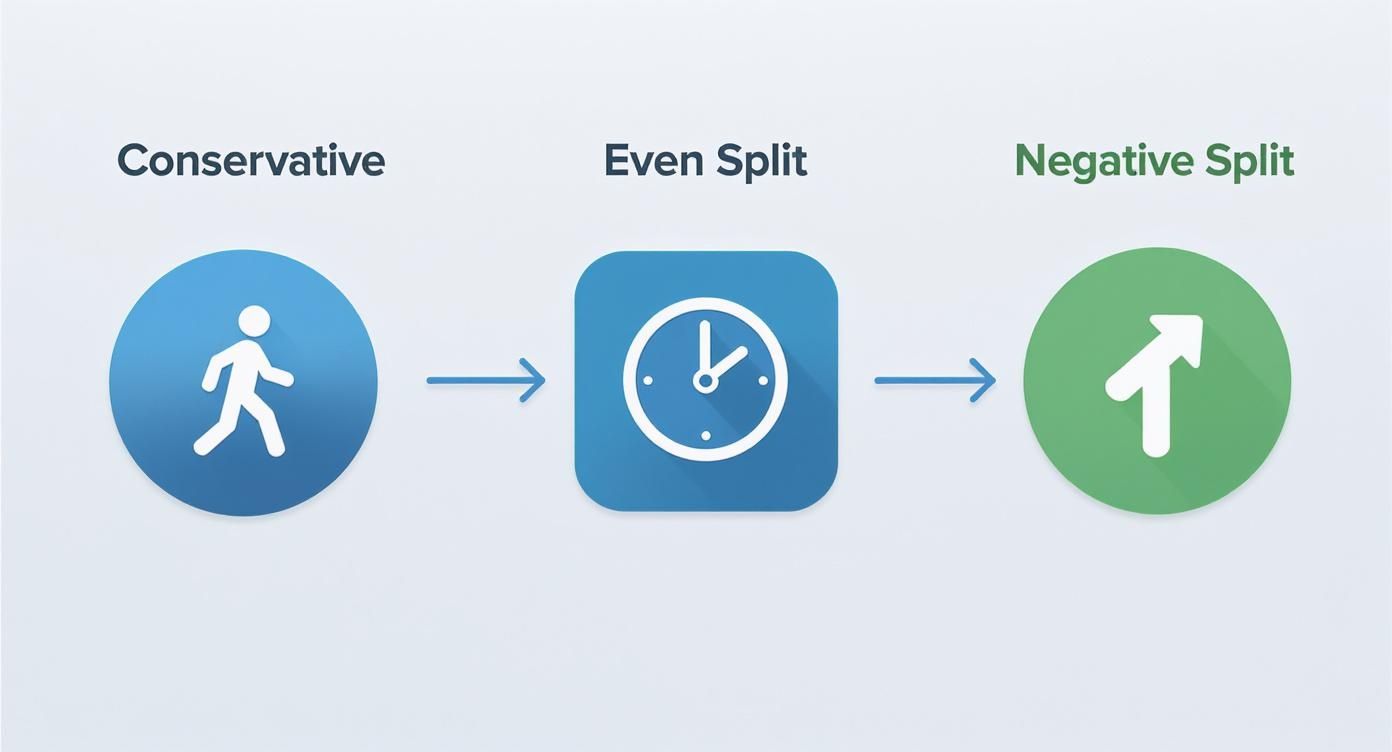
As you can see, no matter which path you choose, a smart, controlled start is the bedrock of a strong marathon finish.
Your Pacing Toolkit
While your brain is your best pacing tool, a little bit of tech can certainly help keep you honest. Just remember that technology is a guide, not a dictator.
- GPS Watch: Your watch is invaluable for tracking your overall average pace and preventing you from shooting out of the start line like a cannon. But be warned—GPS signals get notoriously wonky in big cities with tall buildings. Don’t panic and surge just because your watch spits out a weird split.
- Heart Rate Monitor: If you’ve trained with a heart rate monitor, you know what marathon effort feels like in your chest. This becomes a fantastic secondary data point, especially on hills, helping you monitor your effort when pace alone can be misleading.
- Pace Band: This might be the most underrated tool in a marathoner’s arsenal. A simple wristband with your target splits is a foolproof, at-a-glance reminder that keeps you on track without constantly fiddling with your watch.
The Art of Running by Feel
Let’s be real: technology fails. Batteries die, satellites drop. But your body’s feedback system? It’s been with you every step of the way. Learning to run by feel, or Rate of Perceived Exertion (RPE), is your ultimate safety net.
On a scale of 1 to 10, your marathon effort should hover around a 6 or 7 for most of the race. Think “comfortably hard”—you can get out a few words, but you’re definitely not chatting with your neighbor about the weather.
Trusting your RPE is a skill you build over hundreds of miles in training. If your watch says you’re 10 seconds too slow, but the effort feels spot-on, trust your body. It’s almost always more accurate than a satellite signal bouncing off skyscrapers.
Weaving Fueling and Hydration into Your Pace
Your pacing strategy and your nutrition plan aren’t two separate things; they’re completely intertwined. One fueling mistake can blow up a perfectly executed race pace. The only way to get this right is to practice, practice, practice on your long runs.
Here’s a basic timeline to build into your plan:
- First Gel: Take your first gel around mile 4 or 5. You won’t feel like you need it yet, and that’s the point. If you wait until you feel your energy dip, it’s already too late.
- Keep it Coming: From there, take another gel every 40-45 minutes like clockwork. I recommend setting a recurring alert on your watch so you don’t forget when marathon brain kicks in.
- Aid Station Strategy: Grab water or a sports drink at every single aid station, even if it’s just a quick sip. Pro tip: run toward the last few tables at the station. They’re almost always less crowded, so you can grab a cup without breaking your stride.
Proper hydration is non-negotiable. If you prefer carrying your own fluids to get through the crowded aid stations, a good guide to handheld water bottles for running can help you find one that works for you.
What if Things Go Wrong? Your Contingency Plan
No marathon is perfect. Something will inevitably go sideways. A smart runner anticipates this and has a Plan B (and maybe a Plan C) ready to go. This isn’t about being negative; it’s about being prepared so you can make a clear-headed decision instead of panicking.
Scenario 1: The Adrenaline Trap—You Started Way Too Fast
- The Fix: Whatever you do, do not think you can “bank” that time. It’s a myth that will come back to bite you. Immediately and consciously pull back for the next 2-3 miles, running 15-20 seconds slower than your goal pace to let your heart rate settle.
Scenario 2: The Dreaded Side Stitch or Cramp
- The Fix: Don’t try to run through it. Slow down to a walk and focus on deep belly breathing. Gently press on the spot that hurts. Once it eases up, slowly jog for a minute before gradually returning to your race pace.
Scenario 3: An Unexpected Heatwave
- The Fix: This one requires a major mental adjustment. You have to let go of your original time goal. Immediately add 5-15 minutes to your target finish time, depending on how hot it is. Shift your entire focus to hydration and running by effort (RPE), not the pace on your watch. Thoroughly planning everything during the can help you mentally prepare for these last-minute curveballs.
How to Practice Pacing in Training
Your marathon pacing strategy is just a theory until you put it to the test. A brilliant plan on paper means nothing if you haven’t taught your body and mind how to execute it when things get tough on race day. Pacing isn’t something you just decide to do; it’s a skill you have to sharpen over months of training.
The goal is to make your race pace feel completely familiar long before you’re standing at the starting line. These workouts are designed to ingrain what your goal pace feels like—in your legs, in your lungs, and in your head. When you do this right, you build the confidence that you can hold that effort, even when fatigue starts screaming at you.

Weave Goal Pace Miles into Your Long Runs
One of the most effective ways to practice is to run miles at your goal marathon pace (GMP) during your long runs. Now, this doesn’t mean you should go out and hammer your entire long run at race pace. That’s a surefire way to burn out. Instead, you sprinkle in GMP segments strategically.
A classic approach is to drop a block of goal-pace miles into the back half of a long run. For example, during an 18-miler, you could structure it like this:
- Miles 1-6: Start easy and relaxed, a true warm-up.
- Miles 7-14: Settle into your goal marathon pace.
- Miles 15-18: Cool down with a slow, recovery jog.
This workout is powerful because it forces you to run efficiently on tired legs, which is exactly what the middle of a marathon feels like. It’s a dress rehearsal for the real thing.
Master the Fast-Finish Long Run
If there’s one workout that prepares you for the marathon’s brutal final miles, it’s the fast-finish long run. The concept is simple but incredibly challenging: you run most of the distance at a comfortable pace, then drop the hammer for the last few miles.
This trains your body to dig deep when fatigue is setting in, teaching you to keep your form together when every instinct tells you to slow down. A 20-mile fast-finish run might look something like this:
- Miles 1-16: Run at a relaxed, easy pace where you could hold a conversation.
- Miles 17-20: Pick it up and run at or slightly faster than your goal marathon pace.
This single workout does more to prepare you for the mental and physical demands of the final 10K than almost any other session. It’s about teaching yourself that you can run strong when it hurts.
Of course, the foundation for all of these tough workouts is a strong aerobic base. It’s crucial to understand how to build cardiovascular endurance so your body has the engine to handle these efforts.
Other Key Workouts for Pacing Practice
Your long runs are just one piece of the puzzle. Other sessions during the week are essential for fine-tuning your internal clock.
- Tempo Runs: These are sustained efforts at a “comfortably hard” pace, usually lasting 20-40 minutes. They’re fantastic for raising your lactate threshold, which is key to holding a faster pace for longer.
- Progression Runs: Start your run easy and gradually speed up, finishing the last mile or two near your 10K pace. This teaches you how to manage your effort and finish strong.
- Marathon Pace Intervals: Instead of a steady block of GMP, break it up. Think 3 x 2 miles or 4 x 1.5 miles at marathon pace, with a short recovery jog in between.
- Yasso 800s: While the predictive power of Yasso 800s is often debated, they are an undeniable tool for improving running economy. For more on these, check out this guide to using Yasso 800s for marathon training.
Putting It All Together: A Sample 4-Hour Marathon Pace Plan
A pace chart or band is your roadmap for race day. It breaks the daunting 26.2 miles into smaller, more manageable segments. For a runner aiming for a 4-hour marathon (9:09 min/mile goal), a smart, conservative plan might look like this:
| Race Segment | Mile Range | Target Pace Range (min/mile) | Strategy and Notes |
|---|---|---|---|
| Settle In | Miles 1-3 | 9:20 – 9:30 | Don’t fight the crowds. Run deliberately slower than your goal. Bank energy, not time. |
| Find Rhythm | Miles 4-13 | 9:05 – 9:15 | Lock into your goal pace. This should feel comfortable and almost too easy. Start your fueling plan. |
| Maintain Focus | Miles 14-20 | 9:00 – 9:10 | This is the proving ground. Stay disciplined. The effort will increase, but your pace should stay steady. |
| Finish Strong | Miles 21-26.2 | 9:00 – 9:15+ | Now you rely on your training. Your pace might fade slightly, but focus on maintaining effort. Start passing people! |
By consistently practicing these workouts, your race plan stops being a hopeful guess and becomes a well-rehearsed performance you can execute with confidence.
Answering Your Biggest Marathon Pacing Questions
Even the best-laid plans can go sideways on race day. Knowing how to handle the curveballs is just as crucial as having a solid pacing strategy in the first place. When things get tough, you don’t rise to the occasion—you fall back on your training and preparation.
Let’s break down some of the most common pacing problems runners face so you can make smart, calm decisions when the pressure is on.
What’s the Single Biggest Pacing Mistake Runners Make?
Hands down, it’s starting out too fast. It’s an incredibly easy trap to fall into. You’re rested from your taper, the adrenaline is pumping, and the roar of the crowd is electric. It feels like you can run forever.
But that initial burst of speed comes at a heavy cost. Going just 10-15 seconds per mile too fast for the first 10K burns through your precious glycogen stores way too quickly. It’s a classic rookie mistake that almost guarantees you’ll hit the dreaded “wall” later on.
The smartest thing you can do is consciously hold yourself back for the first few miles. Aim to run them slightly slower than your goal pace. This lets your body ease into a sustainable rhythm. Resisting that early urge to surge is the mark of a seasoned, strategic marathoner.
How Do I Adjust My Pace for a Hilly Course?
On a hilly course, forget about maintaining a perfectly even pace for every mile. It’s just not going to happen. The key is to shift your focus from pace to effort. You want to keep your effort level consistent, which means your pace will naturally slow down on the ups and speed up on the downs.
This is where running by feel (RPE) or using a heart rate monitor really shines.
- Going Uphill: Shorten your stride, keep your feet light, and let your pace slow down. Don’t try to power up the hill and force the pace; just work with the grade.
- Coming Downhill: Let gravity help you out, but don’t get carried away and bomb down at a reckless speed. Over-striding on descents is a surefire way to shred your quads, leaving you with nothing for the final miles.
The goal isn’t to nail your target split on a brutal uphill mile. It’s to average your goal pace over the entire course.
What Should I Do If My GPS Watch Is Acting Up?
It happens all the time, especially in big city marathons where skyscrapers and tunnels can mess with GPS signals. You look down at your watch, see a pace that makes no sense, and start to panic.
First, take a breath. Don’t make any sudden moves based on one wonky reading from your watch. Instead of obsessing over your current pace, check your overall average pace for the run—it’s a much more stable and reliable number.
Better yet, use the official mile markers on the course. They are your ground truth. Do a quick mental calculation as you pass them. If the course clock and your own sense of time are lining up, you’re fine. Ultimately, you have to trust your internal clock. If the effort feels right based on all those training runs, it probably is.
At RunDreamAchieve, we build training plans that teach you how to nail your race-day execution. Whether you’re trying to smash a PR or just cross the finish line, our programs give you the tools and confidence to get it done. You can explore all of our marathon training resources on our website.


