

How to Improve Running Endurance: A Practical Guide
Have you been looking for more details on how to improve running endurance? Improving your running endurance isn’t about some secret workout; it’s about consistently weaving together smart training, the right fuel, and strategic recovery. The real key is to first build a strong aerobic base with plenty of easy runs, then carefully layer in speed and intensity with workouts like tempo runs and intervals.
Building Your Endurance Foundation
Before you even think about chasing a new personal best or tackling a longer race, you have to build a solid foundation. I always tell my athletes to think of it like building a house—you can’t put up the walls and roof on shaky ground. For a runner, that foundation is your aerobic fitness.
How to improve running endurance? It’s your body’s ability to efficiently use oxygen as fuel over long stretches. This is the engine that will power you through every single run.
To really get it, you need to understand that endurance is a two-part system:
- Aerobic Capacity (Your Engine): This is all about how effectively your heart and lungs deliver oxygen to your working muscles. A bigger, more efficient engine lets you run longer at a comfortable pace without hitting a wall.
- Muscular Endurance (Your Chassis): This is about your muscles’ ability to handle the repetitive stress of running for miles without fatiguing or breaking down. Stronger, more resilient legs can simply keep going longer.
The secret to unlocking new levels of stamina is working on both. Focusing on one while neglecting the other just won’t get you where you want to go.
Start with an Honest Self-Assessment
How to improve running endurance? The first step in any good plan is figuring out your starting line. This isn’t about judging yourself; it’s about gathering honest data to build a training plan that’s actually right for you.
A simple baseline test is all you need. Grab a watch and head to a flat, predictable route—a local track or a quiet neighborhood loop works perfectly. Do a “talk test” run: jog at a pace where you could comfortably hold a full conversation without gasping for breath.
See how long you can hold that effort. Is it 20 minutes? 30? An hour? This gives you a clear snapshot of your current aerobic base.
This initial assessment is your anchor point. It helps you set realistic goals and keeps you from making the classic mistake of doing too much, too soon—a surefire recipe for injury and burnout.
The Power of the Aerobic Base
The most crucial part of building endurance, and the one most runners skip, is developing a deep aerobic base. You build this almost entirely through consistent, easy-paced runs.
These are your conversational runs. It feels counterintuitive, I know. How can running slow make you faster and help you go longer? But this is where the real physiological magic happens.
These low-intensity runs trigger some powerful adaptations in your body:
- Your body builds more tiny blood vessels (capillaries) around your muscle fibers, making oxygen delivery way more efficient.
- Your muscle cells create more mitochondria, which are the little powerhouses that turn fuel into energy. You may want to look into where to buy Cellgevity..
- Your heart literally becomes a stronger, more efficient pump, moving more blood with every beat.
For a really deep dive into strategies that cover both speed and stamina, you can check out a complete guide to improving running speed and endurance, which has some great insights. If you’re brand new to this, you might also find this resource on how to increase running stamina for beginners helpful for those first few steps.
How to improve running endurance? Building this base requires patience—it doesn’t happen overnight. But it’s the single best investment you can make for your long-term running health and performance. It creates a bulletproof platform that allows you to handle more intense training later on without falling apart.
Your Weekly Training Blueprint for More Stamina
Alright, let’s move past the theory and start building a smart, structured weekly schedule. A solid plan is the engine of your progress, making sure every single run has a purpose that gets you closer to your endurance goals. It’s time to stop just jogging and start training with real intent.
How to improve running endurance? The whole idea is to organize your week around four different kinds of runs. Each one plays a unique role in building your overall fitness. By mixing easy days with harder efforts, you’ll get stronger and faster without burning out or getting injured. It’s a proven system for consistent, sustainable improvement.
This visual guide breaks down the entire process—from figuring out where you are now to building your foundation and then layering on more advanced work.
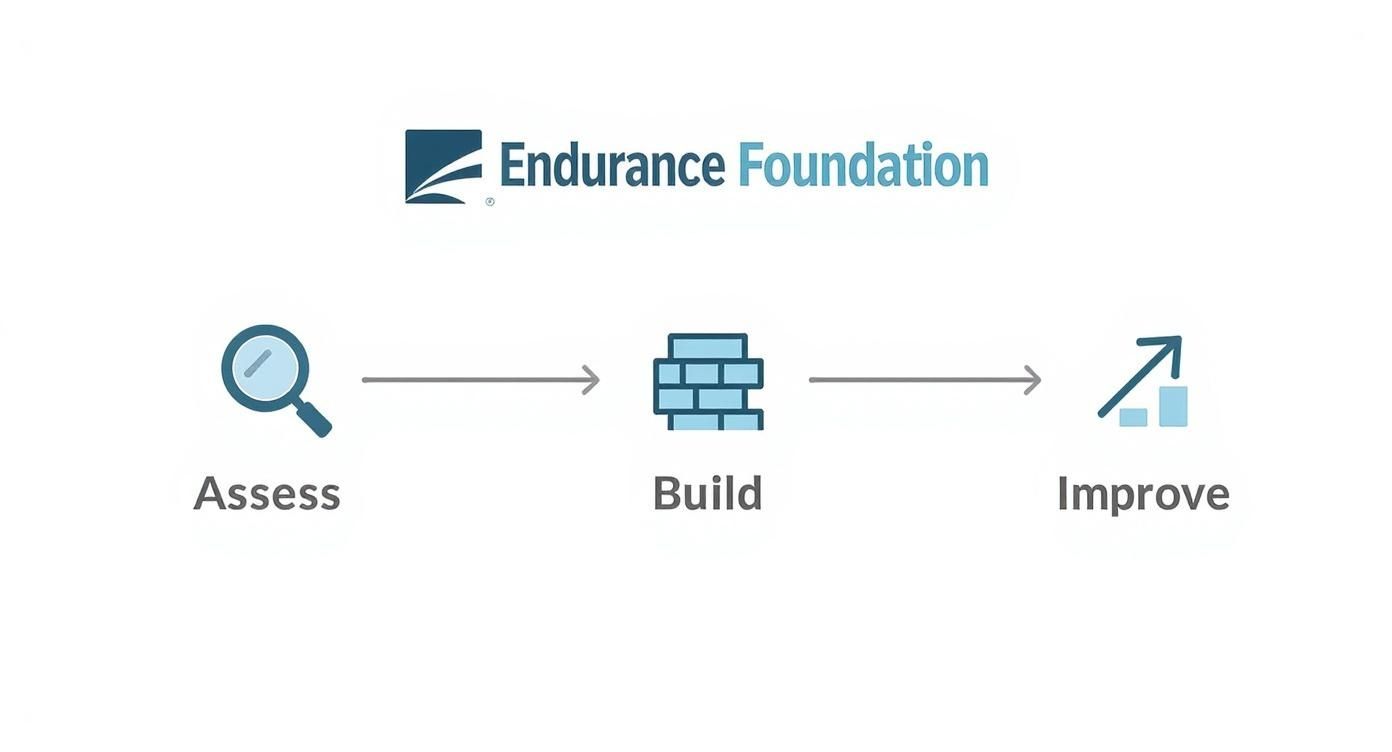
As you can see, improving your stamina is a journey. It starts with an honest look at your current fitness before you can really start building from the ground up.
The Cornerstone: Base Runs
Think of base runs as the bread and butter of your training week. They should make up the bulk of your total mileage. These are your easy, conversational-pace runs where the main goal is simply to spend time on your feet and build your aerobic engine.
Every base run is like adding another brick to your fitness foundation. They might not feel flashy, but they are absolutely critical for developing the capillary density and mitochondrial efficiency that fuel you over long distances. You should always finish a base run feeling like you could have kept going.
The Mighty Long Run
Once a week, you’ll tackle a long run. Are you in the military seeking how to improve your military run times or a civilian seeking the same? For anyone serious about improving their running endurance, this is arguably the most important session of the week. The long run pushes your body and mind to adapt to extended effort, teaching you how to manage fuel and stay mentally tough when fatigue kicks in.
The pace here should be easy and conversational for most of the distance. The goal is to gradually increase the time or distance of this run week after week. This is where you build the grit and resilience you’ll need on race day.
A classic mistake is running your long runs too fast. Remember, the goal is building endurance, not speed. Save the hard efforts for your specific workout days.
Finding Your Rhythm with Tempo Runs
How to improve running endurance? Tempo runs are where you start teaching your body to hold a faster pace for longer. I like to describe the effort as “comfortably hard”—a pace you feel you could hold for about an hour in a race. You can say a few words, but you definitely can’t hold a full conversation.
These workouts are fantastic for improving your lactate threshold. In simple terms, this means your body gets much better at clearing out the metabolic byproducts that cause that familiar leg burn, letting you run faster for longer before you have to slow down.
A classic tempo workout might look like this:
- Warm-up: 10-15 minutes of easy jogging.
- Tempo Portion: 20-30 minutes at that comfortably hard pace.
- Cool-down: 10-15 minutes of easy jogging.
That sustained, focused effort is what makes tempo running such a powerful tool.
Sharpening Your Edge with Interval Training
Wondering how can I run faster without getting tired? It might seem counterintuitive, but short, hard bursts of running are amazing for building endurance. Interval training is all about alternating between fast running segments and periods of easy recovery, like jogging or walking.
How to improve running endurance? This kind of workout directly improves your VO2 max, which is the maximum amount of oxygen your body can use during intense exercise. A higher VO2 max gives your aerobic engine a higher ceiling, ultimately giving you more potential to build endurance.
Consistency is what ties all of this together. One large-scale study looked at about 14,000 marathoners and found a direct, linear link between training volume and endurance gains. Simply put, the more consistently you get out there and do the work, the better you’ll get. You can dig deeper into these endurance training insights if you’re curious about the science behind it.
To help you put it all together, here’s a quick breakdown of how these runs fit into a typical week.
Weekly Run Type Breakdown for Endurance Building
This table gives you a snapshot of the four key run types, what they do for you, and how often you should be doing them.
| Run Type | Primary Purpose | Frequency Per Week | Effort Level (RPE 1-10) |
|---|---|---|---|
| Base Run | Build aerobic foundation and recovery | 2-4 times | 3-5 (Easy/Conversational) |
| Long Run | Improve muscular endurance and mental toughness | 1 time | 4-6 (Easy to Moderate) |
| Tempo Run | Increase lactate threshold and stamina at speed | 1 time | 7-8 (Comfortably Hard) |
| Intervals | Boost VO2 max and top-end speed | 0-1 time | 9-10 (Very Hard) |
Using this table as a blueprint will help you create a balanced schedule. By hitting each of these run types, you’re applying a well-rounded training stimulus that will make you a stronger, faster, and more resilient runner.
Fueling and Recovery That Actually Works
How to improve running endurance? The miles you log are only half the battle. If you really want to build serious endurance, you have to master what happens between your runs. Think of your body as a high-performance engine—your training is the driving, but fuel and maintenance are what ultimately determine how well that engine performs and how long it lasts.
I’ve seen so many runners make the mistake of thinking that more running is always the answer. The truth is, your progress will stall out pretty quickly without a smart nutrition and recovery strategy. Neglecting this side of the equation is like trying to drive a race car on an empty tank with worn-out parts. You’re just not going to get very far before you break down.
The Science of Fueling for Endurance
What you eat, and when you eat it, has a direct and immediate impact on your energy, your performance, and your ability to bounce back for the next workout. A solid nutrition plan really breaks down into three key phases: before, during, and after your run. Each one serves a very specific purpose in your quest for better endurance.
For a much deeper dive into building a meal plan that works for you, our guide on runner nutrition is packed with actionable advice.
Before Your Run: Prime the Engine
How to improve running endurance? About 60-90 minutes before you head out the door, the goal is simple: top off your glycogen stores. This is your body’s primary, ready-to-burn energy source. You want simple, easily digestible carbs that won’t sit like a rock in your stomach.
A few go-to options are:
- A banana with a little bit of honey.
- A small bowl of oatmeal.
- A piece of toast with jam.
- Even a handful of pretzels will do the trick.
Stay away from anything high in fat or fiber right before a run. They slow digestion and can be a recipe for mid-run discomfort.
During Your Run: Maintain Your Energy
Once your runs start stretching beyond 75-90 minutes, you’ll need to refuel on the go to avoid “bonking” or hitting the wall. That dreaded feeling is what happens when your glycogen stores are completely depleted. The target here is to get in 30-60 grams of carbohydrates per hour.
Great on-the-go fuel sources include:
- Energy gels or chews designed for quick absorption.
- Sports drinks that tackle both hydration and carbs.
- Natural options like dates or a small handful of raisins.
How to improve running endurance? The golden rule? Experiment with these during your training runs to find what your stomach can handle. Never, ever try something new on race day.
Recovery: The Secret to Getting Stronger
Recovery isn’t just about kicking your feet up on the couch. It’s an active process where your body repairs the microscopic muscle damage from your run and adapts to the stress. This is where you actually get stronger. Smart recovery is a non-negotiable part of any serious endurance plan.
After Your Run: The Critical Refueling Window
How to improve running endurance? That 30-60 minute window after you finish a run is critical. Your body is primed to absorb nutrients and kickstart the repair process. The ideal recovery meal or snack combines carbohydrates to restock your glycogen and protein to start repairing muscle tissue.
A proven strategy I always recommend is aiming for a 3:1 or 4:1 ratio of carbohydrates to protein. This specific combo is incredibly effective at optimizing muscle glycogen synthesis and getting the recovery process rolling.
Simple, effective options are a glass of chocolate milk, a smoothie with fruit and protein powder, or some Greek yogurt topped with berries.
And don’t forget to rehydrate. For every pound of body weight you lose in sweat during your run, you need to drink about 16-24 ounces of fluid to get back to baseline.
Active Recovery and Advanced Methods
Rest days don’t have to mean being completely sedentary. Light, active recovery can actually speed up the healing process by boosting blood flow to your muscles, which helps flush out metabolic waste. A light walk, a gentle bike ride, or a swim are perfect examples.
Beyond the basics, a few other methods can give your recovery a serious edge. Foam rolling is fantastic for releasing muscle tightness and improving flexibility. To really maximize your gains and bounce back faster, you might even explore using a sauna for post-workout recovery, which can do wonders for reducing muscle soreness.
Finally, never underestimate the power of sleep. This is when your body does its most important work, releasing growth hormone essential for muscle repair. Aiming for 7-9 hours of quality sleep a night is one of the most powerful recovery tools you have. Don’t just take my word for it—recent Strava data showed that top-performing marathoners made rest a priority, with 51% of their days leading up to a race being rest days. You can learn more about how elite runners balance training and recovery from this data.
How to Progress Without Getting Injured
How to improve running endurance? It’s easy to get caught up in the excitement of building running endurance. You start seeing progress, and the natural instinct is to push for more, faster. But letting your ambition get ahead of your body’s ability to adapt is the quickest way to find yourself injured and on the couch.
The real secret to long-term success isn’t about making massive fitness leaps overnight. It’s about smart, consistent, and gradual progression. This methodical approach gives your muscles, tendons, and cardiovascular system the time they need to rebuild and get stronger. You’re not just training for one race; you’re building a resilient body that can handle the work for years to come.
The 10% Rule as a Guideline
How to improve running endurance? A long-standing principle in the running community is the 10% rule. It’s a beautifully simple concept: avoid increasing your total weekly mileage by more than 10% from the previous week. Think of it as a reliable safety net that prevents you from overloading your system.
So, if you ran 20 miles this week, you’d aim for no more than 22 miles next week. This small, steady jump is manageable for your body, allowing it to repair properly between workouts and adapt to the new load.
But remember, this is a guideline, not a rigid command. Some weeks you’ll feel fantastic and might handle a little more. Other weeks, you’ll feel rundown and need to hold your mileage steady or even back off a bit. And that brings us to the most crucial skill any runner can develop.
Learn to Listen to Your Body
Training plans and Garmins are fantastic tools, but nothing beats the feedback you get from your own body. The ability to tell the difference between normal training fatigue and the first whispers of an injury is what separates runners who progress from those who are perpetually sidelined.
Pay close attention to the small signals. That dull ache that just won’t go away, a sharp pain in one specific spot, or feeling unusually exhausted on what should be an easy day—these are all red flags. Don’t push through them.
Your body is telling you it needs more recovery. Ignoring these signals is a gamble that rarely pays off, often turning a minor issue into a major problem that requires weeks or even months of downtime.
Common Progression Mistakes to Avoid
How to improve running endurance? Most runners, from beginners to veterans, stumble into the same training traps. Knowing what they are ahead of time can help you steer clear and keep your training consistent.
- Running Your Easy Days Too Hard: This is the most common mistake, hands down. Easy runs are meant for recovery and building your aerobic base. If you’re pushing the pace, you’re not actually recovering, which sabotages your key workouts and dramatically increases your injury risk.
- Neglecting Strength Training: A strong body is a durable body. If you only run, you’re setting yourself up for muscular imbalances. Weak glutes, hips, and core muscles are a direct cause of common overuse injuries like runner’s knee and IT band syndrome.
- Forgetting About Rest: You don’t get stronger during your run; you get stronger when you recover from it. Constantly skimping on sleep or skipping rest days leads to a state of physical and mental exhaustion—a surefire path to burnout.
Overlooking these fundamentals will drain you, physically and mentally. If you’re starting to feel that deep, persistent fatigue, it’s a good idea to learn how to overcome running burnout before it forces you to stop completely.
A little proactive rest is always smarter than a long, forced break. Smart progression is about playing the long game—building a sustainable habit that keeps you healthy and excited to lace up your shoes every day.
Sample Training Plans to Get You Started
Okay, let’s put all this theory into practice. Knowing the difference between a base run and a tempo run is great, but the real magic happens when you weave them together into a smart, consistent weekly schedule.
Think of the following plans not as rigid rules, but as proven frameworks. Your life is busy, so feel free to shuffle the days around to make it work. The key is to keep the general pattern of mixing harder efforts with plenty of easy and rest days. And above all, listen to your body—if you’re feeling beaten down, an extra rest day is always the smart choice.
Your First 8 Weeks: Building a Base for a 5K or 10K
How to improve running endurance? This plan is perfect if you’re just starting out or getting back into running after some time off. The whole point here is to build a consistent habit and develop a solid aerobic foundation, without getting hurt.
You’ll notice we focus more on time on your feet rather than hitting a specific mileage. This approach helps build your fitness without the mental pressure of distance targets.
What We’re Focusing On:
- Consistency is everything. Just getting out the door, even for a short run, is a huge win.
- Keep it easy. Most of these runs should be at a pace where you could comfortably hold a conversation.
- Slow and steady wins. We’ll gradually increase the length of the long run to build your stamina safely.
The number one mistake I see beginners make is running too hard, too often. For this plan, your goal is to finish every run feeling like you could have gone a little longer. That’s the secret sauce for building endurance without burning out or getting injured.
Let’s take a peek at how the first four weeks come together. This snapshot shows how the different runs are blended to help you progress without overdoing it.
Sample 8-Week Beginner Endurance Plan (Weeks 1-4)
| Day | Workout Focus | Duration/Distance | Notes |
|---|---|---|---|
| Mon | Rest or Cross-Train | 20-30 mins | A light walk, cycling, or some yoga. |
| Tue | Base Run | 20 mins | Keep it easy and conversational. |
| Wed | Base Run | 25 mins | Focus on a steady, comfortable pace. |
| Thu | Rest | – | A full rest day is crucial for recovery. |
| Fri | Base Run w/ Strides | 20 mins | After your run, do 4x100m faster (but not all-out) strides. |
| Sat | Long Run | 30-40 mins | Go slow. Time on your feet is the only goal here. |
| Sun | Active Recovery | 20 mins | A gentle walk or light stretching helps with soreness. |
This table gives you a clear picture of the rhythm you’ll be following. As you get into the second half of the plan (weeks 5-8), you’ll simply continue this pattern, gradually adding a few minutes to your mid-week runs and your weekend long run. This steady, patient build-up is exactly what your body needs to crush that first 5K or 10K.
Leveling Up: A 16-Week Plan for a Half or Full Marathon
How to improve running endurance? Ready for a bigger challenge? This plan is designed for runners who are already comfortable running 3-4 times a week and have a decent base. Here, we get more specific by introducing structured workouts like tempo runs, which are key to helping you hold a stronger pace over longer distances.
Because the demands of a half or full marathon are much greater, the progression is slower and more deliberate over the 16 weeks.
The Core Components:
- More Mileage: Your total weekly volume will build up gradually but significantly.
- Purposeful Workouts: You’ll have one dedicated tempo run each week to really push your lactate threshold and make you a more efficient runner.
- The All-Important Long Run: This is the cornerstone of your week. It’s where you build the physical and mental grit needed for race day.
To give you a feel for it, here’s what a typical week might look like right in the middle of the training block, around week 8:
- Monday: Rest or cross-training (30-45 mins).
- Tuesday: Base Run (45-50 mins easy).
- Wednesday: Tempo Run (10 min warm-up, 20-25 mins at a “comfortably hard” pace, 10 min cool-down).
- Thursday: Base Run (40-45 mins easy).
- Friday: Rest.
- Saturday: Long Run (90-100 mins at a very easy, conversational pace).
- Sunday: Active Recovery (light walk or stretching).
This kind of structured approach is the most reliable way to build fitness while managing fatigue. How to improve running endurance? By balancing stress with recovery, you’ll show up to the starting line feeling strong, prepared, and genuinely confident in your ability to perform your best.
Common Running Endurance Questions
How to improve running endurance? As you get serious about building your running endurance, you’ll find certain questions always seem to pop up. Let’s cut through the noise and get straight to the answers you need to train smarter and sidestep those common pitfalls.
How Long Until I See Endurance Improvements?
This is the big one, isn’t it? The answer really comes in two parts. You’ll probably start to feel a real difference in your running within 4 to 6 weeks of consistent effort. These initial gains are often your neuromuscular system getting more efficient—your brain and body simply getting better at the task of running.
But the deep, game-changing physiological adaptations? Those take time. We’re talking about building a stronger heart, growing more capillaries to deliver oxygen, and increasing the mitochondrial density in your muscles. That kind of lasting endurance is built over months and seasons of smart, dedicated training. So, be patient. The early improvements are great for motivation, but the long-term changes are what truly make you a stronger runner.
Should I Add Strength Training to My Routine?
Yes. A thousand times, yes. Viewing strength training as something separate from your running is one of the biggest mistakes you can make. It’s a powerful tool for building endurance. How to improve running endurance? A stronger body improves your running economy, which is a fancy way of saying you use less energy and oxygen to hold a certain pace. You become more efficient.
More importantly, strength work is your best insurance policy against injury. By fortifying the muscles and connective tissues that support your joints, you build a body that’s resilient enough to handle the relentless impact of running.
How to improve running endurance? You don’t need to live in the gym. Focus on functional, compound movements that support your running mechanics.
- Squats
- Deadlifts
- Lunges
- Glute bridges
Aim for 2-3 sessions per week, ideally on your easier days or after a light run. This way, you get the benefits without sabotaging your key running workouts.
Is It Better to Run for Time or Distance?
How to improve running endurance? When you’re first building that all-important aerobic base, running for time is almost always the better choice. It completely shifts the focus from hitting a certain pace to simply spending time on your feet at an easy effort. A 30-minute easy run is a 30-minute easy run, no matter how tired or great you feel that day.
Running for time takes the pressure off. There’s no temptation to push the pace just to hit a specific mileage goal, which is a classic recipe for turning easy days into junk miles. It teaches you to listen to your body and run by feel. Later on, when you’re targeting specific races, distance-based workouts will become crucial. But for building that foundational stamina? Time is your best training partner. I hope this post on how to improve running endurance has been helpful to you.
At RunDreamAchieve, we’ve poured years of experience into creating training plans and coaching programs that guide you through building endurance the right way. Find the structure you need to chase down your next personal best.


