

How to Become a Better Runner: A Practical Guide
Learning how to become a better runner means ditching the guesswork and building a smart plan. Simply pounding the pavement without structure will only get you so far. It often leads to frustration or injury. The real secret is building a structured foundation. This turns vague hopes into concrete, achievable goals.
This isn't about complexity. It's about clarity. It's what separates runners who consistently improve from those who spin their wheels.
Building Your Running Foundation

Before you can map out where you're going, you need to know where you are. Think of it as a "You Are Here" sticker on your running journey. Without that initial baseline, you're just running in the dark.
Build Your Running Performance System
Move from research to action with training, recovery, nutrition, pacing, and performance tools built for runners.
More Guides for This Runner Goal
This doesn't require a fancy lab test. Your starting point can be a recent 5K or 10K race result. If you don't have one, a simple time trial is perfect. Head to a track or a flat path. Warm up thoroughly. Then run a mile or two at your best, consistent effort. This simple act gives you a powerful piece of data—your starting line.
Setting Meaningful Goals
With your baseline in hand, you can move past fuzzy goals like "get faster." An effective goal is specific and has a deadline. For instance, instead of just wanting to be faster, you might say this. "I'm going to take my 5K time from 28:30 down to 26:30 in the next 12 weeks."
See the difference? That clarity gives every single run a purpose. Your easy days, long runs, and tough workouts all become puzzle pieces. They fit together to hit that one clear target. This focus builds the consistency you need to see real change. If you struggle with staying consistent, our guide on how to make running a habit has practical tips.
"The work is the reward. Every day, we show up not to prove something, but to become something. A better version of ourselves—that's what makes it all worthwhile."
Embracing this idea turns training from a grind into a process of self-discovery. The real win is in the effort, not just the finish line.
The Core Components of a Training Week
A well-rounded training plan isn't random. It’s built on three fundamental types of runs. Each one has a very specific job. Get the mix right, and you'll build fitness safely and effectively. Neglect one, and you’ll likely hit a plateau.
Here's a look at the essential runs that should form the backbone of your week.
| Your Weekly Running Blueprint | ||
|---|---|---|
| Run Type | Primary Purpose | Frequency Per Week |
| Easy Runs | Builds your aerobic engine, strengthens muscles and joints, and aids recovery. This is the foundation. | 2-4 times |
| The Long Run | The cornerstone of endurance. It builds mental grit and improves your body's fuel efficiency. | 1 time |
| Quality Workout | The "speed" day. These harder efforts (intervals, tempos) boost your top-end fitness. | 1-2 times |
This structure ensures you develop endurance, speed, and resilience all at once. Each piece complements the others. It creates a powerful synergy that will make you a much stronger runner over time.
Understanding Pacing and Training Intensity

I see runners make one mistake over and over. They run their easy days too hard and their hard days too easy. This trap is often called the "gray zone." It is where progress goes to die. You end up feeling perpetually tired. You never give your body the right stimulus to actually improve.
Getting a handle on training intensity is crucial. It's key if you want to break through a plateau. Think of your run paces as tools in a toolbox. You wouldn't use a sledgehammer for a delicate job, right? The same goes for running. Each run has a purpose, and that purpose dictates your effort. Nailing your intensity on the right day unlocks real physiological gains.
This is where training zones come into play. They give you a simple framework. This ensures your easy runs are truly easy. Your hard workouts are sharp enough to make a difference. It's about training smarter, not just harder.
Finding Your Training Zones
So, how do you know how hard you're working? There are two great ways to measure your intensity. You can measure by feel, using the Rate of Perceived Exertion (RPE). Or you can use data, using Heart Rate (HR) Zones. The best approach is to use them together.
RPE is as simple as it gets. It's a scale from 1 to 10. 1 is you sitting on the couch. 10 is an all-out, can't-breathe sprint. It's wonderfully intuitive. An easy, conversational run should feel like a 3–4. A tough interval workout might hit an 8–9.
Heart Rate Zones give you a more objective look at your body. These are based on percentages of your maximum heart rate. Most GPS watches today will calculate these zones for you. This gives you real-time feedback.
Here’s a quick breakdown of what these zones mean and do for you:
| Zone | RPE | HR (Approx. % of Max) | Primary Purpose |
|---|---|---|---|
| Zone 1 | 2-3 | 50-60% | Active Recovery |
| Zone 2 | 3-4 | 60-70% | Aerobic Base Building (Easy Runs) |
| Zone 3 | 5-6 | 70-80% | Aerobic Endurance (Marathon Pace) |
| Zone 4 | 7-8 | 80-90% | Lactate Threshold (Tempo Runs) |
| Zone 5 | 9-10 | 90-100% | Anaerobic Capacity (VO2 Max) |
Knowing these zones helps you follow a training plan with precision. It ensures your recovery runs actually help you recover. And your workouts push you just the right amount.
The Purpose Behind Each Effort Level
Every zone targets a different energy system in your body. For example, running in Zone 2 is the bread and butter of endurance training. This is where you build your aerobic base. You improve your body's ability to burn fat for fuel. You also develop a dense network of capillaries to deliver oxygen. It’s no surprise that 80% or more of your weekly mileage should be at this effort.
On the flip side, workouts in Zone 4 are your tempo or threshold runs. This is where you build stamina. This is that "comfortably hard" effort. It teaches your body to clear lactate more efficiently. This allows you to hold a faster pace for much longer. Understanding this workout is a game-changer for race performance. For a deeper dive, learn more about what a threshold run is.
The biggest training mistake is chronic fatigue from running moderate-to-hard all the time. True progress comes from polarizing your training. Make your easy days genuinely easy and your hard days purposefully hard.
This approach gives your body the chance to absorb the hard work. It helps you recover and adapt. Ignore this, and you’re on a fast track to burnout.
Putting It All Into Practice
Let’s see how this looks in the real world. Imagine a runner training for a half marathon. Their week might be structured around these different intensities.
- Tuesday (Intervals): A Zone 5 workout. This could be 6x800m repeats at an RPE of 9. It's designed to sharpen speed.
- Wednesday (Easy Run): A pure Zone 2 effort. The pace is slow and conversational (RPE 3–4). It's focused only on recovery and building that aerobic engine.
- Thursday (Tempo Run): A classic Zone 4 workout. Maybe a 20-minute run at that "comfortably hard" RPE of 7. This directly targets their lactate threshold.
- Saturday (Long Run): Mostly Zone 2. A long, slow effort to build endurance. Maybe add a few miles in Zone 3 to practice race pace on tired legs.
By respecting these zones, this runner gets the maximum benefit from every run. They build speed, stamina, and endurance. They do this all while giving their body the recovery it needs to come back stronger.
Putting Your Weekly Training Together
Consistency gets you to the finish line. But a smart training structure gets you there faster and stronger. Think of it as a recipe. Each type of run is an ingredient. When you combine them correctly, you create a powerful stimulus for improvement. This balance is everything. It prevents burnout, keeps you healthy, and makes sure every mile has a purpose.
Let's build your perfect training week from the ground up. We'll start with the non-negotiables.
The Cornerstone: The Long Run
Every runner's week should be anchored by one long, slow run. This is hands-down the most important workout for building raw endurance. It trains your body to become more efficient. It strengthens your bones and connective tissues. It also builds the mental grit you need when things get tough on race day.
The secret to a successful long run? Keep it easy. The pace should be relaxed and conversational. Stay squarely in your Zone 2. So many runners push this run too hard. This just adds unnecessary stress and increases injury risk. It also tanks your recovery for the next few days. The goal here is time on your feet, not speed.
To build up safely, add no more than 10–15% to your long run distance each week. Every 3–4 weeks, schedule a "cutback" week. Shorten the long run to give your body a chance to absorb all that hard work.
The Unsung Heroes: Your Easy Runs
Easy runs are the unsung heroes of every great training plan. People often dismiss them as "junk miles." But they're where most of the aerobic magic really happens. These runs should make up the bulk of your weekly mileage. They should be done at a truly low-intensity, conversational effort (RPE 3–4).
They might feel too easy, but they're working hard behind the scenes.
- Building Your Aerobic Engine: Easy mileage increases mitochondria in your cells. These are the tiny powerhouses that generate energy. More mitochondria mean more endurance.
- Making You More Durable: They gently strengthen your muscles, tendons, and ligaments. This makes you more resilient to the pounding of harder workouts.
- Speeding Up Recovery: A light run increases blood flow. This helps flush out metabolic waste. It also helps repair muscle damage from your tougher sessions.
Without enough easy mileage, you never fully recover. You simply can't get the maximum benefit from your speed work. A huge analysis of over 2,300 runners found a strong link. It was between weekly mileage and race performance, from 5K to marathon. It’s a compelling argument, which you can read about in this article on the case for running more frequently from Outside Online.
The Sharpeners: Adding Quality Workouts
Once you have your foundation of easy and long runs, it's time to add quality. These are the higher-intensity sessions that make you faster. Plan on doing one or two of these a week. But always have at least one easy day in between to recover.
Here are the three main types of quality workouts every runner should know.
Tempo Runs for Race-Day Stamina
A tempo run is a sustained effort at a "comfortably hard" pace. This is a pace you could hold for about an hour if racing (Zone 4 or RPE 7). The goal is to train your body to clear lactate from your blood more efficiently. It teaches you to hold a faster pace for a longer time without fatiguing.
A great tempo run isn't about running yourself into the ground. It's about finding that edge of control. It's the fastest pace you can sustain while staying relaxed. That's where you build real race-day strength.
Example Workout: After a 15-minute warm-up, run for 20 minutes at your tempo pace. Follow it with a 15-minute cool-down jog.
Interval Training for Pure Speed
Intervals are short, fast bursts of running. They are followed by periods of recovery (a slow jog or a walk). These workouts are intense, pushing you into Zone 5 (RPE 9-10). They are incredibly effective at improving your VO2 max. This is your body's maximum ability to use oxygen. A higher VO2 max means a higher top-end speed.
Example Workout: After a solid warm-up, run 6 repetitions of 800 meters. Run at your goal 5K race pace. Take a 400-meter easy jog to recover between each one. Don't forget to cool down afterward.
Hill Repeats for Building Power
Think of hills as speedwork in disguise. Charging up an incline builds serious leg strength and power. It improves your running form and forges mental toughness. This all happens without the high-impact stress of sprinting on flat ground.
Example Workout: Find a hill with a moderate grade. It should take about 45-60 seconds to run up. After warming up, run hard up the hill. Focus on driving your knees and using your arms. Jog or walk slowly back down to recover. Start with 4-6 repetitions. Gradually add more as you get stronger.
Strength, Mobility, and Recovery: Your Foundation for Success

It’s a common mistake to think all progress happens on the pavement. The reality? The fastest and most resilient runners know real improvement happens when you're not running. Your strength work, mobility drills, and recovery build a durable and powerful athlete.
Ignoring these areas is like building a house on a shaky foundation. It’s only a matter of time before something cracks. If you're serious about learning how to become a better runner, making time for this is non-negotiable. It helps you enjoy this sport for the long haul.
Building a Stronger, More Efficient Running Body
Think of strength training as your secret weapon. It helps you fight fatigue in the final miles. It improves your running economy (how efficiently you use oxygen). It also helps you hold your form together when things get tough. The good news is you don't need to live in the gym to see a huge difference.
Focus on simple, compound movements. They hit the big running muscles: your glutes, hamstrings, quads, and core. For a deep dive, this guide to strength training for distance runners is a fantastic resource.
A simple, effective routine can be built around these staples:
- Squats: The king of lower-body exercises. They build power in your quads, hamstrings, and glutes.
- Lunges: Great for balance and working each leg independently. This mimics the demands of running.
- Glute Bridges: Essential for "waking up" your glutes. They are the powerhouse muscles for a stable stride.
- Planks: The gold standard for core strength. This is your key to maintaining good posture on long runs.
Try to slot in two 20-30 minute strength sessions a week. Do them on easy run days or rest days. Consistency trumps intensity every time.
Why Mobility and Flexibility Matter
Strength gives you power. Mobility ensures your joints can move through their full range of motion. When mobility is poor, the body starts to compensate. This forces other muscles to pick up the slack. That's a classic recipe for injury.
It's also crucial to know when to do certain types of stretching.
Dynamic Warm-ups (Before You Run)
Your pre-run goal is to get the body ready for action. Dynamic stretches use active movements to increase blood flow. They raise your core temperature and get your nervous system fired up.
- Leg Swings (forward and side-to-side)
- Walking Lunges with a Twist
- High Knees and Butt Kicks
Static Stretching (After You Run)
Post-run is the ideal time for static stretching. Your muscles are warm and receptive. Holding stretches can improve long-term flexibility. It also signals to your body that it's time to cool down. Hold each stretch for 20-30 seconds. Never bounce.
Static stretching isn't about forcing flexibility. Think of it as a gentle release. It helps your muscles return to their resting length. This simple habit can make a huge difference in how you feel the next day.
Unlocking Your Potential Through Recovery
Recovery is when the magic happens. You don't get fitter during a workout. You get fitter when your body adapts to the stress from that workout. Nothing beats good old-fashioned sleep as a recovery tool.
During deep sleep, your body releases human growth hormone. It helps repair muscle tissue. Your brain also consolidates what it’s learned. This literally helps lock in better running form. Getting 7-9 hours of quality sleep is one of the most effective things you can do.
This isn't just about avoiding being tired. It's a critical part of your training. If you're struggling, check out these excellent tips on how to improve sleep quality.
By weaving these three pillars into your weekly rhythm, you build a complete system. It doesn't just make you faster. It keeps you healthy and enjoying the journey.
Fueling for Performance and Injury Prevention
You can have the most dialed-in training plan on the planet. But if you neglect nutrition and self-care, you’ll never see your true potential. A successful running journey is powered by smart fueling and a resilient body. This isn't about restrictive diets. It's about giving your body what it needs to perform day in and day out.
Think of your body as a high-performance engine. Carbohydrates are the premium fuel that powers your runs. Protein is the oil that repairs the engine after a tough workout. Getting this balance right is fundamental.
The Runner's Plate: What to Eat and When
Your daily nutrition provides the raw materials for every run. For any runner, the primary focus has to be on carbohydrates. They're your body's most accessible energy source. I always recommend focusing on complex carbs. Things like oatmeal, sweet potatoes, and brown rice provide slow, sustained energy.
Protein is all about muscle repair and recovery. After a hard workout, your muscles need nutrients to rebuild damaged fibers. Include lean protein sources like chicken, fish, eggs, or legumes in your meals. This gives your body the tools it needs to bounce back stronger.
To get this right, you need a solid grasp of the basics. Dive deeper with this essential guide to macronutrients and micronutrients.
Fueling for Race Day Success
What you eat before a race can make or break your performance. The game plan is simple. Top off your glycogen stores without upsetting your stomach. That means focusing on easily digestible carbs. Steer clear of high-fat or high-fiber foods that can cause trouble.
For longer efforts, fueling during the run becomes non-negotiable. Your body only has enough stored glycogen for about 90-120 minutes of hard running. After that, you must put fuel back in to avoid hitting the "wall."
- Pre-Race Breakfast (2-3 hours before): Keep it simple. A bagel with peanut butter or a bowl of oatmeal with a banana are reliable choices.
- Mid-Race Fueling (For runs over 90 mins): The goal is 30-60 grams of carbohydrates per hour. This can come from energy gels, chews, or sports drinks.
- Post-Race Recovery (Within 30-60 mins): Get a mix of carbs and protein in quickly. This replenishes energy stores and kick-starts muscle repair.
Nailing your pre-race meal is a key part of your race day strategy. For more ideas, explore our guide on what to eat before running a 10K.
"I've never felt stronger and smarter in a race. It was the best feeling… Not only did they teach me how to be a better runner, but how to be a better human." – Aiden Hammond, Sub-3 Marathoner
This quote from a runner really hits home. Smart fueling and recovery don't just make you faster. They make you a more confident and intelligent athlete.
Staying Healthy: Listening to Your Body
The other half of the performance equation is injury prevention. The best training plan is useless if you're on the sidelines. A critical skill is learning to listen to your body. Know the difference between normal soreness and a real injury.
That ache after a hard workout is typically Delayed Onset Muscle Soreness (DOMS). It usually fades within 24-48 hours. An injury often presents as a sharp, localized pain that gets worse as you run. If you feel that, the smartest thing you can do is stop.
Common issues like shin splints stem from doing too much, too soon. Pay attention to those early warning signs. A little ache is your body whispering. A sharp pain is it screaming. Learning to heed the whispers is the secret to a long running career.
Putting It All Together: Your Progression Plan
This is where the rubber meets the road. Pacing, recovery, and smart workouts come together in a weekly plan. A good plan isn't a rigid calendar. It's a living framework that shows you how to build up your mileage. It shows where to slot in tough sessions and when to rest.
Think of it as the blueprint for your running goals. It turns abstract concepts into a clear, actionable roadmap. This works whether you're eyeing your first 5K or a half-marathon PR.
Sample Beginner 5K Progression
If you're just starting, the name of the game is consistency. Your job is to get your body used to the new stress of running. This 8-week plan is about slowly increasing your time on your feet. It introduces one simple, faster workout once you've built a small base.
- Weeks 1-2: Just focus on showing up. Get out for three 20-25 minute run/walk sessions each week. Keep the effort easy enough to hold a conversation.
- Weeks 3-4: Introduce a "long run." Extend one run to 30 minutes, then 40 the next week. On another day, try a simple quality workout. Do 1 minute of faster running, then 2 minutes of easy walking.
- Weeks 5-6: Push that long run toward 45-50 minutes. Your quality day can evolve. Try running faster for 3 minutes, then 3 minutes of easy jogging.
- Weeks 7-8: It's time to taper. Your longest run should be in week 7. In the final week, cut back your volume. Make sure your last quality session feels controlled.
Sample Intermediate Half Marathon Plan
For the runner with a base who wants to get faster, the plan is more sophisticated. This means balancing higher mileage with two different quality workouts each week. This builds both raw speed and the stamina to hold it.
Getting this right in the months before a race is crucial. Research shows a strong link between higher mileage and faster finish times. This includes consistent quality sessions and cross-training. You can dive deeper by checking out the full analysis of marathoner preparation.
Don't forget that fueling becomes a bigger piece of the puzzle for longer races.
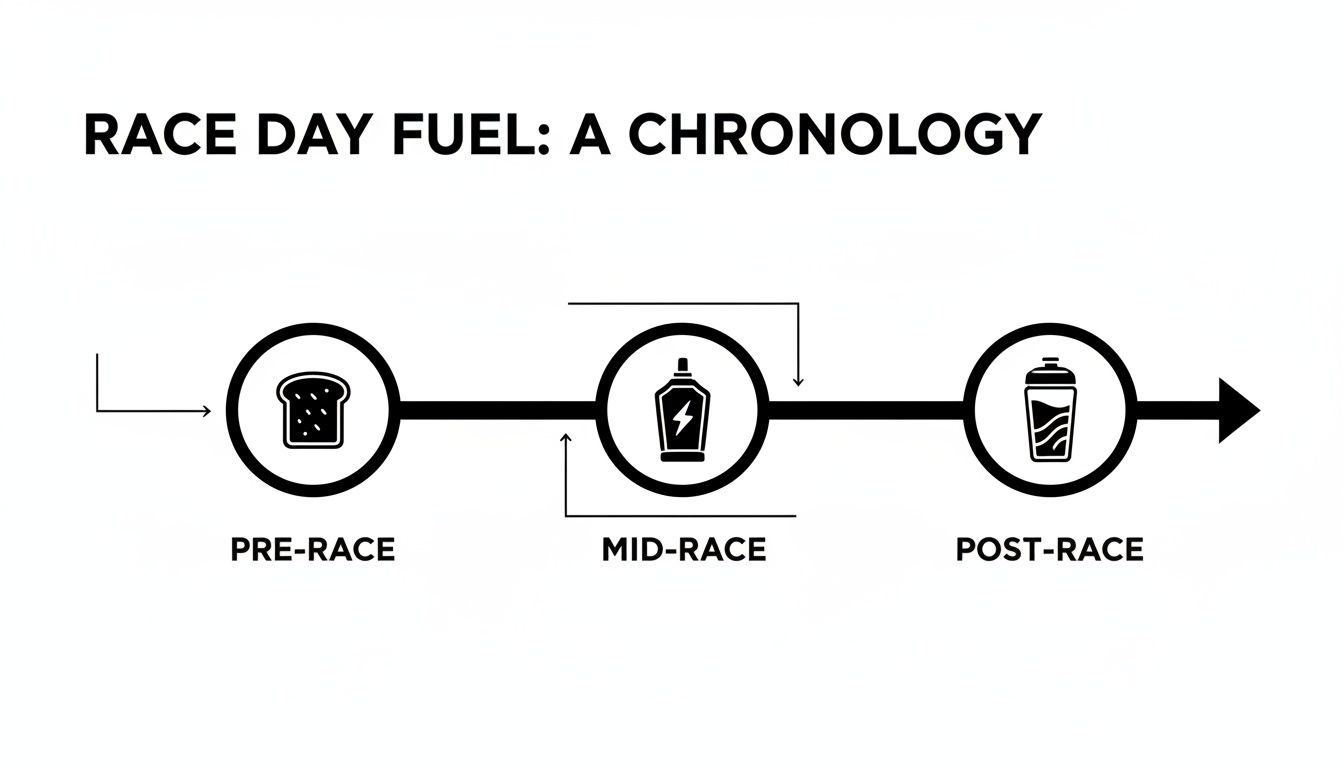
This simple timeline gives you a great visual for timing your fuel intake. It maximizes energy on race day and kick-starts your recovery afterward.
When to Consider Personalized Coaching
Sample plans are fantastic starting points. But sometimes a generic template just won't cut it. There are moments where a personalized approach is needed to break through a wall.
A great coach does more than write a schedule. They provide accountability, offer objective feedback, and help you navigate the challenges of chasing an ambitious goal.
So, when does it make sense to hire a coach?
- You're Chasing a Major Goal: This could be a Boston Marathon qualifier or a sub-3-hour marathon. Big goals require precision.
- You're Stuck in an Injury Cycle: If you find yourself getting injured over and over, a coach can help. They can analyze your training history to spot patterns.
- You've Hit a Plateau: You're putting in the work, but your race times aren't improving. An expert can pinpoint weaknesses and prescribe the right workouts.
For those moments, a tailored RunDreamAchieve plan can give you specific guidance. It can help you finally unlock that next level of performance.
Common Running Questions Answered
So, how do you keep getting faster as the years tick by? It's a question I hear all the time from runners. The biggest shift you need to make is embracing a longer warm-up.
Forget rolling out of bed and hitting your goal pace two minutes later. Now, the first 10 to 15 minutes of every run are non-negotiable easy jogging. Think of it as giving your body a chance to wake up. It prepares your muscles and joints for the real work.
Another hot topic is recovery. When you're in peak shape, one easy day between hard sessions might feel great. But what if you're feeling flat or constantly tired? That's your body telling you it needs more time.
Don't be afraid to add a second easy day between tough workouts. Shifting to a hard/easy/easy cycle gives your body space to fully adapt. This change ensures you're recovered and ready for your quality session.


