

How Should Your Feet Land When Running?
Heel strike, midfoot, or forefoot, which one is actually “right” for running? Here’s the quick answer to how should your feet land when running: there isn’t one perfect foot strike for everyone, and many runners do best with what feels natural.
“Foot strike” simply means which part of your foot touches down first when you run. Some runners land on the heel, others closer to the middle, and a smaller group lands on the ball of the foot, each has tradeoffs for comfort, efficiency, and how stress spreads through your legs.
The most useful goal isn’t copying someone else’s strike, it’s landing under your body and avoiding overstriding (that long reach in front that often leads to braking). If pain keeps showing up, or you get the same injury again and again, that’s when a change can make sense, and it should be gradual.
Next, you’ll learn what the different foot strikes look like, what research says about efficiency and injury risk, how to self-check your form, and how to adjust safely if you decide it’s needed.
Build Your Running Performance System
Move from research to action with training, recovery, nutrition, pacing, and performance tools built for runners.
More Guides for This Runner Goal
Back to RunDreamAchieve Courses
What it really means for your foot to land “right”
When people ask, How should your feet land when running, they often mean, “Should I heel strike or land on my forefoot?” In reality, “right” usually looks like this: quiet steps, a stable ankle and knee, a foot landing close to under your hips, and a quick, light contact that keeps you moving forward.
Think of your body’s center of mass (roughly your hips) like a shopping cart rolling forward. If you stick a leg way out in front, you are basically putting a brake in front of the cart. If your foot lands closer under you, you roll forward with less braking, and each step feels smoother.
Landing under your hips, not out in front
Overstriding is when your foot lands far ahead of your hips, often with a straighter knee. From the side, it looks like you are reaching for the ground instead of letting the ground meet you. That reach usually creates a braking force, because your foot hits out front and your body has to travel over it.
Common clues show up fast:
- Loud heel slap or heavy, smacking steps
- Sore shins or cranky knees after easy runs
- A feeling of pounding instead of gliding
To clean it up, you do not need a total form makeover. Try these quick fixes for your next run:
- Shorten your stride a little. Keep the same pace, just take smaller steps.
- Use the cue “feet under me.” Picture stepping down under your hips, not reaching.
- Nudge cadence up slightly. A small increase in step rate often pulls your landing back under your body without overthinking it.
If you feel like you are “catching yourself” every step, you are probably landing too far in front.
A “soft” landing is about force timing, not tiptoeing
A soft landing does not mean sneaking around on your toes. It means the force of impact builds more gradually instead of hitting you all at once. In simple terms, loading rate is how fast that force spikes into your foot, leg, and hips after contact.
You get a smoother, quieter landing when your joints act like springs. A slightly bent knee on contact and a controlled ankle help spread the load over a bit more time. That usually feels better than a stiff leg that slaps the ground.
It also helps to remember this: forcing a forefoot strike can trade one problem for another. Many runners who switch too aggressively end up with sore calves or an angry Achilles. Instead of trying to “run on your toes,” aim for quiet contact and a rounded feel to each step. Your foot can touch heel-first, midfoot, or slightly forefoot, the key is avoiding the harsh slap and the long reach.
Stability first: what your ankle and knee should do
Even with a great landing spot, you want your leg to stay stacked and steady as you load it. Two common leaks are ankle collapse (your arch drops and rolls in without control) and knee cave-in (the knee dives inward as you push off).
Use simple checkpoints as you run:
- Keep your knee tracking over your middle toes, especially as you load your weight.
- Build a “foot tripod,” pressing the ground with your big toe, little toe, and heel.
- Let your hips do their job, because strong hips make it much easier to keep the knee and ankle aligned.
When things line up, your stride feels calmer. Your steps sound quieter, your push-off feels straighter, and you spend less energy fighting wobble.
Heel, midfoot, or forefoot: what each landing style looks like
When people ask, How should your feet land when running, they often picture three “types”: heel (rearfoot), midfoot, and forefoot. In real life, it’s more like a dimmer switch than three on-off buttons. Your strike can shift with speed, fatigue, hills, and even your shoes.
That said, one pattern is far more common. In studies of recreational runners, roughly 70% (and often much more) naturally land on the heel, while true forefoot striking is rare. So if you’re a heel striker, you’re in very normal company.
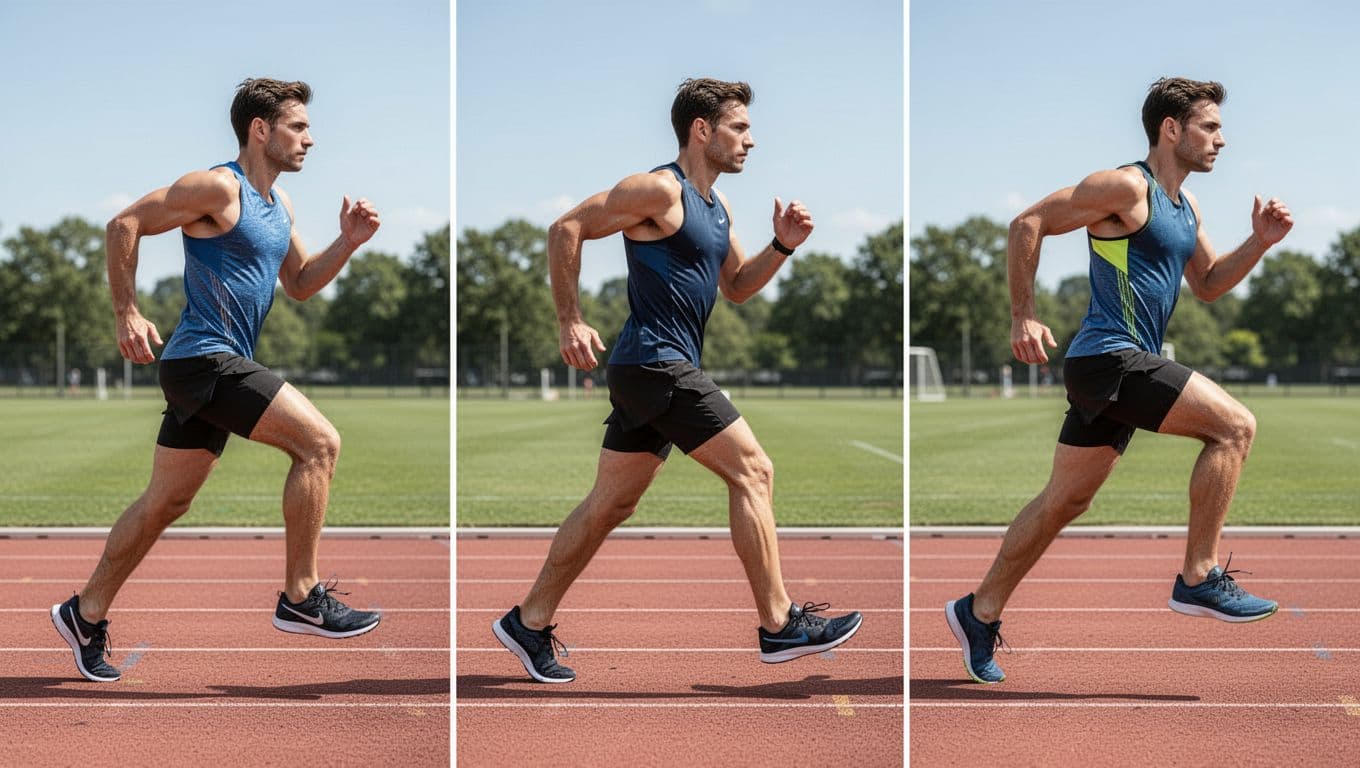
Heel strike: common, often efficient, but watch for overstriding
A heel strike (rearfoot strike) means your heel touches down first, usually with your toes slightly up. Many runners also land with the ankle a bit flexed and the knee closer to straight than in other strikes (not locked, just less bent).
Heel striking gets a bad rap online, but at typical recreational paces, research often finds rearfoot striking can be metabolically efficient, especially when it’s your natural pattern. Put simply, it can cost less energy for many runners at easy to moderate speeds.
The big thing to watch is not the heel contact itself, it’s what often comes with it: overstriding. When your foot reaches too far ahead, you tend to hit with a stiffer leg, and you can feel that “braking” each step.
A few common heel-strike pitfalls look like this:
- Reaching forward: Your foot lands well in front of your hips, and your shin angles forward.
- Stiff landing: The knee stays too straight on contact, so the impact feels sharp.
- High loading rate: Force rises quickly right after contact, which can show up as sore shins or cranky knees.
If heel striking feels fine and you stay healthy, it may not need fixing. However, if shin issues keep showing up, some runners do better in rocker-style shoes, since the curved sole can help the foot roll through contact more smoothly. It’s not a cure, but it can reduce how “stuck” the transition feels for certain heel strikers.
A heel strike isn’t automatically a problem. Overstriding and a stiff landing usually are.
Midfoot strike: “flat” contact that can feel smooth for some runners
A midfoot strike is when the heel and forefoot contact the ground at about the same time. From the side, it often looks like a flatter foot placement with the ankle closer to neutral. Many midfoot strikers also land with a bit more knee bend, and the foot often appears closer to under the hips.
For some runners, that “whole foot” contact feels smoother and quieter, because there’s less of a distinct heel slap. It can also reduce the feeling of a hard impact spike for certain bodies and certain paces.
Still, midfoot is not automatically “better” or more efficient for everyone. At common training speeds, some research shows rearfoot striking can use less energy, partly because midfoot contact can ask more from your lower leg early in stance.
If you’re curious about midfoot landing, treat it like a gentle nudge, not a forced makeover. Changing your strike overnight usually shifts stress somewhere else, often to the calves and feet. A better approach is to keep the goal simple: land closer under you and keep steps quiet, no matter which part touches first.
Forefoot strike: can reduce impact spike, shifts work to calves and Achilles
A forefoot strike means you land on the ball of your foot first, with the heel still off the ground at initial contact. The knee is usually more bent, and the ankle often sits in a position that lets the heel lower after you land.
One reason forefoot striking can feel softer is that force often builds more gradually, like loading a spring instead of slapping a board. The calf and Achilles complex can store and release energy as the heel drops, which can smooth out the initial impact for some runners.
The tradeoff is simple: that spring has to come from somewhere. Forefoot striking usually shifts more demand to your:
- Calf muscles (they work harder to control the heel drop)
- Achilles tendon (more tension, more repetitive loading)
- Foot structures (including the arch and plantar fascia)
Because of that, be cautious if you have a history of Achilles pain, plantar fascia pain, or calf strains. A sudden switch to forefoot striking can flare those areas fast, even if your knees feel better at first.
Forefoot striking also tends to show up more with faster running, hills, and sprinting, even in runners who heel strike on easy days. That’s normal. Most runners aren’t 100% one style, and your body will often choose what fits the pace and terrain.
What research says about efficiency and injury risk, without the hype
Most runners want one clear answer to how should your feet land when running. Research keeps pointing to a less exciting, more useful truth: there’s no single best foot strike for everyone. Heel, midfoot, and forefoot patterns can all work when the rest of your form and training make sense.
Across recent reviews, runners also tend to self-select what feels efficient at their usual pace. In other words, your body often finds a “good enough” solution on its own. Changing that pattern can help in some cases, but it can also cost more energy or shift stress into a new weak spot.
Efficiency: your natural stride often wins
When scientists compare running economy (how much oxygen you use at a set speed), the differences between heel, midfoot, and forefoot striking are often small at recreational speeds. Several studies also report that rearfoot (heel) striking can be slightly more economical for many runners at easy to moderate paces, especially when it’s their natural pattern.
The big takeaway is simpler than the foot strike debate: forcing a new strike or a shorter stride “because pros do it” can make you less efficient. That happens because your current pattern is like a familiar route home. Your calves, quads, hips, and foot tendons have practiced it for years, so they coordinate well and waste less energy.
When you suddenly try to land “more on your toes” or micro-manage your stride length, you often add tension. You also ask different tissues to do more work than they’re ready for. That extra work has to come from somewhere, and it usually shows up as fatigue.
A smooth stride that you can repeat for miles usually beats a “perfect” strike you can’t hold for five minutes.
If you want a performance-focused cue, keep it broad: quiet steps, foot under you, steady rhythm. Those changes tend to improve efficiency without rewriting your whole gait.
Injuries: impact vs tissue load, pick your tradeoff
Foot strike can change how forces look on a graph, but it doesn’t “solve” injuries by itself. A heel strike often shows a clearer early impact spike and can come with higher loading rates, especially if you overstride and land stiff. On the other hand, a forefoot strike usually reduces that visible impact peak, but it tends to raise calf, Achilles, and foot demands.
So you’re not choosing “safe vs unsafe”. You’re choosing where the work goes.
In real life, injury risk tracks more closely with total training load, sudden mileage or speed jumps, sleep and recovery, and whether your tissues are strong enough for what you’re asking. Foot strike is one piece of that puzzle, not the whole picture.
If you’re troubleshooting, use symptoms as clues, not a diagnosis:
- Shin pain or a “hard slap” feeling: You might be overstriding with a firm heel landing. A slightly shorter step and a quieter landing can help reduce the bang each step.
- Knee pain that flares with long reaches: Overstriding and braking can be part of the picture. Bringing contact closer under your hips often helps more than changing strike type.
- Achilles or calf pain: An aggressive forefoot switch can make this worse because it increases tendon and calf load. A softer, more natural roll-through is often safer than tiptoeing.
- Bottom-of-foot soreness (arch or forefoot): Too much forefoot loading too soon can irritate the foot. Progressions need time.
When changing foot strike might help, and when it usually hurts
If you’re healthy and consistent, don’t change your strike just because social media says heel striking is “bad”. Many runners do well with a heel-first contact for decades, especially at everyday training speeds.
Consider small, careful changes when the same issue keeps coming back and the pattern is obvious. Two examples: repeated stress-type injuries paired with a loud, reaching stride, or a clear overstride where your foot lands far in front and you feel braking each step.
Use simple decision rules:
- Pain-free and progressing: Keep your natural strike. Put your effort into smart training load and recovery.
- Recurring problems plus overstriding signs: Try tiny adjustments first (slightly shorter steps, a small cadence lift, quieter landing). Those often change loading without forcing a new strike.
- Thinking about a strike switch: Treat it like strength training for new tissues. Go slow, because sudden changes commonly trigger new pain, especially in the calves, Achilles, and feet.
The goal is not to copy a pro runner. It’s to find a pattern you can repeat, week after week, without your body sending warning signals.
How to tell how your feet land, and what to adjust first
You already know how should your feet land when running often comes down to landing under your hips without a big reach. Now picture checking your own form today. Simple tests reveal if you overstride or slap hard, and small tweaks fix most issues right away. Start with these checks, then try easy adjustments like a quick cadence bump. They cut braking and smooth contact without forcing a toe-run style.
Quick self-tests you can do today (video, sound, and feel)
Grab your phone for fast feedback. These three methods take minutes and show real patterns.

First, record a 10-to-15-second video from the side. Use slow motion if possible. Look for your foot landing near under your hips with a bent knee; if it reaches ahead, that’s overstriding.
Second, listen to your steps. Quiet taps mean light contact. Loud slaps point to heavy heel hits or long ground time.
Third, note the feel. Pounding in knees or shins signals stiff impact. Tight calves suggest too much forefoot push.
Video works best because feel alone fools many runners. Outdoors beats treadmill for true habits, since belts change stride.
The safest fix for most runners: a slightly quicker cadence
Most runners fix overstriding with one change: a 3-to-5% cadence boost. It pulls feet under you, cuts impact peaks, and needs no strike rethink. Studies back this; beginners hit 170-180 steps per minute to shorten strides safely.
Here’s how. Count right-foot steps for 30 seconds at easy pace, then multiply by 4. Add 3-to-5% (say from 160 to 168-176). Run to that beat with a metronome app or playlist.
Keep effort easy at first. Practice short runs; it feels choppy, then smooths out. This tweak reduces braking for any strike type.
Form cues that work, and cues that usually backfire
Good cues build habits without strain. They focus on rhythm and position. Bad ones add tension or overload calves.
Try these four:
- Run tall: Stack head, shoulders, hips straight with slight ankle lean.
- Land under you: Foot drops below hips, like hot coals underfoot for quick lift.
- Quick light steps: Short ground time keeps steps quiet and bouncy-free.
- Push ground behind: Drive from hips, not forward reach.
Avoid these two. “Run on toes” tenses calves fast and spikes Achilles load. “Reach knee higher” worsens overstriding, because it extends stride ahead.
Stick to cues that feel natural. They improve efficiency over weeks.
Shoes and surfaces: how they change your landing without you noticing
Your gear and ground shift strike quietly. Cushioned high-drop shoes encourage heel-first; they absorb slap but can promote reach. Rocker shapes roll you forward midfoot-style for smoother transitions. Low-drop pairs boost midfoot sense.
Hills push forefoot naturally uphill; trails demand midfoot for grip. Pick stable pairs for your goals. Swap gradually over 100 miles to let legs adapt. Comfort guides best, so test on real runs.
Conclusion
Your feet should land close to under your body when running, with a controlled, quiet contact that fits your natural style and keeps injuries away. Heel, midfoot, or forefoot strikes can all work well, because research shows no single best option for everyone. Most runners naturally heel strike, and it often saves energy on long runs, as long as you avoid overstriding.
Start with this simple action plan today. First, check a side-view video for overstriding; if your foot reaches ahead, shorten steps. Next, bump cadence by 3 to 5 percent for quicker, lighter feet under your hips. Then, only tweak your strike slowly if the same pains return. Finally, build hip and calf strength, and ramp up training gradually to match your form.
Back to Running Form Technique


