Gold Coast Marathon Road Closures: Closed Roads, Times & Best Detours
Race morning on the Gold Coast begins with thousands of runners filling roads that usually carry cars, buses, and local traffic. As the marathon and other events move through the city, temporary closures, changed traffic rules, and parking limits can affect runners, spectators, residents, workers, and tourists.
The Gold Coast Marathon road closures can make a short trip take much longer, especially if you rely on coastal roads, need to reach a start area, or plan to meet a runner along the course. Some streets may close before the first runners arrive and reopen in stages after course crews clear the route, so checking the details before leaving is essential.
Exact streets and closure times can change each year. This guide explains where disruptions usually occur, how long they may last, where to find the latest official notices from the Gold Coast Marathon and City of Gold Coast, and how to plan a safer trip by car, public transit, bicycle, or on foot. First, let’s look at the main areas affected and why race-day restrictions can extend beyond the course itself.
Key Takeaways
- Gold Coast Marathon road closures often begin before race start and reopen in stages after runners and course crews pass.
- Coastal roads around the Gold Coast Highway, Broadbeach, and Surfers Paradise may face the greatest disruption.
- Check the official marathon road closure details before driving, booking transport, or choosing a meeting point.
- Use public transportation, walk, or cycle when practical, but allow extra time for changed routes and crowded stations.
- Residents and visitors should also review the City of Gold Coast’s current road closure information before leaving.
What Gold Coast Marathon Road Closures Usually Cover
Gold Coast marathon road closures are designed to protect runners, volunteers, spectators, and drivers while the race moves through busy coastal neighborhoods. Organizers need clear space for the course, medical access, aid stations, timing equipment, barriers, and support vehicles.
The restrictions can reach beyond the painted race line. A road may close completely, lose one lane, restrict turns, or become difficult to enter from a nearby side street. Since the marathon weekend includes several events, setup, and pack-down, disruption periods can vary by location.
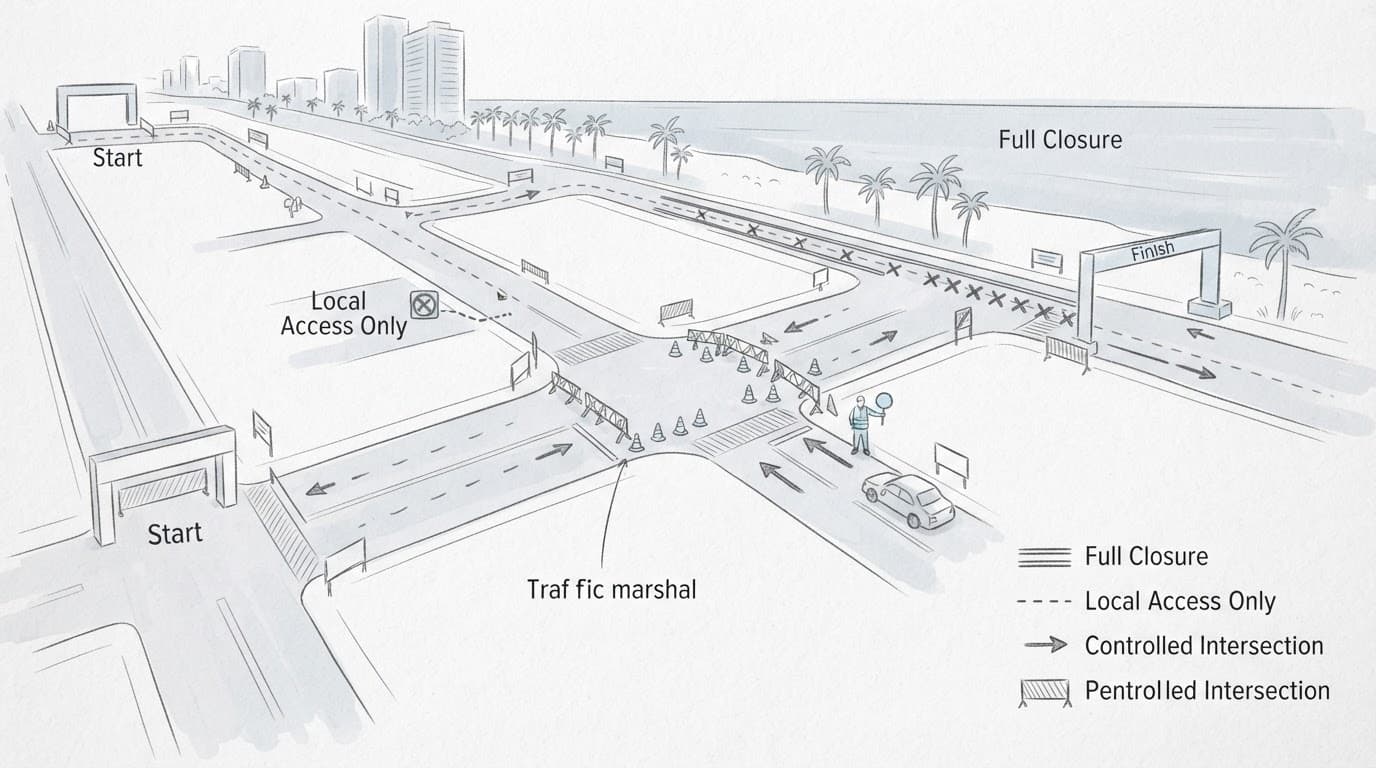
Different types of traffic restrictions
A full road closure prevents general traffic from using both directions of a street. A partial closure may keep one direction open, while a lane reduction leaves fewer lanes available and creates slower traffic.
You may also encounter these controls:
- A changed intersection allows traffic to continue straight but blocks a turn across the course.
- A no-parking zone keeps vehicles away from runners, barriers, emergency access points, and turning areas.
- A rolling closure moves with the race. Traffic stops briefly as runners approach, then reopens after the group passes.
- A traffic marshal may direct you away from a street even when the road ahead looks clear. Follow the marshal rather than attempting to pass a barrier.
A road can be open in one direction and still be unusable for your planned trip if the required turn is blocked.
Organizers use these measures because runners need a predictable, protected corridor. Limiting turning movements also prevents vehicles from crossing into the path of athletes or becoming trapped between course barriers.
Areas most likely to be affected
The greatest disruption usually occurs along the beachfront route and nearby major arterial roads. Streets around Broadbeach, Surfers Paradise, the race start, and the finish area may carry heavy pedestrian traffic and temporary barriers.
Side streets can also feel the effect. Access may close where they meet the course, especially near aid stations, recovery zones, marshal posts, and crossings used by event vehicles. A nearby parking lot or hotel entrance might remain open but require entry from a different direction.
The marathon is only one part of the weekend schedule. Wheelchair races, the half marathon, 10-kilometer event, and fun runs can create separate closure periods. Setup begins before runners arrive, while pack-down may keep barriers and traffic controls in place after the final participant finishes.
Check the official marathon road closure details before traveling. The Queensland Police marathon travel advice can also help you understand broader traffic changes.
A street may reopen in stages rather than all at once. Wait for official clearance, then expect intersections and side streets to reopen at different times.
Where and When Traffic Disruptions Are Most Likely
The busiest disruption zones usually sit where the race course meets major roads, narrow crossings, and spectator areas. Before traveling, compare your starting street with your destination street. A short trip can cross several controlled zones, even when neither location is directly on the course.
How to Read the Official Closure Map and Timetable
Start with the current official road closure map and timetable, then trace your complete journey. Look for:
- Street names and the direction affected, since one side of a road may close before the other.
- Estimated closure and reopening times, plus arrows showing detours.
- Pedestrian crossings, vehicle access points, and restricted turns near the course.
- Differences between Saturday and Sunday event schedules.
Pay close attention to the central start and finish precinct, coastal highway approaches, beachfront roads, bridges, and major crossings. Residential streets may carry diverted traffic, while race villages and spectator gathering points can become slow or difficult to pass.
Treat every reopening time as flexible. Weather, crowd movement, the final runner, medical activity, and cleanup work can extend restrictions. A road may appear empty while marshals still control access.
Save an offline copy of the map or take screenshots before leaving. Crowded areas can weaken mobile service, and navigation apps cannot help much when your phone battery is low.
Why Race Morning and Post-Race Times Can Be Different
Race-day controls begin before the official start. Crews may need time to place barriers, timing equipment, signs, cones, aid stations, and medical equipment. As a result, a road can close before sunrise, even though the first race wave starts later.
Active race closures continue while competitors use the route. Afterward, crews must wait for the final participant, remove equipment, clear barriers, and receive permission to reopen each section. Traffic may return in stages, not all at once.
For example, a resident whose driveway sits near the course might see the last runners pass at 10:00 a.m. If barriers and medical equipment remain in place, access could stay restricted beyond that time. Planning only around the race start or elite finish creates a narrow window and increases the chance of getting stuck.
Check the race weekend transport information and council traffic notices before traveling. Build extra time into both ends of your trip, especially when crossing the beachfront corridor or a major bridge.
How the Closures Affect Driving, Parking, and Public Transport
Gold Coast Marathon road closures affect more than the streets marked on the course map. A hotel driveway may be open while the road outside is blocked, and a navigation app may still direct you toward a barrier. Before leaving your hotel or home, check the latest race weekend transport information and plan the final approach on foot.
The Best Way to Reach the Start or Finish Area
Runners and spectators should arrive early, then use an approved park-and-ride location or public transport option when available. You may need to walk several blocks from a drop-off point, station, or parking area, so allow more time than your usual route requires.
Dropping a runner near a closed start zone often creates stress and unsafe congestion. Cars may stop in restricted areas, rideshare vehicles may face changed pickup points, and traffic controllers may turn vehicles around without warning. Confirm the locations of bag drop, toilets, race check-in, and meeting points before race morning.
Drivers should move vehicles before parking restrictions begin. Check for no-parking and tow-away areas, including streets near hotels, spectator zones, and course crossings. A destination can remain open while driving across the course becomes impossible, so follow traffic controllers rather than trying to bypass barriers.
Hotel guests should ask reception about driveway access, taxi instructions, luggage storage, and changed rideshare pickup areas. Workers and businesses should plan staff shifts, collect supplies early, arrange deliveries outside closure windows, and tell guests where access remains available. Keep driveways and emergency routes clear, and never move barriers or direct traffic yourself.
Planning Around the Gold Coast Light Rail and Bus Network
Public transport can reduce driving pressure, but it isn’t a guaranteed shortcut on race day. Buses and light rail services may use altered routes, skip stops, or operate with temporary access changes. Stops near the course can close, while nearby services become crowded before the race and after runners finish.
Check event-day updates for:
- Changed routes, stop closures, and replacement buses.
- First and last service times.
- Accessibility information and station access.
- Capacity limits or crowd-control measures.
Your trip may require a walk to a stop outside the closure area. Build that walk into your schedule, especially if you’re carrying a race bag, traveling with children, or using a wheelchair or mobility aid. People with accessibility needs should confirm step-free paths, working lifts, accessible drop-off points, and the safest crossing locations before setting out.
Residents with special access questions should contact the marathon organizers or City of Gold Coast through the current official process. Keep any instructions available on your phone, but follow on-site traffic controllers if conditions differ. Temporary barriers exist to protect runners and preserve emergency access.
A Simple Travel Plan for Race-Day Visitors and Spectators
Gold Coast Marathon road closures can disrupt a carefully planned morning, but a simple route plan keeps the day calm. Treat the start, finish, and viewing location as separate destinations rather than assuming you can move freely between them.
How Runners Can Protect Their Race-Morning Routine
The day before, check the latest Gold Coast Marathon closure notice and mark your hotel, start area, bag drop, finish, and meeting point. Charge your phone, save an offline map, and tell your companions exactly where you’ll meet after the race.
Leave earlier than your normal race plan allows. Closures can force hotel guests to walk to a pickup point, use a different entrance, or cover the final section on foot. If you stay in Surfers Paradise, Broadbeach, Main Beach, Southport, or a nearby suburb, don’t assume your usual route will work. Conditions may differ by street and event day.
Pack only what you need:
- Your race essentials, identification, phone, and any required medication.
- A small amount of water and breakfast you know your stomach tolerates.
- A lightweight layer or gear-bag item that follows the event’s storage rules.
Allow extra time for toilet lines, bag checks, crowded paths, and slower crossings. Walk around the course rather than cutting across it, and use official pedestrian crossings whenever available. Marshals and traffic controllers may redirect you even when the road looks clear, so follow their instructions instead of searching for a gap in the barriers.
Safer Options for Families, Older Adults, and Visitors With Disabilities
Choose an accessible path before race morning. Look for step-free routes, nearby seating, shade, toilets, and a viewing point away from the loudest barriers. Carry water, identification, essential medication, and any mobility equipment your group depends on.
Families should agree on one primary meeting place and one backup location away from the course. Mobile service can slow in crowded areas, and a child or older relative may not reach the first location. Share the plan with every companion, including the exact side of a street or landmark to use.
Spectators should reach viewing points without crossing the race line. Use official pedestrian crossings, keep moving near narrow barriers, and avoid sudden stops in front of runners or wheelchair athletes. Event staff can explain available routes, but they may not be able to create a passage through a closed section. Choose one clear path and avoid improvising when barriers or traffic controls change.
Detours, Alternate Routes, and Common Planning Mistakes
A detour only works when it carries you past the entire controlled area. Before leaving, trace the full journey, including bridges, major intersections, drop-off points, and destination parking. The fastest normal route can become the slowest option on race day if it leads toward a closed crossing or crowded spectator zone.
When Driving Is Necessary, Build a Better Backup Plan
Check your fuel, vehicle access, and parking availability before departure. Then choose a second route that avoids the closure area rather than ending at its edge. Confirm that your destination parking remains legally accessible, since a hotel garage or shopping center can sit inside a restricted zone.
Where practical, park outside the controlled area only in a legal space, then walk or use public transport for the final section. Never use a hotel driveway, service lane, or private lot as an unofficial shortcut. The latest closure update can help you check expected reopening times, but traffic controllers have priority when conditions change.
Your backup plan should include:
- At least 30 extra minutes for walking, waiting, or a longer detour.
- A second pickup location away from the start, finish, and race barriers.
- A charged phone and a way to contact companions if the original meeting point becomes inaccessible.
- A return route, since roads may remain restricted after your outward trip.
Common mistakes include leaving at the usual time, relying only on a navigation app, parking inside a restricted zone, and assuming a closure ends when the advertised race finish occurs. Drivers also forget that the return journey may face different controls.
Use this simple guide:
- Local residents: Move vehicles early and confirm driveway access in both directions.
- Airport or train travelers: Check the final walking route after transit and allow time for changed stops.
- Hotel guests: Ask reception about vehicle access, entrances, and approved pickup points.
- Employees: Arrange arrival, deliveries, and staff departure before closures tighten.
- Spectators: Select legal parking outside the course and walk to one viewing area.
How to Travel Safely Near an Active Race Course
Runners may arrive in waves, making them hard to see at intersections. Pedestrians should use marked crossings, wait for marshals, keep children close, and never step onto the course for photos.
Drivers must follow signs, police, and traffic officers. Avoid sudden turns, and never move cones or barricades. Keep controlled roads clear because emergency vehicles may need immediate access to runners, spectators, or an incident elsewhere on the course. Safety instructions from traffic controllers always take priority.
Where to Check the Latest Gold Coast Marathon Traffic Updates
Gold Coast Marathon road closures can change as weather, safety needs, and event operations develop. Use official sources in the weeks before race weekend, then repeat the check before leaving your hotel or home.
Build a Reliable Race-Day Information Checklist
Use each source for the type of update it handles best:
- The official marathon road closure page is the primary source for affected streets, closure windows, reopening estimates, and route-specific restrictions.
- The event’s race weekend transport information is useful for travel advice, expected delays, public transport arrangements, and access to start or finish areas.
- The City of Gold Coast road closure page helps identify current local closures, detours, and restrictions that may affect your route beyond the race course.
- Queensland Police travel advice can provide broader warnings about traffic conditions, crowd movement, and safety controls during the event weekend. Review the marathon travel advice from Queensland Police alongside the event notice.
- Public transport operator updates, including Translink service alerts, can show temporary stop closures, changed routes, replacement services, and station access conditions. Check the latest Translink marathon service notice rather than relying on a normal weekday timetable.
- Your hotel or accommodation provider can confirm driveway access, luggage drop-off instructions, changed entrances, and approved pickup locations. Ask before race morning, especially if the property sits near the course.
Official event social channels can also provide fast event-day updates. Treat them as a supplement to the main closure page, not a replacement for it.
Old blog posts, screenshots, crowd-sourced maps, and search snippets may describe a previous year’s plan. Even accurate information can become outdated when organizers change a closure for safety.
Complete a Final Check Before You Leave
Run through this short routine the night before, then repeat it that morning:
- Confirm the event date and make sure you are reading the current year’s notice.
- Check whether your hotel, pickup point, destination, or parking street sits in an affected suburb.
- Compare both closure and reopening times, including the return journey.
- Look for event-day updates after major weather changes or new safety warnings.
- Check public transport alerts immediately before leaving.
- Confirm hotel access and save the key map or notice offline.
If a newer official notice conflicts with your itinerary, follow the newest notice. Road controls can change when wind, heavy rain, an incident, or crowd conditions create a safety concern. Also watch the road signs near your destination, because traffic controllers may apply a temporary change that appeared after you checked online.
How Runners Can Use the Closure Plan to Race With Less Stress
Traffic planning is part of race execution. When you know when roads close, you can choose a better hotel, set your alarm, protect your breakfast routine, and arrive with enough time to warm up without rushing.
Choose Accommodation Based on Access, Not Just Distance
The closest hotel isn’t always the easiest choice during the Gold Coast Marathon road closures. A property beside the finish area may leave you trapped behind barriers, while a hotel farther away may offer a dependable walking route.
Before booking, ask about:
- Pedestrian access to the start and race precinct.
- Breakfast hours or early takeaway options.
- Luggage storage after checkout.
- Parking restrictions and garage access.
- Public transport changes and nearby stops.
- The best walking route to the start.
A slightly longer walk can be more reliable than a short drive through a closed precinct. Check the event’s official transport information and trace the route from your door, not just from the hotel entrance to the map pin.
Choose clothing for changing coastal weather. Pack a light layer you can leave in your bag, along with familiar fluids and a breakfast your stomach handles well. Knowing where the bag drop, bathrooms, and warm-up space are located keeps small decisions from draining your focus.
Build a Calm Pre-Race and Post-Race Exit Strategy
Create your race-morning timeline before race weekend. First, wake with enough margin for breakfast and hydration. Next, walk to the start, use the bathroom, drop your bag, and complete an easy warm-up. Then reach your start corral early enough to breathe and settle your pace plan.
The exact clock times will depend on the current closure schedule, so work backward from your start wave. Treat travel logistics as part of race execution, not an obstacle before it begins.
After the finish, decide where you and your companions will reunite. Choose a landmark outside the busiest finish zone, confirm how you’ll collect bags, and identify a route that remains usable if roads are still closed. Fatigue, heat, crowds, and a low phone battery can turn a vague plan into a long search.
Don’t rely on a last-minute rideshare pickup at the finish. Drivers may face blocked approaches, changed pickup points, and heavy pedestrian traffic. Walk slowly and safely away from the precinct before arranging transport.
Once you’re moving again, keep the first kilometer controlled. A calm arrival supports a calm start, and disciplined early pacing protects the energy you trained to use later in the marathon.
Choose Your Distance, Duration and Goal Time
Make three quick selections and open the exact plan built for your race target.
Looking for a Fully Personalized Training Plan?
The training plans above are an excellent choice if they match your goal. However, if you’d rather train with a plan built specifically around your current fitness, goal race, preferred training days, weekly mileage, and target finish time, our RDA Custom Training Plans provide a personalized solution. We also have running courses available for runners seeking to run faster from the mile to the marathon.
Why Choose a Custom Training Plan?
| Standard Training Plan | RDA Custom Training Plan |
|---|---|
| Follows a fixed schedule | Built around your schedule |
| Standard weekly mileage | Peak mileage customized for you |
| Fixed workout days | Train on the days you choose |
| Same structure for everyone | Designed around your current fitness |
| Static plan | Updated as your fitness improves |
| One-time purchase | Ongoing personalized coaching and support |
What You’ll Receive
- A training plan built specifically for your goal
- Personalized training paces
- Long runs, tempo runs, threshold workouts, interval sessions, recovery runs, and easy runs
- Peak weekly mileage matched to your experience level
- Flexible training schedule that fits your life
- Ongoing plan adjustments as your fitness improves
Ready to Train Smarter?
Stop guessing and start following a plan built specifically for you, your schedule, and your racing goals.
Frequently Asked Questions
Gold Coast Marathon road closures can create practical problems that a route map doesn’t always answer. These questions cover the details runners, visitors, and residents often need before race morning.
Can I cross the marathon course by car?
Usually, you can’t cross an actively controlled section by car. Traffic officers may block turns or hold vehicles until runners, wheelchair athletes, and support vehicles have passed.
A nearby intersection may look open, but the required turn could still be closed. Follow the officer’s direction and use the official detour rather than trying to find a gap in the barriers.
What time should I leave for the Gold Coast Airport?
Leave much earlier than you would on a normal weekend, especially if your route uses the Gold Coast Highway. The event’s official transport guidance warns of heavy delays between Southport and Mermaid Beach from approximately 7:00 a.m. to noon.
Check your flight’s bag-drop deadline, then add time for a longer drive, parking, and the walk into the terminal. If possible, choose a route that avoids the race corridor entirely.
Can I use rideshare during the marathon?
Rideshare services may operate, but drivers might not reach hotels or pickup points inside the controlled area. A driver may also need to stop several blocks away because barriers prevent vehicle access.
Ask your accommodation for an approved pickup location before race morning. After the race, walk outside the busiest finish zone before requesting a ride, and share a landmark that remains accessible by car.
How do I know when a closed road has reopened?
Check the official Gold Coast Marathon road closure page for scheduled times and current instructions. Reopenings are progressive, so one street may clear while the next intersection remains restricted.
Don’t move toward a barrier simply because runners have disappeared. Marshals must confirm that the course, equipment, and emergency routes are clear first.
Can residents leave homes near the course?
Driveway access depends on the street, the direction of travel, and the current safety controls. Move your vehicle before restrictions begin if you need to leave during the morning.
Residents should contact their building manager, hotel, or event organizers before race day. Keep identification and any access instructions available, but follow the traffic controller’s directions on site.
What if weather changes the closure schedule?
Rain, wind, heat, or an incident can alter traffic controls and event operations. Check official updates again before leaving, then allow extra time in case roads reopen later than scheduled.
A charged phone, offline map, water, and a backup meeting point will help when conditions change. Use the newest official notice rather than an old screenshot or navigation-app estimate.