

Gold Coast Marathon Prize Money: How Much Winners Earn & Who Qualifies
Racing along the Gold Coast means chasing a fast time beside beaches, city streets, and thousands of spectators, but elite runners have another target in sight: the finish-line payout. For professional athletes, prize money can influence race selection and reward a season of disciplined training. Serious amateurs and curious spectators also want to know what the Gold Coast Marathon prize money includes, who qualifies, and whether a strong performance can lead to more than a medal.
The amount isn’t fixed forever. The purse can change by race year, division, sponsor, and official event policy, so you should confirm the latest figures on the Gold Coast Marathon’s official website before making financial or racing plans. A clear breakdown also matters because the winner’s award is only one part of the picture; age-group prizes, performance bonuses, and non-cash rewards may follow different rules.
If you’re racing for a podium place, planning your season, or watching the elite field, accurate details help you set realistic expectations. Next, we’ll examine the current prize structure, eligibility requirements, and the performances needed to earn each type of award. Remember, ensure you book your Gold Coast Marathon hotels early to save on money too.
Key Takeaways
- The 2026 Gold Coast Marathon winner (of course, this will change pending what year you are reading this post) receives $25,000, while second and third place earn $10,000 and $5,000.
- Additional payouts cover selected finishing positions, incentive awards, and qualifying performances, so the winner’s purse isn’t the only opportunity.
- Eligibility depends on the official race rules, athlete category, qualifying standards, and compliance with event requirements.
- Review the official prize money schedule before racing because amounts and conditions can change.
- Check past Gold Coast results to compare finishing times, placings, and previous winning performances.
Gold Coast Marathon Prize Money: How the Purse Is Structured
Gold Coast Marathon prize money is usually divided by finishing position, athlete division, race category, and special performance conditions. The headline winner’s award gets the most attention, but the full purse may also include payments for podium finishers, Australian athletes, wheelchair competitors, and approved bonus achievements.
Use the latest official prize schedule before relying on any figure. Check its publication date, confirm whether amounts are listed in Australian dollars, and read the conditions beside each payment. The official entry information can also help clarify which race and athlete categories are covered.
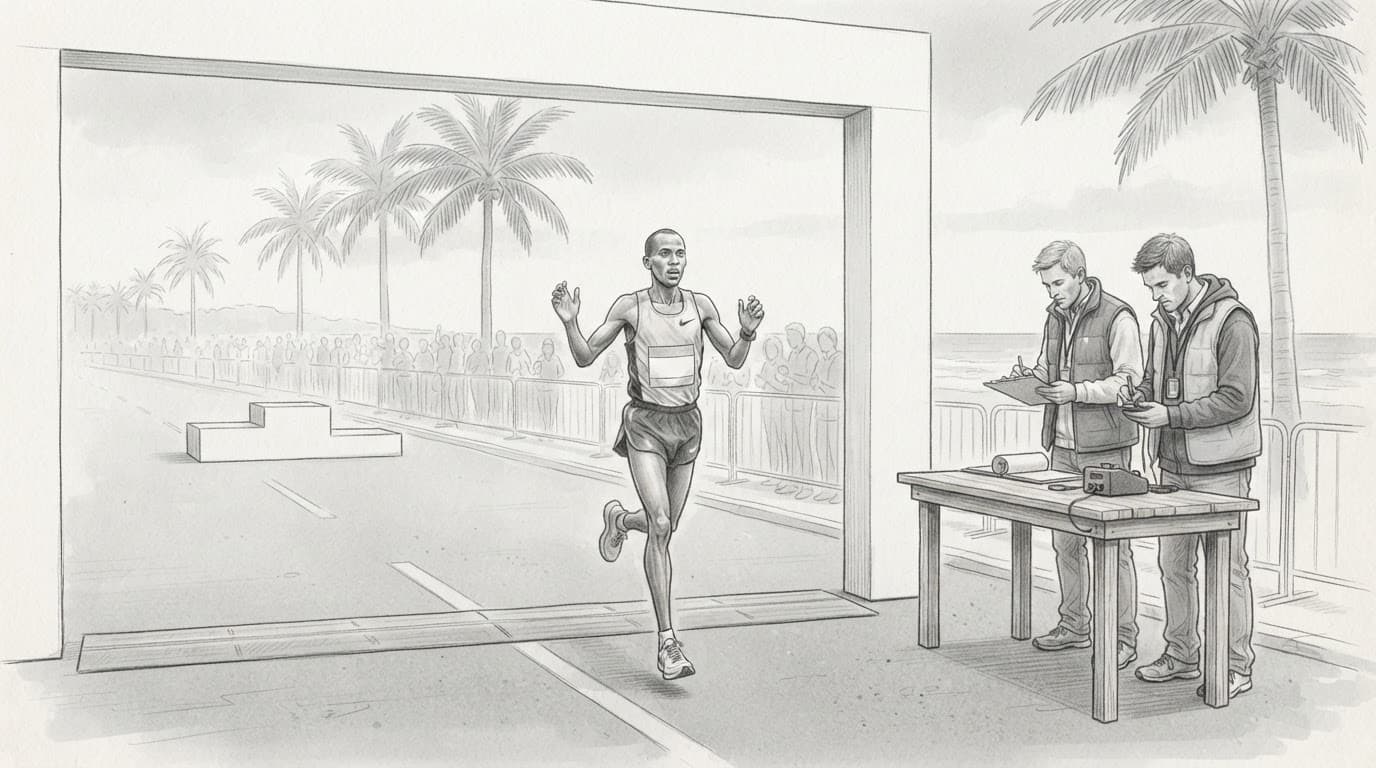
What the Marathon Winners and Podium Finishers May Receive
A published purse commonly places first, second, and third in descending order. The overall open men’s and women’s winners may have separate awards, with additional payments extending to other eligible finishing positions.
That structure doesn’t automatically cover every runner who finishes near the front. Organizers may separate:
- Open men’s and women’s results.
- Australian men’s and women’s results.
- Wheelchair or para-athlete divisions.
- Invited elite fields and other official race categories.
- Special awards listed in the current regulations.
An Australian winner could receive a national-category award, for example, while also placing in the overall open standings. Whether those awards can be combined depends on the event’s rules. Equal prize structures for men’s and women’s divisions should also be confirmed in the current schedule rather than assumed from an older race year.
A simple example shows how to read a prize table. This is illustrative only, not an official Gold Coast amount:
| Category | First place | Second place | Third place |
|---|---|---|---|
| Open men | AUD $10,000 | AUD $5,000 | AUD $2,500 |
| Open women | AUD $10,000 | AUD $5,000 | AUD $2,500 |
The example shows the hierarchy, not the actual Gold Coast Marathon prize money. Always check whether the listed currency is AUD and whether the table applies to the full marathon, a separate event, or a specific athlete class.
Bonuses for Records, Fast Times, and Special Achievements
Guaranteed finishing-place money is different from a performance bonus. A race may offer extra money for a course record, event record, Australian record, or sponsor-funded achievement. Appearance payments can also exist for selected invited athletes, but they are separate from the public finishing purse.
A fast time alone doesn’t guarantee additional money. The regulations must state the qualifying mark, eligible race category, and payment terms. Record claims may require all of the following:
- An official timing result from the approved course.
- Confirmation that the athlete followed race rules.
- Ratification by the relevant governing body.
- Completion of drug testing requirements.
- Verification that the course and timing systems met applicable standards.
If a record falls, payment may wait until officials complete those checks. An athlete should therefore separate the guaranteed award from any bonus shown in promotional material or sponsor announcements.
Does the Entry Fee Lead to a Cash Prize?
For most recreational entrants, the entry fee pays for race access and event services, not a cash award. Participants usually receive a race number, timing, course support, finisher recognition, and a medal when they complete the event.
Entering the marathon, gaining a place in an elite field, and becoming prize-eligible are three different steps. Charity runners, fun-run participants, and many age-group competitors generally receive recognition rather than purse money unless the official terms create a separate award.
Before racing for a payment, confirm the exact category, eligibility standard, placement rules, and any deadline for claiming funds. A medal is normally automatic for finishers, while prize money depends on the current regulations.
Who Qualifies for Gold Coast Marathon Prize Money?
Winning Gold Coast Marathon prize money requires more than finishing near the front. You must enter the correct event, follow the race rules, complete the approved course, and appear in the final official results. Your category also matters because overall awards, national awards, and age-group prizes can follow separate ranking systems.
Elite Entry, Open Entry, and Age-Group Awards
An invited elite athlete usually receives a place through the race’s elite-selection process. A seeded runner may have a qualifying time or approved performance that places them near the front, while a standard open entrant registers through the regular entry process. These labels describe how you enter, not whether you automatically qualify for cash.
Prize eligibility depends on the current official prize money schedule. It may limit certain awards to approved elite competitors, official open-category finishers, Australian athletes, or runners meeting stated performance standards. A fast open entrant might qualify for an overall placing, but entry status alone doesn’t guarantee payment.
Age-group awards usually work differently. Organizers rank runners within defined age bands rather than against the entire field. Check whether the race calculates age using your age on race day, your age at registration, or another published rule. Also confirm whether age-group awards are cash, merchandise, recognition, or a separate prize from the overall purse.
Nationality and residency can affect special awards. An Australian category may require citizenship, residency, or another condition, so don’t assume that living in Australia creates eligibility. Gender categories, para-athlete divisions, and duplicate-award rules can also change the final amount. Some regulations allow an athlete to collect multiple awards, while others pay only the highest applicable prize.
Gun Time, Chip Time, and Official Results
Gun time starts when the race officially begins and measures every runner against the same starting signal. Chip time, also called net time, starts when your timing chip crosses the start mat and ends when you cross the finish mat.
For a large field, chip time gives a clearer picture of an individual runner’s actual effort. However, elite podium decisions often use gun time because athletes start close to the line and race for position from the official start. A two-second difference can move one runner ahead of another when the finish is tight.
Timing data is only one part of the decision. Results may remain provisional while officials review mat records, split points, course issues, protests, and anti-doping requirements. Wait for the final classification before treating a listed placing as a confirmed payment.
Disqualifications, Protests, and Payment Requirements
A prize can be withheld if officials find course cutting, missed timing checkpoints, unauthorized assistance, an incorrect bib, or a transferred entry. Other problems include starting in the wrong event, failing to complete the full course, exceeding a time limit, or breaking conduct and equipment rules. The event terms and conditions explain how rule breaches can lead to suspension or disqualification.
Even a provisional winner may need to provide government identification, tax details, bank information, and proof of eligibility before payment. Australian and overseas athletes should also check how prize income must be reported in their own circumstances. The race organizer can confirm payment procedures, but personal tax decisions require advice suited to your situation.
How the Gold Coast Marathon Purse Compares With Other Australian Races
The Gold Coast Marathon sits among Australia’s most visible road races, but its value cannot be measured by the winner’s check alone. A runner may choose it for the purse, a fast time, strong competition, course records, or a qualifying mark that supports the next stage of a career.
The comparison below uses 2026 prize information where official figures are available. Since race purses, bonuses, and eligibility rules change, confirm the current regulations before booking travel or building a season around one event.
Prize Money Versus the Value of a Fast Gold Coast Course
Gold Coast’s flat, beachfront course gives athletes a practical advantage when conditions cooperate. Long stretches with limited elevation change make it easier to settle into an even pace, protect energy, and judge effort against a target finish time.
That course profile can matter more than a larger advertised purse for some athletes. A personal best may help a runner qualify for another marathon, meet a federation standard, improve a ranking, or gain consideration for a national team. Strong performances can also attract sponsor attention, especially when the result comes in a well-known race with broad media coverage.
Those benefits are not direct cash payments. A personal best doesn’t automatically create a bonus, and a qualifying time doesn’t guarantee selection. The result only gives the athlete a stronger credential for opportunities governed by separate standards.
For pacing, the Gold Coast course rewards discipline. A runner should establish a realistic pace before race day, account for wind and humidity, and avoid burning energy during the early kilometers. The flat profile removes some terrain-related problems, but it doesn’t remove heat, crowding, poor fueling, or an aggressive opening pace.
The official 2026 Gold Coast schedule lists AUD $25,000 for each open winner, with $10,000 for second and $5,000 for third. By comparison, the official Sunshine Coast Marathon page lists AUD $4,000 for each marathon winner, $2,000 for second, and $1,000 for third. That makes Gold Coast’s top award much larger, although the best choice still depends on field depth, travel, conditions, and an athlete’s goal.
The Real Cost of Chasing a Marathon Purse
A headline purse is gross income, not profit. Airfare, lodging, entry fees, coaching, racing shoes, nutrition, massage, recovery tools, and lost work time can reduce the return quickly. Some athletes also need a coach, manager, physiotherapist, or training partner at the event.
Use a simple estimate before committing:
Possible award - race-related costs = estimated net earnings
For example, if a runner expects AUD $5,000 but spends AUD $1,200 on travel, $600 on lodging, $250 on entry and local transport, and $500 on coaching, nutrition, and recovery, the estimated return is AUD $2,450 before taxes.
That calculation still leaves out the value of a personal best, ranking improvement, or selection standard. A runner chasing a first elite qualifying time may accept a small financial return because the performance can shape future race invitations. Another athlete may choose a closer race with a smaller purse because lower expenses create a better net result.
Gold Coast’s public prize and incentive schedule should be compared with the official Sunshine Coast prize details, not with promotional headlines alone. Read the conditions beside each award, then compare the likely competition, course speed, exposure, and total trip cost. The largest purse is only the best opportunity when you have a realistic chance to reach the paid positions.
How to Confirm the Latest Gold Coast Marathon Payouts Before Race Day
Gold Coast Marathon prize money can change with the race year, athlete category, sponsor conditions, or updated regulations. Before you build travel plans around a possible payout, verify the details through official event channels and save the evidence.
The safest process is simple: find the current prize schedule, compare it with the race regulations, then ask the organizer about anything unclear.
What to Look for in the Official Prize Schedule
Start with the official Gold Coast Marathon website, especially its elite athlete information and linked prize documents. Confirm that the document shows the correct event name and race year. A page that says “2026” may still link to an older PDF, so check the date and document title carefully.
Read the full table rather than stopping at the winner’s award. Look for:
- Award categories, including open men, open women, Australian athletes, wheelchair competitors, and other listed divisions.
- Place-by-place amounts, including payments beyond first, second, and third.
- Record bonuses, fast-time incentives, appearance payments, or sponsor-funded awards.
- Nationality, citizenship, residency, or eligibility rules for special categories.
- The timing standard, such as gun time or chip time, used to rank paid places.
- Rules for ties, dead heats, corrected results, disqualifications, and protests.
- Tax requirements, identification documents, and the payment method.
- Payment deadlines, claim deadlines, and the time required for final verification.
A prize table may cover only the elite marathon. It might not apply to the half marathon, 10-kilometer race, wheelchair race, age-group awards, or other events held during the same weekend. Check the heading above the table and the conditions below it before assuming every race shares the same purse.
Save the PDF, print the relevant pages, or take a screenshot that includes the document date and URL. If the page changes after race day, your copy gives you a clear reference when discussing an eligibility or payment question.
Also compare the schedule with official past results. Results can show how the event labels divisions and finishing places, but they don’t replace the current prize rules.
Questions to Ask the Race Organizer
If the website leaves a gap, contact the race organizer before you enter or travel. Ask direct questions that produce a clear answer:
- Is the listed prize money guaranteed, or does it depend on sponsor funding, field size, or final approval?
- Can a finishing-place award and a record or performance bonus be combined?
- If two athletes tie, do they split the money, receive equal awards, or follow another rule?
- Does gun time decide paid places, or does the organizer use chip time?
- When will payments be made, and what documents must the athlete submit?
- Do overseas athletes need tax forms, identity documents, bank details, or other paperwork?
- Does the award apply to the marathon only, or also to another race or division?
Request written confirmation by email when the answer affects your entry decision or expected income. Keep the message, reply, and attached regulations together with your saved prize schedule.
Only the current organizer or official event regulations can settle a disputed payout. A blog post, social media claim, or third-party race listing may provide a useful lead, but it cannot override the rules published for the current Gold Coast Marathon.
Choose Your Distance, Duration and Goal Time
Make three quick selections and open the exact plan built for your race target.
Looking for a Fully Personalized Training Plan?
The training plans above are an excellent choice if they match your goal. However, if you’d rather train with a plan built specifically around your current fitness, goal race, preferred training days, weekly mileage, and target finish time, our RDA Custom Training Plans provide a personalized solution. We also have running courses available for runners seeking to run faster from the mile to the marathon.
Why Choose a Custom Training Plan?
| Standard Training Plan | RDA Custom Training Plan |
|---|---|
| Follows a fixed schedule | Built around your schedule |
| Standard weekly mileage | Peak mileage customized for you |
| Fixed workout days | Train on the days you choose |
| Same structure for everyone | Designed around your current fitness |
| Static plan | Updated as your fitness improves |
| One-time purchase | Ongoing personalized coaching and support |
What You’ll Receive
- A training plan built specifically for your goal
- Personalized training paces
- Long runs, tempo runs, threshold workouts, interval sessions, recovery runs, and easy runs
- Peak weekly mileage matched to your experience level
- Flexible training schedule that fits your life
- Ongoing plan adjustments as your fitness improves
Ready to Train Smarter?
Stop guessing and start following a plan built specifically for you, your schedule, and your racing goals.
Frequently Asked Questions
Gold Coast Marathon prize money can include several award categories, and each one may follow different eligibility and payment rules. Because the schedule can change each race year, check the current official prize and incentive schedule before relying on any payout figure.
How much money does the Gold Coast Marathon winner receive?
The winner’s exact award depends on the official prize schedule for that race year. Gold Coast Marathon prize money can change because of sponsorship arrangements, event policy, or changes to the race’s award structure.
Check the current schedule on the official event website for the amount in Australian dollars. Read the conditions beside the winner’s award as well, since the listed figure may apply only to a particular division or require final verification.
Is there prize money for the Gold Coast half marathon?
The half marathon can have a separate award structure from the full marathon. Its prizes may cover championship categories, selected finishing positions, or recognition that differs from the open marathon purse.
Look for the half marathon section in the current official regulations and prize schedule. The document should clarify whether an award is paid in cash, offered as a product, or limited to athletes who meet championship or category requirements.
Can an amateur runner win Gold Coast Marathon prize money?
A runner doesn’t always need professional status to qualify for a paid placing. The result depends on the official ranking, entry category, timing method, eligibility rules, and compliance with the race regulations.
An amateur who finishes high enough in an eligible open category may have a valid claim. Still, most recreational runners compete for a personal best, a finisher medal, or age-group recognition rather than the elite purse. Before race day, confirm whether your entry type can appear in the results used for prize awards.
Do age-group winners receive cash awards?
Age-group prizes vary by race year, age category, and event policy. Some awards may include cash, while others provide medals, merchandise, products, or public recognition.
Don’t assume that every age-group winner receives money. Check the current official award list and confirm how organizers determine age, whether awards are presented at the event, and whether a separate claim process applies.
Are Gold Coast Marathon bonuses paid separately from place money?
Record and performance bonuses may be separate from the standard finishing-place award. A runner could earn a bonus for meeting a stated mark or setting an approved record, but the rules must define the qualifying performance.
Bonuses may require official timing, course verification, result confirmation, or anti-doping checks. Also review the stacking rules, because some schedules allow multiple awards while others pay only one applicable amount.
When is marathon prize money usually paid?
Organizers commonly pay prize money after officials confirm the final results and the athlete submits the required documents. Those documents may include identification, tax information, eligibility evidence, and accurate bank details.
Payment timing can differ for Australian and international athletes. Banking procedures, tax requirements, currency transfers, protests, and anti-doping checks may delay an overseas payment. The official regulations or payment terms should state when claims are processed and what each athlete must provide.
Conclusion
The Gold Coast Marathon offers more than a finish-line payout. Its flat beachfront course can help serious runners chase a personal best, test themselves against a strong field, or pursue a qualifying performance. However, the advertised Gold Coast Marathon prize money is only useful when you meet the event’s category, timing, eligibility, and payment requirements.
Prize amounts, bonuses, and award conditions can change with each race year. Travel, lodging, entry fees, coaching, and other expenses also affect the money an athlete may actually keep. Compare the potential payout with the full racing opportunity, including course speed, competition, qualifying potential, and total trip cost.
Before booking travel or building a race plan around a projected award, confirm every detail in the current official prize schedule and event regulations. The beachside finish may provide the setting for a major performance, but only the latest rules can confirm what that performance is worth.


