Finish Time Predictor Calculator Benefits
So you’ve signed up for your next big race, and you’re wondering what kind of time you can actually expect to hit. Guessing is no fun, and it can mess up your training. That’s where a finish time predictor calculator comes in handy. It uses your past race results to give you a pretty solid idea of what you might run for a different distance. Think of it as a smart way to set realistic goals and train smarter, not just harder.
Key Takeaways
- A finish time predictor calculator uses your past race data to estimate your finish time for a different distance.
- The most common method uses Riegel’s formula, which accounts for pace slowing down over longer distances.
- For the best results, use a recent race time (within 2-3 months) from a similar type of race (e.g., road to road).
- Predictors are great for setting race goals, figuring out training paces, and deciding which race distance to aim for.
- Remember that predictions are estimates; factors like training specificity, race day conditions, and pacing strategy can affect your actual finish time.
Understanding Your Finish Time Predictor Calculator
Ever wonder what kind of time you could hit in a half marathon if your last 5K felt pretty good? Or maybe you’re eyeing a marathon and want a realistic target based on your recent 10K performance. That’s exactly where a finish time predictor comes in handy. It takes a race result you’ve already achieved and uses it to estimate your potential finish time for a different distance. Think of it as a smart guess, but backed by some solid math.
What a Finish Time Predictor Does
Basically, this tool helps you figure out what you’re capable of. You plug in a time from a race you’ve recently completed – say, a 5K – and tell it what distance you’re interested in next, like a 10K or even a half marathon. The calculator then spits out a predicted finish time for that new distance. It’s super useful for setting actual goals. Instead of just picking a number out of thin air, you get a target that’s based on your current fitness. This means your training plan, how you decide to fuel on race day, and your overall strategy can all start from a place that’s actually achievable.
The Science Behind the Predictions
So, how does it actually work? The most common method uses something called Riegel’s Formula. It’s a mathematical equation developed by a researcher named Peter Riegel, and a lot of running coaches and scientists use it. The formula looks like this:
T₂ = T₁ × (D₂ / D₁) ^ 1.06
Let’s break that down a bit. T₁ is the time you took for your recent race, and D₁ is the distance of that race. D₂ is the distance you want to predict a time for, and T₂ is the predicted time. That little number, 1.06, is important – it’s like a built-in fatigue factor. It acknowledges that as a race gets longer, your average pace naturally slows down because your body accumulates fatigue. This formula generally works pretty well for most standard race distances, from a 1K all the way up to a marathon.
Riegel’s Formula Explained
To make Riegel’s formula a bit more concrete, let’s look at an example. Imagine you recently ran a 10K in 45 minutes. If you wanted to predict your potential half marathon time, you’d plug those numbers in. The formula accounts for the increased distance (D₂/D₁) and adds that 1.06 exponent to factor in the extra effort and fatigue over the longer distance. The result gives you a projected finish time for the half marathon.
It’s important to remember that the further apart the distances are, the more other factors start to play a role. Predicting a marathon time from a 5K result is less precise than predicting a 10K time from that same 5K result, because endurance plays a much bigger part in the longer race.
Here’s a quick look at how predictions might shake out based on a 5K time:
| 5K Time | Predicted 10K Time | Predicted Half Marathon Time | Predicted Marathon Time |
|---|---|---|---|
| 20:00 | 41:29 | 1:31:46 | 3:11:51 |
| 25:00 | 51:51 | 1:54:48 | 3:59:53 |
| 30:00 | 1:02:14 | 2:17:20 | 4:46:49 |
While Riegel’s formula is a great starting point, it’s a mathematical model. It doesn’t know about your specific training, how you feel on race day, or the weather. Think of the prediction as a strong guideline, not a guaranteed outcome.
Maximizing Prediction Accuracy
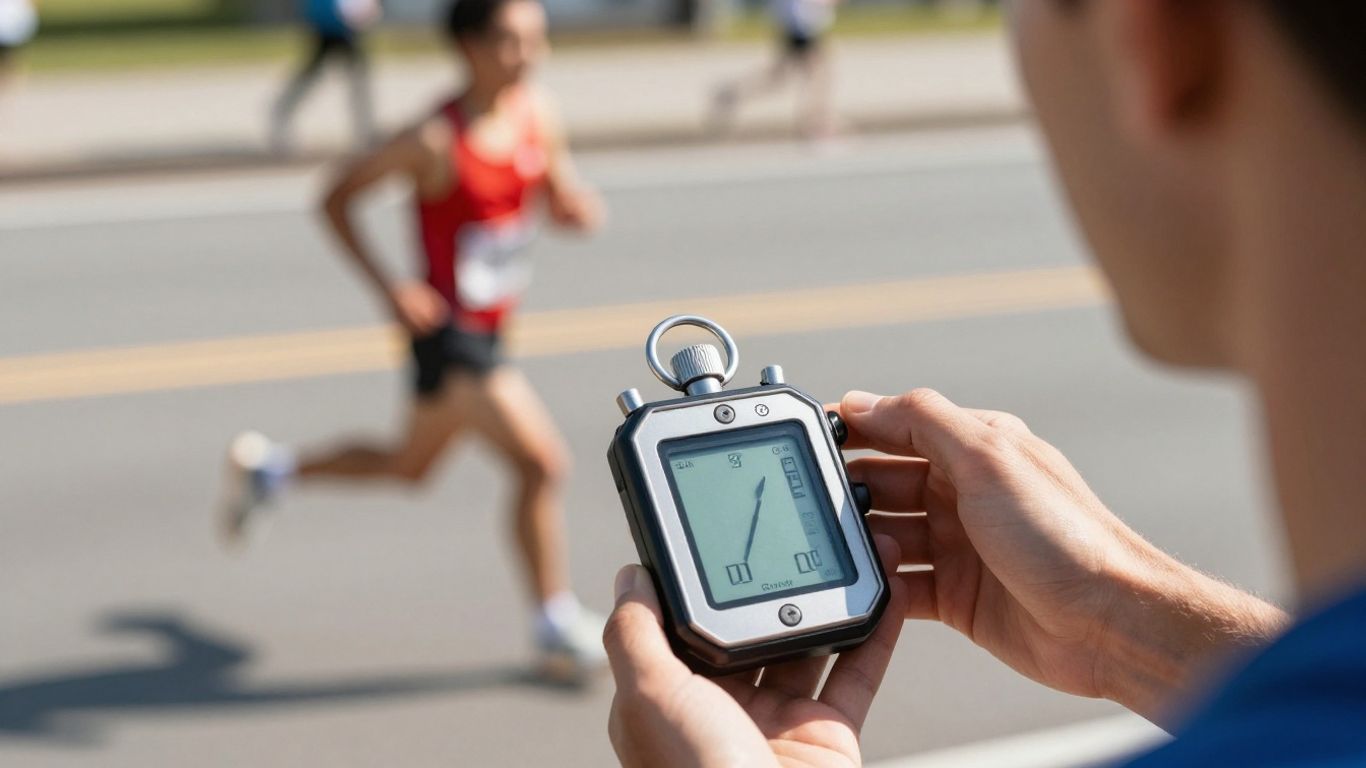
So, you’ve got a race coming up and you’re eager to see what you might run. That’s where a good prediction calculator comes in handy. But just plugging in any old number won’t cut it. To get a prediction that’s actually useful, you need to be smart about the data you feed it. The accuracy of your predicted finish time hinges on the quality of your input.
Choosing the Right Recent Race Result
This is probably the most important step. Think of it like this: if you’re trying to predict how well you’ll do on a test next week, you wouldn’t use your scores from last year, right? You’d use your most recent quiz or homework grades. The same applies here. You want to use a race result that truly reflects your current fitness level.
Ideally, this means a race you completed within the last two to three months. If your training has changed a lot since then – maybe you’ve focused more on speed or endurance – even a result from a few months ago might be a bit out of date.
Also, make sure the race you use was a genuine, all-out effort. A time from a training run, even a hard one, or a casual jog with friends, won’t give you the same accurate picture as a race where you pushed yourself to the limit. The calculator assumes you gave it your best shot.
Matching Race Types for Reliability
This is a big one that often gets overlooked. If you’re training for a road marathon, using a recent road 10K time for your prediction is going to be way more reliable than using a time from a hilly trail race. Why? Because different race types have different variables. Trail races can have tricky terrain, significant elevation changes, and technical sections that slow you down compared to a smooth, flat road course. The formulas used for prediction are generally based on road running. Trying to predict a road race time from a trail race, or vice versa, introduces too many unknowns that the calculator can’t account for.
Here’s a quick guide:
- Road Race Input: Best for predicting other road race times.
- Trail Race Input: Best for predicting other trail race times (though predictions might be less precise than road-to-road).
- Track Race Input: Can be useful for shorter distances, but less ideal for predicting longer road races due to different pacing dynamics.
Considering Distance Ratios
Predicting a 10K time from a recent 5K is usually pretty accurate. The distances are close enough that the physiological demands are similar, just scaled up. However, the further apart the distances are, the less reliable the prediction becomes. For example, predicting a marathon time from a 1-mile race result is going to be a wild guess. That’s because running a marathon involves a whole different set of challenges – endurance, fuelling strategy, mental toughness, and specific long-run training – that aren’t really tested in a short sprint. The further you stretch the distance ratio, the more other factors come into play that the basic formula doesn’t capture.
The further the gap between your input race distance and your target race distance, the more likely your actual performance will deviate from the prediction. This is because longer races demand different physiological and mental adaptations that aren’t fully represented in shorter race results.
Leveraging Predictions for Race Success

So, you’ve crunched the numbers and got a predicted finish time. Awesome! But what do you actually do with that number? It’s not just about bragging rights; this prediction is a powerful tool for making your next race a success. Think of it as a roadmap, guiding your training and race-day strategy.
Setting Realistic Race Goals
This is probably the most common reason people use a predictor. Instead of just picking a time out of thin air, you get a number that’s actually based on your current fitness. This means you’re not setting yourself up for disappointment by aiming too high, nor are you leaving potential performance on the table by aiming too low. It gives you a solid target to work towards.
- Avoids burnout: Training for a goal that’s too ambitious can lead to overtraining and injury.
- Maximizes potential: A realistic goal pushes you to train effectively without being unrealistic.
- Boosts confidence: Hitting training milestones towards a well-defined goal feels great.
A predicted time acts as a realistic anchor. It helps ensure your training plan is aligned with what you can actually achieve, making the whole process more enjoyable and effective.
Calculating Training Paces
Once you have that target finish time, you can work backward to figure out what paces you need to hit in your training. This is where the prediction really shines. Coaches often use these predicted times to build out entire training plans. You’ll know what pace to aim for during your tempo runs, your interval sessions, and even your long runs.
Here’s a general idea of how paces might break down, using a hypothetical predicted marathon time:
| Training Type | Pace Relative to Predicted Marathon Pace |
|---|---|
| Easy/Recovery | 1:00-1:30 min/mile slower |
| Marathon Pace | At predicted marathon pace |
| Tempo/Threshold | 0:20-0:30 min/mile faster |
| Intervals | 0:45-1:00 min/mile faster |
This structured approach means every workout has a purpose, directly contributing to your race goal.
Informing Race Distance Choices
Sometimes, you might be on the fence about which race distance to sign up for. Should you go for the 10K or step up to the half marathon? Use the predictor! Plug in a recent result and see what your predicted times are for both distances. If your predicted half marathon time is something you’re excited about and feels achievable with dedicated training, it might be the push you need to commit to that distance. Conversely, if the predicted times for both feel a bit too ambitious, it might be a sign to stick with a shorter distance for now and build your base.
Limitations and Considerations
While finish time predictors are super helpful, they aren’t magic wands. It’s important to remember that these calculators give you an estimate, not a guarantee. A lot of things can throw off even the best prediction.
The Role of Training Specificity
Think about it: if you’ve been training for a hilly 10k, your predicted time for a flat half-marathon might be a bit off. The calculator doesn’t know the specifics of your training. Did you focus on speed work? Long, slow miles? Hills? The type of training you’ve done matters a lot.
- Focus on the race distance: If you’re aiming for a marathon, your training should include long runs that mimic that distance.
- Mimic race conditions: If your target race is known for its hills, make sure your training includes hill work.
- Pace variety: Incorporate different paces in your training, not just one steady speed.
Impact of Race Day Conditions
Race day itself can be a wild card. Weather is a big one. A super hot and humid day can slow you down significantly, no matter how well you trained or what the predictor says. Similarly, a strong headwind or unexpected rain can change everything.
Here’s a quick look at how conditions might affect your race:
| Condition | Potential Impact on Time |
|---|---|
| Extreme Heat | Significant slowdown |
| High Humidity | Noticeable slowdown |
| Strong Headwind | Moderate slowdown |
| Icy/Slippery | Significant slowdown |
| Downhill Finish | Slight improvement |
Understanding the Fatigue Factor
This is a big one that calculators can’t really account for. How tired are you really going into the race? If you’ve had a super demanding week at work, or you didn’t sleep well the night before, your body might not perform at its peak, even if your training has been spot on. The predictor assumes you’re starting from a place of good recovery. Don’t ignore how you feel on race morning.
Sometimes, the best predictor is simply how your body feels. If you’re feeling sluggish, it might be wise to adjust your race day goals slightly, rather than pushing for a time that seems mathematically possible but physically out of reach.
Advanced Prediction Strategies
So, you’ve got a handle on the basics of race time prediction. But what if you want to get even more dialed in? There are a couple of ways to push the accuracy of these predictions further, especially if you’re a runner who likes to have all the data points.
Using Multiple Input Results
Sometimes, relying on just one recent race result feels a bit… limiting. What if you’ve got a couple of solid performances under your belt from different distances? Using multiple inputs can give you a more robust picture of your current fitness. Instead of a single predicted time, you’ll get a range. This can be super helpful for setting realistic goals, as it acknowledges that different race types and distances might show slightly different fitness levels.
For example, if you ran a fast 5K last month and a solid 10K a few weeks before that, plug both into the predictor. See what times you get for your target race distance from each. If both predictions fall within, say, a two-minute window, you can be pretty confident that’s a realistic target. If they’re wildly different, it might be worth looking at why – maybe one race was on a tougher course, or your training was more focused on one distance over the other.
Predicting Custom Distances
Most predictors work with standard race distances, but what if you’re training for something a little off the beaten path? Maybe a 15K, or a 50K ultra? Riegel’s formula, the backbone of many predictors, is pretty flexible. You can often input custom distances for both your known race (D₁) and your target race (D₂). This means you’re not limited to just predicting a half marathon from a 10K; you can get a sense of your potential for almost any distance.
Just remember, the further apart your input distance and target distance are, the more other factors come into play. Predicting a marathon from a 1-mile time is going to be way less accurate than predicting a 10K from a 5K. The formula is great for estimating potential, but it can’t account for the specific endurance, fueling, and mental grit required for ultra-distances without proper training.
When to Use a Predictor vs. Pace Calculator
This is a common point of confusion, but it’s pretty straightforward once you break it down. Think of them as tools for different stages of your race preparation.
- Race Time Predictor: This is your goal-setting tool. You use it before you start a specific training block for a new distance. It answers the question: “Based on my current fitness, what’s a realistic finish time I could aim for?”
- Pace Calculator: This is your race-day strategy tool. You use it in the final weeks leading up to your race, once you have a target time (likely set using the predictor!). It answers the question: “To hit my target time, what pace do I need to run each mile or kilometer at?” It helps you break down that big goal into manageable chunks.
So, the typical flow is: use a predictor to set a smart goal, train hard towards it, and then use a pace calculator to figure out exactly how to execute on race day. They work best together, not as replacements for each other.
Closing Thoughts
Using a race time predictor is a pretty straightforward way to get a handle on what you might be capable of in your next race. It’s not magic, and it won’t account for a bad night’s sleep or a sudden downpour on race day, but it gives you a solid starting point. Remember to use a recent, honest effort when you plug in your numbers. This tool is best used to set realistic goals and plan your training paces, not as a crystal ball. Give it a try for your next race and see how it helps you aim for a finish time that’s both challenging and achievable.
Frequently Asked Questions
What exactly does a race time predictor do?
A race time predictor is like a crystal ball for runners! It takes a time you’ve already achieved in a race and uses that information to guess how fast you might finish a different race distance. Think of it as figuring out your potential for a half marathon based on how you ran a 5K.
How does the predictor figure out my future race time?
It uses a math formula called Riegel’s formula. This formula is pretty smart because it knows that as you run longer distances, your pace naturally slows down a bit. It takes your past race time and distance, and applies a ‘fatigue factor’ to estimate your time for a new distance.
What’s the best kind of race result to use for a prediction?
For the most accurate guess, use a result from a race you ran pretty hard, ideally within the last 2 or 3 months. It should be a real race, not just a casual training run. Also, try to match the type of race – a road race result is best for predicting another road race.
Can I use this to predict my time for any race distance, even unusual ones?
Absolutely! Most predictors let you enter custom distances. So, if you want to know how you might do in a 15K or even a 20-miler, you can enter that in. It’s super helpful for planning training for races that aren’t the standard 5K, 10K, or marathon.
Why might my predicted marathon time seem too fast?
The formula is great at showing what your body is *capable* of, but it doesn’t know if you’ve actually trained for that specific distance. Running a fast 5K doesn’t automatically mean you’ll run a fast marathon without the long runs and endurance training needed. The prediction is a potential, not a promise!
How is a race time predictor different from a pace calculator?
They do different jobs! A predictor tells you what finish time you might achieve. A pace calculator takes a goal time you already have and tells you exactly what speed (pace) you need to run each mile or kilometer to hit that goal. You use the predictor to set your goal, then the pace calculator to plan how to get there on race day.