

Dublin Marathon Finish Time: Pace Chart, Cutoff & Goal Times
When you search for a Dublin Marathon finish time, you may be checking the official time limit, estimating your own result, comparing past performances, or building a race plan around a target. The phrase can mean several things, including gun time, chip time, a qualifying standard, or the course cutoff, so knowing which measurement applies matters.
Your expected finish depends on pace, training, race-day execution, and the demands of the course. This guide connects finish times with pace conversions, practical pacing decisions, course factors, and proven ways to improve your result. First, let’s clarify the key Dublin Marathon time limits and how they affect your race plan. Remember, be sure to book your Dublin Marathon hotels months in advance to ensure you get the lowest prices possible.
Key Takeaways
- Your Dublin Marathon finish time depends on pace, endurance, course conditions, and how well you manage effort after halfway.
- Use a pace chart to match your target time with realistic mile and kilometer splits before race day.
- The official race cutoff matters, so confirm the latest rules in the Dublin Marathon event information before planning your strategy.
- Pacers run at 10-minute intervals, giving you a practical reference for steady pacing and goal selection.
- Start conservatively, protect your energy early, and build your race around a finish time your training supports.
What Does a Dublin Marathon Finish Time Include?
A Dublin Marathon finish time can refer to more than the number shown on the finish-line clock. Your result may include gun time, chip time, intermediate split times, and an official status based on the race rules for that year. The marathon distance is 26 miles and 385 yards, commonly rounded to 26.2 miles, so even small pacing errors can add several minutes by the finish.
Gun Time, Chip Time, and Your Official Result
Gun time begins when the race officially starts, when the starting signal sounds. It continues whether you have crossed the start line or not. Chip time, also called net time, begins when your timing chip crosses the start mat and ends when you cross the finish mat.
That difference can matter in a large field. If you start near the back, you may spend several minutes moving toward the line after the gun has already fired. A runner with a 4:00:00 chip time could show a noticeably slower gun time, even though both clocks measure the same race.
For personal pacing and performance, chip time is commonly the most useful figure. It measures how long you were actually running the course and usually forms the basis for an individual personal record. The Dublin Marathon’s official FAQ describes official timing and scoring in terms of net time, but you should still review the event information for your race year.
Gun time can matter for certain awards, rankings, or qualification standards. Some competitions rank runners by who crosses the line first, while particular qualifying rules may require gun time rather than net time. Age-group results can also follow the event’s published scoring policy, so don’t assume that the fastest chip time always determines every placing.
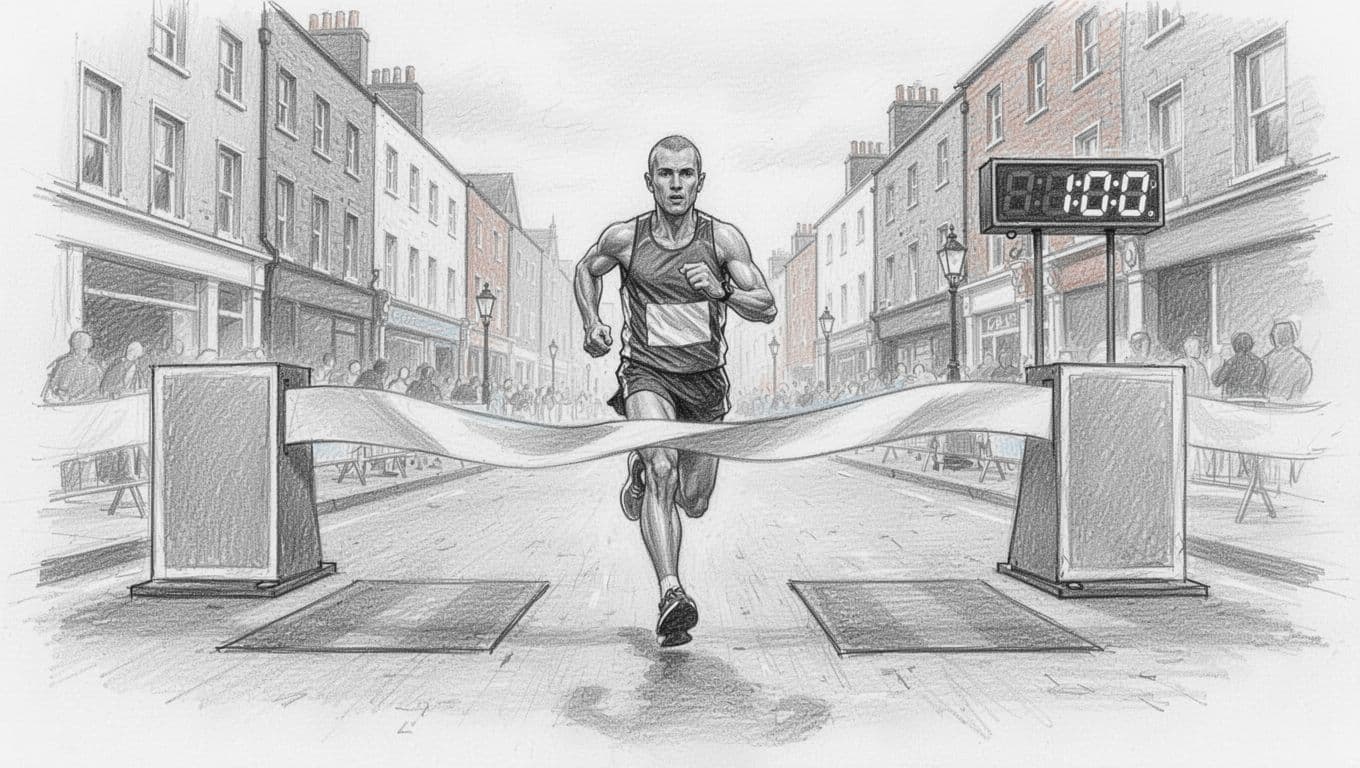
Timing mats record your progress at the start, finish, and any intermediate checkpoints placed around the course. Your published result can differ slightly from your GPS watch because the watch may measure extra distance around turns, crowded sections, or tangents. Buildings, trees, and signal loss can also affect GPS accuracy.
The Dublin Marathon Course Limit and Cutoff Rules
A course time limit tells you how long race operations can remain in place. It may affect more than your finish. Organizers can use checkpoint cutoffs, reopen roads on a set schedule, or limit aid-station and medical support after certain times.
As a result, a runner who expects to finish close to the limit should check the latest Dublin Marathon rules and regulations and current participant information before race day. Don’t rely on a cutoff quoted in an older training plan, forum post, or previous race report.
If your projected finish is close to the published limit, build in a small buffer. Start in the correct wave, avoid unnecessary delays early, and confirm what happens if you miss a checkpoint. The official Dublin Marathon results page can also help you understand how finish statuses and recorded times appear after the race.
Dublin Marathon Finish Time Benchmarks for Different Runners
A good Dublin Marathon finish time depends on your starting point, training history, age, and race-day conditions. A first marathon completed under six hours can be a major achievement, while an experienced runner may judge success by breaking three hours or setting a personal best.
Use these benchmarks as reference points, not rigid labels. Weather, course demands, pacing errors, and the distance you covered in training can change what a strong performance looks like.
What Counts as a Good Marathon Time?
For a beginner, 5:00 to 6:00 can be a realistic and rewarding range. Finishing your first marathon healthy, staying in control, and learning how your body responds after 20 miles are meaningful goals. A runner who completes Dublin in 5:45 after consistent preparation may have executed a better race than someone who starts too fast and struggles to finish in 5:15.
Recreational runners often target 4:30 to 5:00, while intermediate runners may chase 4:00 to 4:30. Breaking four hours requires holding roughly 9:09 per mile, or 5:41 per kilometer, and usually demands disciplined training, sensible fueling, and steady pacing.
More experienced runners may target 3:30, which requires about 8:00 per mile, or 3:00, which requires approximately 6:52 per mile. Those times are strong benchmarks, but they don’t define every runner’s success. An athlete returning from injury may value a controlled 4:15 more than an aggressive attempt at 3:45.
Competitive runners may pursue an age-group placing, while elite athletes race for front-pack positions and times well below three hours. Your goal should match the work your training supports, not the result printed beside another runner’s name.
Boston qualification can provide another target, but the standards depend on age, gender, and the relevant race year. Meeting the published standard also doesn’t guarantee entry because Boston uses a qualifying process and available field size.
Typical Finish-Time Ranges and Percentile Context
Broad marathon averages can help you understand where a Dublin Marathon finish time sits among other results. A 4:00 finish is faster than many recreational marathon results, while 3:30 usually indicates several years of structured training. A 6:00 finish still places a runner among those who completed a demanding endurance event.
Percentiles offer useful perspective, yet they require careful interpretation. Results can shift because of:
- The size and experience level of the race field.
- Weather, wind, heat, and humidity on race day.
- Course design, elevation changes, and crowded sections.
- Whether the source includes every starter or only finishers.
For accurate historical comparisons, use the official Dublin Marathon results for the specific race year. Compare finishers in your age group and estimate your position by percentage, rather than treating an internet-wide average as a universal standard.
How Finish Time Changes With Age and Experience
Age-group performance deserves respect at every level. Many runners improve after 40 because they develop better pacing, fueling habits, and training consistency. Age grading can add useful context by comparing a performance with the accepted best time for a runner’s age and gender.
Experience also changes the meaning of a result. A first-time marathoner running 4:30 may have shown excellent endurance, while a veteran runner may view 4:30 as a difficult day. Comparing those performances directly ignores years of adaptation, race judgment, and accumulated training.
Your clearest benchmark is often your own history. Track your finish time, pacing pattern, recovery, and how well you handled the final 10K. A faster result matters, but a controlled race that builds confidence can be the better platform for your next Dublin Marathon.
Dublin Marathon Pace Chart: Turn Your Goal Into a Finish Time
Your target finish becomes useful when you convert it into a pace you can recognize on the course. Use the chart below for planning, then adjust slightly for aid stations, turns, crowding, GPS error, bathroom stops, and the need to run the shortest legal tangents.
Goal-Time Examples From Three Hours to Six Hours
These are rounded planning paces, not strict commands for every mile. A runner targeting a specific finish should avoid starting faster than goal pace, even when the opening miles feel easy.
| Goal finish | Average pace per mile | Average pace per kilometer |
|---|---|---|
| 3:00 | 6:52 per mile | 4:17 per km |
| 3:30 | 8:00 per mile | 4:58 per km |
| 4:00 | 9:10 per mile | 5:41 per km |
| 4:30 | 10:18 per mile | 6:25 per km |
| 5:00 | 11:26 per mile | 7:07 per km |
| 5:30 | 12:35 per mile | 7:50 per km |
| 6:00 | 13:44 per mile | 8:32 per km |
Marathon pace is an average across 26.2 miles. You may lose a few seconds at a water station, slow around a sharp turn, or spend extra time moving through a crowded section. Your GPS watch may also show more than 26.2 miles, so use official course markers for major pacing decisions.
Build a small buffer into your plan rather than chasing every second. Running wide on corners, stopping for a bathroom break, or weaving around runners can add distance. A goal of 4:00, for example, requires more than simply holding 9:10 on a watch for every mile.
Use Negative Splits Instead of Chasing the Clock Early
A safer pacing model divides the race into three parts. Run the first half under control, settle into steady effort through the middle miles, then aim to increase your effort during the final 10K if your legs and breathing remain strong.
Banking time early rarely works as planned. Running 20 seconds per mile too fast can feel harmless before halfway, but the cost appears later as heavy legs, walking, or a large positive split. Those lost minutes usually outweigh the small gain from an aggressive opening.
Weather and course conditions also change the correct pace. In wind, rain, heat, or on hills, protect your effort instead of forcing the number on your watch. Crowding may require patience in the first miles. Recover time gradually on clearer, flatter sections when your breathing settles.
A controlled first half gives you choices late in the race. An overly fast first half often removes them.
Fueling, Hydration, and the Final 10K
Pacing alone cannot secure your planned Dublin Marathon finish time. Practice your carbohydrate intake during long runs, take fluids regularly, and use gels or sports drinks your stomach already accepts. Race day is the wrong time to test an unfamiliar product or food.
Your needs depend on body size, sweat rate, weather, pace, and personal tolerance. Follow the approach that worked in training, while avoiding long gaps without fluid or carbohydrate. The final 10K often exposes both pacing and fueling mistakes. Runners who conserve energy early and maintain practiced nutrition give themselves a better chance of holding pace when fatigue arrives.
How Dublin’s Course and Race-Day Conditions Affect Your Time
A Dublin Marathon finish time cannot be predicted from pace alone. Your watch may show the right number, yet turns, crowding, wind, road surface, and late-race fatigue can still change the result. Study the current course information, then match your pace plan to the conditions you actually face.
Read the Course Map Before You Race
Break the route into manageable sections instead of carrying all 26.2 miles in your head. Mark the start, halfway point, major turns, aid stations, and the final 10K on your printed map or race notes. Each landmark gives you a short checkpoint and keeps one difficult patch from dominating your thoughts.
Review the official course map and elevation profile for the current event because details can change between race years. A turn may arrive earlier than expected, a narrow section may slow the field, or an aid station may sit in a different location. The official race information should always take priority over an old race report or training plan.
Use landmarks to plan effort rather than demanding identical splits everywhere. A crowded opening may require patience, while a clear stretch later lets you settle into rhythm. Knowing what comes next also reduces mental strain when the course feels long.
Weather, Crowds, and GPS Errors Can Shift Your Result
Weather can change your sustainable pace within minutes. Wind increases effort on exposed roads, rain can affect footing, and an unusually warm or cold day may alter your fueling and hydration needs. Road surfaces, sharp turns, and narrow sections can also interrupt your stride, even when your fitness is strong.
Crowds create another source of lost time. Runners bunch together near the start, around turns, and at aid stations. Avoid weaving through the field, since repeated surges waste energy and may leave you more fatigued than a few seconds of patience would.
Your GPS watch may record more than the certified distance because of wide tangents, signal variation, and small movements around other runners. Follow course markers and official timing mats for reliable reference points. Check lap pace or average pace instead of reacting to every instant reading, which can jump wildly beside buildings or beneath trees.
When pace becomes unreliable, use breathing, posture, and perceived exertion to guide your effort.
A Race-Day Plan for Staying on Target
Arrive early enough to handle transport, bag drop, restrooms, and the start area without rushing. Once you enter your wave, keep the opening miles relaxed, even if the atmosphere makes you want to accelerate. Run slightly below goal effort while the field settles.
Through the middle miles, take fuel at the intervals practiced in training and drink according to your plan. Keep your shoulders loose, shorten your stride when crowded, and check your breathing before making pace changes. A strong Dublin Marathon race often feels controlled until well after halfway.
Around mile 20, make a clear decision. If your form, breathing, and energy remain stable, gradually increase effort. If fatigue is rising, protect your pace, keep fueling, and focus on reaching the next course marker. First-time marathoners can prioritize steady forward movement, while personal-best runners can use this point to decide whether a controlled push is realistic.
How to Predict Your Dublin Marathon Finish Time Before Race Day
A realistic Dublin Marathon finish time comes from combining race results with training evidence. Recent speed matters, but marathon endurance, weekly mileage, fueling practice, and recovery determine whether you can hold that speed for 26.2 miles.
Use a Recent Race Result as a Starting Point
Begin with an all-out race from the last few months, preferably on a course with similar hills, turns, and weather. A recent 5K, 10K, or half marathon reflects your current fitness better than an old personal best from a different training cycle.
Shorter races reveal your speed, but they don’t fully prove marathon endurance. A strong 10K can suggest excellent aerobic ability, yet the marathon asks your legs to keep working for several more hours. Your prediction should therefore compare several indicators:
- A recent race result, using a calculator or established formula.
- Your average weekly mileage and training consistency.
- Your longest completed runs and how well you handled them.
- Marathon-pace workouts completed under control.
- Your recovery after demanding sessions.
The Riegel formula offers a useful estimate: T2 = T1 × (D2 ÷ D1)^1.06. It predicts a longer-distance time from a shorter race, but it is not a promise.
For example, suppose you ran a half marathon in 1:45:00. Applying the Riegel approach produces a marathon estimate near 3:39. That result may suit a runner with strong mileage, several long runs, practiced fueling, and a history of recovering well. For a first-time marathoner with limited endurance, the same half marathon might point toward a slower and safer goal, perhaps closer to 3:50 or 4:00.
Use the estimate as one piece of evidence, then compare it with your training.
Check Your Long Runs and Marathon-Pace Workouts
Your training should support the finish time your race result predicts. Consistent weekly running gives your body repeated exposure to impact, while long runs teach you to maintain form after fatigue builds. You should also complete controlled marathon-pace segments without turning every workout into a race.
A convincing pattern looks like this:
- You have maintained regular mileage without repeated breaks.
- Your long runs are complete, with fueling and hydration practiced.
- Marathon pace feels controlled rather than desperate.
- You recover within a reasonable time after hard workouts.
- Your final weeks show fitness and freshness, not accumulated injury.
One impressive workout cannot guarantee the same performance on race day. Hot weather, hills, missed training, poor sleep, or stomach trouble can reduce your sustainable pace. Lower the prediction when your long-run endurance is limited, your preparation has been interrupted, or Dublin will be your first marathon.
Adjust the Goal With a Three-Level Race Plan
Set three targets before race morning:
- A goal: An ambitious finish based on ideal conditions and strong execution.
- B goal: A realistic performance target supported by your recent races and training.
- C goal: A strong finish based on steady effort if weather, course conditions, or fatigue disrupts the plan.
For instance, a runner might choose 3:40 as the A goal, 3:50 as the B goal, and sub-4:00 as the C goal. Start near the B-goal pace, then move toward the A goal only if your breathing, fueling, and leg strength remain stable after halfway.
This approach reduces panic when the day refuses to follow the script. You can adjust effort without abandoning the race, protect your body during difficult miles, and still finish with a result your preparation deserves.
How to Improve Your Marathon Finish Time Without Blowing Up
A faster Dublin Marathon finish time comes from stacking manageable training weeks, not forcing heroic workouts. Build endurance first, add focused speed, and protect the recovery that allows your body to adapt.
Build Endurance Before Adding More Speed
Steady mileage gives your muscles, joints, and cardiovascular system repeated exposure to marathon demands. A weekly long run then extends that foundation, teaching you to maintain form and fuel your body as fatigue builds.
Increase distance gradually rather than making a sharp jump because one ambitious week can disrupt the next month. Every few weeks, reduce your volume slightly with an easier week. That rhythm helps absorb training while lowering your risk of overuse injuries.
Most runs should feel easy enough to support the harder work. Keep the long run controlled, and add distance only when your current workload feels stable. A 12-to-18-week cycle can work well, but the right length depends on your existing base, marathon experience, and finish-time goal. If you have a recurring injury or a complex performance target, individualized coaching can help you set safer progressions.
Train at Marathon Pace With Control
Marathon-pace running teaches your body the rhythm and effort required for your target finish. You might include controlled sections within a long run or complete a dedicated workout with several miles at goal pace. These efforts should build confidence, not leave you crawling home.
The key training paces have different jobs:
- Easy pace should feel relaxed, with comfortable breathing and enough energy to continue.
- Marathon pace feels steady and purposeful, but still controlled enough to sustain for many miles.
- Threshold pace is harder, near the effort you could hold for roughly an hour, so it belongs in shorter intervals or sustained efforts.
One quality workout each week is often enough when combined with regular mileage and a long run. Strength training can support running economy and durability, especially when it includes controlled work for the calves, glutes, hamstrings, and core. However, starting every workout too fast defeats the purpose. Recovery days allow your muscles to repair and your nervous system to absorb the training.
Choose Your Distance, Duration and Goal Time
Make three quick selections and open the exact plan built for your race target.
Looking for a Fully Personalized Training Plan?
The training plans above are an excellent choice if they match your goal. However, if you’d rather train with a plan built specifically around your current fitness, goal race, preferred training days, weekly mileage, and target finish time, our RDA Custom Training Plans provide a personalized solution. We also have running courses available for runners seeking to run faster from the mile to the marathon.
Why Choose a Custom Training Plan?
| Standard Training Plan | RDA Custom Training Plan |
|---|---|
| Follows a fixed schedule | Built around your schedule |
| Standard weekly mileage | Peak mileage customized for you |
| Fixed workout days | Train on the days you choose |
| Same structure for everyone | Designed around your current fitness |
| Static plan | Updated as your fitness improves |
| One-time purchase | Ongoing personalized coaching and support |
What You’ll Receive
- A training plan built specifically for your goal
- Personalized training paces
- Long runs, tempo runs, threshold workouts, interval sessions, recovery runs, and easy runs
- Peak weekly mileage matched to your experience level
- Flexible training schedule that fits your life
- Ongoing plan adjustments as your fitness improves
Ready to Train Smarter?
Stop guessing and start following a plan built specifically for you, your schedule, and your racing goals.
Taper, Recover, and Arrive Ready
During the taper, reduce training volume while keeping a few short, light-intensity efforts. This lowers accumulated fatigue without making your legs feel flat. Fitness is built during the training cycle and revealed on race day, not created during the final week.
Prioritize sleep, maintain familiar carbohydrate intake, and drink regularly without forcing excessive water. Keep meals simple and use only shoes, gels, drinks, and breakfast foods you have already tested. A last-minute fitness test, sharp mileage increase, or new pair of shoes can turn confidence into soreness.
Monitor small warning signs, including worsening pain, altered stride, unusual fatigue, or poor sleep. Adjusting early protects your Dublin Marathon finish time far better than ignoring a problem until race morning. Arrive rested, fueled, and ready to trust the work already completed.
Frequently Asked Questions
Your Dublin Marathon finish time depends on more than a pace chart. These answers address common questions about results, time limits, race goals, and finishing strategies.
What Is the Average Dublin Marathon Finish Time?
The average Dublin Marathon finish time changes each year because the field, weather, course conditions, and number of finishers are different. Results also vary by data source, since some averages include all finishers while others use selected categories or exclude incomplete records.
For the most reliable current figure, check the official results published for the specific race year. Remember that an average is only a reference point, not a required standard. Your training, experience, and personal goal matter more than matching the middle of the field.
What Is the Dublin Marathon Time Limit?
The Dublin Marathon time limit can change, and organizers may also apply course or checkpoint cutoffs. Road closures, aid-station schedules, and support services can affect how those policies work on race day.
Confirm the current limit in the official race rules and participant guide before you plan your pace. An old blog post, forum comment, or previous race report may describe rules that no longer apply.
How Long Does It Take to Finish a Marathon?
Elite athletes can finish a marathon in a little over two hours, while recreational runners and walkers may need several hours. First-time marathoners often focus on completing the distance safely, rather than chasing a specific pace.
Your result depends on training volume, marathon experience, endurance, pacing, fueling, and course conditions. A runner who starts too quickly may finish slower than someone with less raw speed but better control.
Is Four Hours a Good Dublin Marathon Finish Time?
Yes, four hours is a meaningful goal for many runners because it requires holding about 9:09 per mile, or 5:41 per kilometer, across 26.2 miles. That pace demands more than short-distance speed, since you also need durable legs, practiced fueling, and the endurance to stay composed after mile 20.
Still, four hours is neither a universal benchmark nor the only successful outcome. A first marathon completed in 4:30, 5:00, or longer can be an excellent performance when it matches your preparation and race plan.
Can I Walk Part of the Dublin Marathon and Still Finish?
Many runners use planned walk breaks, especially at aid stations or during difficult late-race sections. However, you should check the event’s current rules and cutoff policies before choosing a run-walk strategy.
Planned walking often works better than waiting until exhaustion forces you to stop. For example, you might run steadily and take brief walking breaks at selected aid stations, then resume before your legs stiffen. Keep each break short enough to protect your forward progress and remain within the published cutoffs.
Where Can I Find My Official Dublin Marathon Result?
Use the event organizer’s official results page, then select the correct race year before searching your name or bib number. Check your gun time, chip time, splits, finishing place, and race status rather than relying on a watch or tracking app.
Early results can be provisional while officials review timing data, course records, and disqualifications. If a result looks incomplete or changes after race day, check again later for the finalized record.
Conclusion
The best Dublin Marathon finish time is one your training can support across the full 26.2 miles. The official cutoff tells you how much time the course allows, while your personal goal should come from recent race results, long runs, marathon-pace workouts, and practiced fueling.
On race day, focus on controlled pacing and adjust your effort when weather, crowds, or fatigue change the plan. A flexible strategy gives you a better chance of finishing strong than chasing an unrealistic split from the opening mile.
Your result is built through consistent preparation, one steady run at a time.


