

COROS Pace 3 vs Garmin Forerunner 55: Which Budget Running Watch Wins?
Back to RunDreamAchieve Courses
Have you been looking for the differences between the Coros pace 3 vs Garmin 55? So, you’re trying to figure out which watch is the better pick between the Coros Pace 3 and the Garmin Forerunner 55? It’s a common question, and honestly, both are solid choices for runners. We’re going to break down what makes each one tick, looking at everything from how they feel on your wrist to how they handle your toughest workouts. Whether you’re a seasoned marathoner or just getting into the running scene, this coros pace 3 vs garmin 55 comparison should help clear things up.
Key Takeaways
- The Coros Pace 3 generally offers more features for its price point compared to the Garmin Forerunner 55, especially regarding sensors and battery life during GPS use.
- Garmin’s ecosystem, including its app and third-party support, is more developed and offers more depth than Coros’, which can be a significant factor for data-driven runners.
- Both watches provide accurate GPS tracking and reliable heart rate monitoring for most users, though neither is perfect and a chest strap is best for absolute accuracy.
- When it comes to smartwatch features and music control, Garmin often has an edge, providing a more robust daily-use experience.
- Considering sale prices, the value proposition can shift, making older Garmin models or even the Pace 2 a compelling budget-friendly option if the absolute latest features aren’t critical.
Design and Display Comparison
When you first pick up the Coros Pace 3 and the Garmin Forerunner 55, you’ll notice some immediate differences in how they look and feel. It’s not just about aesthetics; it’s about how they function day-to-day.
Physical Dimensions and Comfort
Both watches aim for a comfortable fit, but they achieve it differently. The Pace 3 tends to be a bit lighter, which is great if you barely want to feel it on your wrist during long runs or sleep. The Forerunner 55, while also designed for comfort, might feel a touch more substantial. Neither is overly bulky, though, and both use materials that are generally easy on the skin for extended wear.
Build a Smarter Running Watch Setup
Compare the right watch, understand the training data that matters, and choose a model that fits your workouts, racing, recovery, and long-term goals.
More COROS and Running Watch Guides
Button Layout and Controls
This is where things get interesting. Coros has really leaned into its signature digital dial, which is a rotating crown on the side. It’s pretty intuitive for scrolling through menus and selecting options. The Garmin Forerunner 55, on the other hand, sticks with a more traditional button layout. You’ve got a few buttons on each side, which some people prefer because they’re used to them and can press them without looking, especially when sweaty or wearing gloves. It really comes down to personal preference here; some find the dial simpler, while others swear by the tactile feedback of buttons.
Screen Technology: Memory LCD vs. AMOLED
The display is probably the most striking difference. The Coros Pace 3 uses a Memory-In-Pixel (MIP) LCD screen. Think of it like a super-efficient, always-on display that’s fantastic in bright sunlight – it almost seems to get brighter the more sun it gets. It sips battery power, which is a big plus.
However, in low light, you’ll need to use the backlight. The Garmin Forerunner 55, however, sports a vibrant AMOLED display. This screen is gorgeous, with bright colors and deep blacks, making everything pop. It’s great for quick glances and looks more like a modern smartwatch. The trade-off? AMOLED screens generally use more battery than MIP displays, and while they are visible in sunlight, they don’t have that same ‘glitter’ effect as the MIP in direct sun.
Here’s a quick look at how they stack up:
| Feature | Coros Pace 3 (MIP LCD) | Garmin Forerunner 55 (AMOLED) |
|---|---|---|
| Brightness | Excellent in sunlight | Very good, vibrant colors |
| Readability | Always-on, needs light | Good, can be less visible in direct sun |
| Battery Impact | Low | Higher |
| Color Depth | Basic | Rich and vivid |
| Always-On | Yes | Yes (with battery impact) |
Choosing between these two screens is a bit of a classic debate: efficiency and sunlight performance versus visual flair and color. Neither is definitively ‘better’; it depends on what you value most in a watch display.
Core Performance and Accuracy
When you’re out for a run, or really any kind of workout, you want your watch to keep up. It needs to be accurate, reliable, and just generally do what it’s supposed to without fuss. Let’s see how the Coros Pace 3 and Garmin Forerunner 55 stack up in the real world.
GPS Tracking Precision
Both watches generally do a good job with GPS tracking, which is pretty much a must-have for any running watch. The Coros Pace 3, in particular, has been noted for its excellent GPS accuracy, often scoring very well in tests, even in tricky environments. It’s right up there with some of the top-tier devices. The Forerunner 55 also provides reliable tracks for most users, giving you a good idea of your route and distance covered. For most runners, the GPS performance on either watch will be more than sufficient for daily training and logging runs.
Here’s a quick look at how they generally perform:
- Coros Pace 3: Often praised for top-tier GPS accuracy, even in challenging conditions. It uses multi-band GNSS for better signal reception.
- Garmin Forerunner 55: Offers solid and dependable GPS tracking for everyday runs and workouts. It uses standard GPS, GLONASS, and Galileo.
Heart Rate Monitoring Reliability
Wrist-based heart rate sensors have come a long way, and both the Pace 3 and Forerunner 55 offer decent heart rate tracking. However, this is an area where accuracy can sometimes be a bit hit-or-miss, especially during intense activities with lots of arm movement or when you’re sweating a lot. For casual runs or general daily tracking, they’re usually pretty good. If you need super precise heart rate data for intervals or testing, you might still want to consider a chest strap. The Coros Pace 3 has shown mixed results in some tests, while the Forerunner 55 is generally considered adequate for its price point.
Keep in mind that wrist-based heart rate can be affected by factors like watch fit, skin tone, and even temperature. For the most consistent readings during high-intensity efforts, a chest strap remains the gold standard.
Treadmill Running Metrics
Tracking runs indoors on a treadmill presents a different challenge. While GPS is useless, watches rely on accelerometers to estimate pace and distance. The Coros Pace 3 uses wrist-based motion to calculate metrics, and it can also work with external foot pods for more precise data, especially if you’re looking at advanced metrics like running power.
The Garmin Forerunner 55 also provides treadmill metrics, estimating pace and distance based on your stride. Both will give you a reasonable idea of your indoor workout, but for serious treadmill users who need pinpoint accuracy, an external foot pod is often recommended for either watch. The Pace 3’s ability to integrate with devices like Stryd for advanced running power data is a plus for those interested in that level of detail. You can find more information on advanced running metrics if you’re curious.
Feature Set for Runners
When you’re out pounding the pavement or hitting the trails, the features on your watch can make a big difference. Both the Coros Pace 3 and the Garmin Forerunner 55 aim to give runners what they need, but they go about it in slightly different ways.
Sports Modes and Sensor Capabilities
The Coros Pace 3 really shines here, packing in over 20 different sports modes. It’s not just the usual running and cycling; Coros throws in things like skiing and snowboarding too, which is a nice touch if you dabble in winter sports. Onboard, you’ve got the essentials: a heart rate sensor, a barometric altimeter for elevation changes, and even an SpO2 sensor to keep an eye on your blood oxygen levels. Connectivity is mostly Bluetooth, which is fine for syncing and smartphone music control, but it doesn’t support ANT+ sensors. This means if you have older ANT+ accessories, they might not connect.
The Garmin Forerunner 55, while considered an entry-level watch, is surprisingly well-equipped. It covers all the core running activities you’d expect and includes features like wrist-based heart rate monitoring and GPS. It also has safety features, which is a big plus for solo runners.
| Feature | Coros Pace 3 | Garmin Forerunner 55 |
|---|---|---|
| Sports Modes | 20+ | Many (core focus) |
| Barometric Altimeter | Yes | No |
| SpO2 Sensor | Yes | No |
| ANT+ Support | No | No |
| Safety Features | Basic | Yes |
Navigation and Routing Features
For those who like to explore, navigation is key. The Coros Pace 3 offers basic breadcrumb trail navigation with turn-by-turn prompts. It’s good for following a pre-planned route, but it doesn’t provide a full map to give you context about your surroundings. If you’re doing serious off-road adventures, you might find yourself wishing for more detailed mapping.
The Garmin Forerunner 55, on the other hand, doesn’t come with mapping capabilities built-in. This is a common omission in more budget-friendly Garmin models. However, Garmin’s ecosystem is a bit more flexible. Through third-party apps like dwMap, you can often add mapping functionality, which is something Coros doesn’t really offer.
While both watches can guide you along a route, the level of detail and context provided differs. The Pace 3 gives you basic directions, while the Forerunner 55, though lacking built-in maps, can sometimes be expanded with external apps.
Physiology and Training Metrics
This is where the differences get more pronounced. Coros has been improving its physiology tracking, offering features like sleep tracking and basic wellness monitoring. However, its more advanced training load, intensity, and readiness metrics aren’t as developed as Garmin’s. The Pace 3 also lacks an ‘app store’ like Garmin’s Connect IQ, which limits its ability to add specialized data fields or apps.
Garmin’s physiology platform is generally more robust. They offer a wider range of metrics to analyze your training and recovery. While the accuracy of some advanced insights can be debated across all brands, Garmin provides a deeper dive for data-driven runners. A notable recent development is Coros’s support for new Stryd metrics like Impact Loading Rate and Lower Body Stress Score, which can be collected via a Stryd pod, adding more advanced running dynamics to the Pace 3.
Keen runners who want the most detailed training insights and the ability to customize their watch with third-party apps will likely lean towards Garmin, despite the Forerunner 55’s entry-level status.
Ecosystem and Smartwatch Functionality
When we look at the bigger picture beyond just tracking runs, how these watches play with other apps and what they can do as a smartwatch matters a lot. It’s not just about the miles you log; it’s about how that data gets used and what else the watch can handle in your daily life.
App Ecosystem and Third-Party Support
Both Coros and Garmin have their own dedicated apps, and honestly, they’re both pretty good. The Coros App is straightforward, and Garmin Connect is packed with data. Where things get interesting is how they play with others. Both watches generally play nice with other software ecosystems, which is a big plus. This means your running data doesn’t have to stay locked in one place if you use other fitness or health apps.
- Coros App: Clean interface, easy to find your workouts.
- Garmin Connect: Very detailed, lots of metrics and analysis.
- Third-Party Sync: Both allow syncing to platforms like Strava, TrainingPeaks, and others.
It’s worth noting that while both sync well, the depth of integration can sometimes vary. Some advanced metrics might not transfer perfectly, but for most users, the basic workout data syncs without a hitch.
Smartwatch Features and Notifications
This is where the two watches start to feel a bit different. While both can show you notifications from your phone, the experience isn’t quite the same. Garmin has a bit more of a traditional smartwatch feel, with more options for interacting with notifications. Coros is more focused on the sports side, so its smartwatch features are a bit more basic. Neither watch offers contactless payments, which is a feature found on some higher-end Garmin models and many other smartwatches.
- Notifications: Both display calls, texts, and app alerts.
- Interaction: Garmin generally offers more ways to respond or interact with notifications directly from the watch.
- Customization: Watch faces are a big part of this. Coros has a limit on how many you can store on the watch, and you have to manage them through the phone app. Apple, for example, lets you edit watch faces right on the watch and pull complications from third-party apps, something Coros is still a ways off from.
The smartwatch capabilities are a secondary focus for both, but especially for the Coros Pace 3. If you’re looking for a device that can handle everything from your workouts to your grocery list and payments, you might need to look elsewhere or accept some limitations.
Music Control Capabilities
When you’re out for a long run or a workout, having music control on your wrist is super convenient. Both the Coros Pace 3 and the Garmin Forerunner 55 offer music control. This means you can play, pause, skip tracks, and adjust the volume directly from your watch without needing to pull out your phone. It’s a small feature, but one that many runners appreciate.
- Control: Both allow basic playback control (play/pause, skip, volume).
- Storage: Neither of these specific models offers onboard music storage. You’ll need to keep your phone with you to stream music.
So, while you can control your tunes, you can’t leave your phone at home and expect music to come from the watch itself. It’s a controller, not a player with its own library.
Battery Life and Durability
Battery life and durability are two things that can make or break your experience with a running watch. Both the Coros Pace 3 and Garmin Forerunner 55 are known for their long battery lives, but they handle endurance and build quality in pretty different ways. Let’s break down what you really get in day-to-day use.
Continuous GPS Tracking Endurance
When you’re out on a long run, battery life in GPS mode is a real concern. Here’s a quick look at what each watch claims for GPS tracking:
| Watch | Claimed GPS Battery Life |
|---|---|
| Coros Pace 3 | Up to 38 hours |
| Garmin Forerunner 55 | Up to 20 hours |
- Coros Pace 3 nearly doubles the GPS battery time of the Garmin, which is a big deal if you’re doing ultramarathons or are just forgetful about charging.
- Garmin Forerunner 55 still covers most people’s needs for long runs and short races.
- Both watches offer battery saver modes, but the Coros’s higher starting point means more time before you ever have to worry.
Runners who hate charging will find the Coros Pace 3’s GPS life especially forgiving; it lasts for days even with regular use.
General Battery Performance
Outside of GPS, general smartwatch battery life counts for a lot.
- Coros Pace 3 can go up to 24 days in regular smartwatch mode — almost a month before you need the charger.
- Garmin Forerunner 55 offers up to 14 days in smartwatch mode, which is still decent and will get you through plenty of training weeks.
- If you tend to use features like daily heart rate tracking and smart notifications, expect real-life results to be a bit less than the max claims.
| Mode | Coros Pace 3 | Garmin Forerunner 55 |
|---|---|---|
| Smartwatch | Up to 24 days | Up to 14 days |
| Battery Saver | Up to 40 days | Up to 20 days |
Build Quality and Materials
How tough are these watches? Both are designed with runners in mind, but there’s a slightly different feel day-to-day.
- The Coros Pace 3 uses a fiber-reinforced polymer case and a super lightweight design, making it easy to forget on your wrist. The screen has a thin bezel but is well protected. The silicone band holds up well to sweat and dirt.
- Garmin Forerunner 55 also uses a tough fiber-reinforced polymer. Garmin’s reputation for reliability holds up here — it’ll shrug off daily abuse from runs, gym sessions, and the occasional drop.
- Water resistance is solid for both. You can shower or run in heavy rain without worry; Pool swims are no issue, either.
Key points on ruggedness:
- Both watches resist heavy sweat, dirt, and light impacts
- Each model is swim friendly (rated to 5 ATM)
- Coros is slightly lighter, which might mean less noticeable over long days
Even though neither of these models is built to survive mountain climbing disasters, both will easily handle a few years of training, racing, and everyday life.
In short, if battery life is your top concern, the Coros Pace 3 stands out with almost double the endurance of the Forerunner 55, both for GPS use and everyday wear. For durability, they’re about even — light but tough enough for running and everything that comes with it.
Value Proposition and Pricing
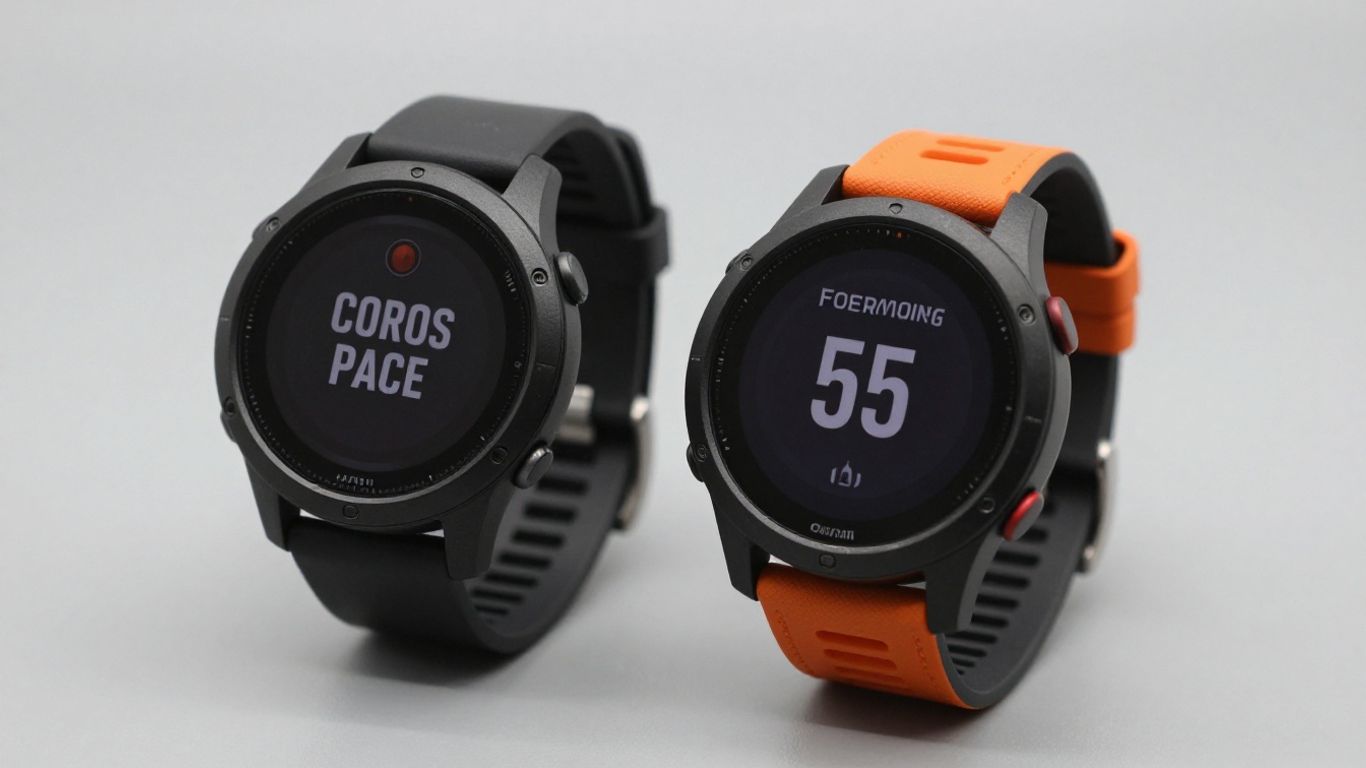
Coros Pace 3 vs Garmin 55 Cost Analysis
When you look at the price tags, the Coros Pace 3 generally comes in a bit lower than what you might expect for its feature set. It’s positioned as a strong contender for those who want a lot of bang for their buck. The Garmin Forerunner 55, on the other hand, is typically the more budget-friendly option, especially when you see it on sale. It’s often positioned as an entry-level GPS watch, which makes sense given its feature set.
It’s worth noting that prices can really fluctuate, especially during big sale events. Sometimes, you can find older Garmin models, like the Forerunner 255, dropping to prices that compete directly with the Pace 3. This can make the value proposition shift quite a bit depending on when you’re shopping.
Features Per Dollar
This is where the Coros Pace 3 really tries to shine. For its price, it packs in a surprising number of features. You get things like a barometric altimeter, SpO2 sensor for blood oxygen, and even Wi-Fi for updates, which aren’t always standard on watches in this price bracket. The Pace 3 undoubtedly offers more headline features for your dollar.
Garmin’s Forerunner 55, while cheaper, offers a more streamlined experience. It focuses on core running metrics and doesn’t have some of the more advanced sensors or connectivity options found on the Pace 3. However, Garmin’s strength lies in its mature ecosystem and the depth of its training metrics, which are harder to quantify purely by dollar amount.
Sale Pricing Considerations
Don’t forget to keep an eye out for sales. This is where the landscape can really change. If you catch the Garmin Forerunner 55 during a promotion, it becomes an even more attractive option for budget-conscious buyers. Similarly, if you’re looking at the Coros line, sometimes older models like the Pace 2 can be found at significant discounts, offering much of the same functionality as the Pace 3 for less money.
Waiting for a sale can often get you a better watch for your money, whether that’s a discounted Coros or a slightly older Garmin model that still packs a punch. It’s a smart move if you’re not in a rush.
Here’s a quick look at how they generally stack up:
| Feature Category | Coros Pace 3 | Garmin Forerunner 55 |
|---|---|---|
| Typical Price | Mid-range | Entry-level |
| Advanced Sensors (e.g., Baro Altimeter, SpO2) | Yes | No |
| Wi-Fi Connectivity | Yes | No |
| Ecosystem Depth | Developing | Mature |
| Sale Price Impact | Moderate | Significant |
So, Which One Should You Go For?
Alright, so we’ve gone through all the nitty-gritty details of the Coros Pace 3 and the Garmin Forerunner 55. Honestly, both are pretty solid watches for anyone looking to track their runs and general fitness. The Pace 3 packs a lot of features for its price, and its battery life is pretty impressive, which is a big plus for longer activities. On the other hand, Garmin’s ecosystem is just more developed, and when you catch their watches on sale, the value proposition gets really strong, sometimes even better than what Coros is offering at full price.
If you’re just starting out or need a reliable fitness tracker without breaking the bank, either will likely make you happy. But if you’re looking for that slightly more polished experience and a wider range of connected features, especially when prices drop, the Garmin might just edge out the Coros. It really comes down to what you prioritize: raw features for the money upfront, or a more established system with potential sale savings.
Frequently Asked Questions
Which watch is better for running, the Coros Pace 3 or the Garmin Forerunner 55?
Both watches are great for running and have accurate GPS. The Coros Pace 3 often gives you more features for your money, but Garmin’s system is more developed and has more options. It really depends on what you value most: getting more features for less cash, or a more polished system with lots of support.
Is the Coros Pace 3 worth upgrading to if I have an older Coros watch like the Pace 2?
If you have the Pace 2, the Pace 3 might not be a big enough upgrade. It has newer sensors, but the main features are pretty similar. If you have a much older model or are switching from a non-sports watch, then the Pace 3 is a good choice.
How do the screens on the Coros Pace 3 and Garmin Forerunner 55 compare?
The Coros Pace 3 uses a Memory LCD screen, which is good for battery life and easy to see in bright sunlight. The Garmin Forerunner 55 uses an AMOLED screen, which is brighter and has more vibrant colors, but can use more battery.
Are the GPS and heart rate tracking accurate on these watches?
Both watches generally offer good GPS accuracy, especially when using multiple satellite systems. Heart rate tracking on the wrist can sometimes be a bit off for both, but they are usually close enough for most runners. For the most precise heart rate, a chest strap is always recommended.
Can I use these watches for more than just running?
Yes! Both watches come with many different sports modes, so you can track activities like swimming, cycling, and more. They also offer basic smartwatch features like notifications from your phone.
Which watch offers better value for the money?
The Coros Pace 3 often provides more features for its price point, making it a strong contender for value. However, during sales, Garmin watches can become very competitive, sometimes offering a more robust ecosystem for a similar price.
Back to GPS Watch for Running


