

Your Guide to 12 Week Half Marathon Training
A 12 week half marathon training plan is a serious undertaking. But it’s an achievable and rewarding goal for runners at every level. The next three months are all about building endurance. You will gain the speed and mental grit needed to cross that finish line.
It all starts with a solid foundation.
Laying the Groundwork for Your 12-Week Journey
A great half marathon doesn't happen by accident. The real work begins long before your first scheduled run. It starts with a look at where you are right now. You need a clear picture of what you want to achieve. Grabbing a generic plan off the internet won't cut it. You need to get your body, mind, and gear ready. This will prepare you for the consistent work that lies ahead.
Think of this early phase as building your personal launchpad. It’s about knowing your current fitness. It's about setting goals that motivate you. And it is about making sure you have the right equipment. Skipping these steps is a fast track to frustration or injury.
Build Your Running Performance System
Move from research to action with training, recovery, nutrition, pacing, and performance tools built for runners.
More Guides for This Runner Goal
Honestly Assess Your Current Fitness Level
Before you pick a training plan, you must take an honest inventory. This isn't just about the longest run you've ever done. It’s about your consistency over the last few months. An athlete who consistently logs 10 miles a week is in a different spot. They are not the same as someone who runs 20 miles one week. Then takes two weeks off.
Ask yourself these questions:
- Weekly Mileage: What have you averaged per week for the last month?
- Longest Recent Run: What's the farthest you've run comfortably?
- Running Frequency: How many days a week are you lacing up?
- Injury History: Do any aches or pains need addressing first?
Answering these truthfully is key. It helps you choose the right training intensity. It sets you up for success.
I see it all the time. Runners jump into a plan that's too advanced. It’s far better to start conservatively and build momentum. Do not overreach in the first few weeks and get sidelined. The number one goal is to arrive at the starting line healthy.
Which Training Plan Is Right for You?
To make it simple, use this table. It matches your current fitness with the best training plan. This will help you find the right starting point for your 12-week journey.
| Running Level | Current Weekly Mileage | Recent Longest Run | Recommended Plan |
|---|---|---|---|
| Beginner | 5-10 miles | 2-3 miles | Beginner Plan |
| Intermediate | 15-25 miles | 5-6 miles | Intermediate Plan |
| Advanced | 30+ miles | 8-10 miles | Advanced Plan |
Remember, this is a guide. If you're between levels, choose the more conservative plan. You can always add a little extra if you're feeling great. You can't undo an injury from doing too much, too soon.
Set a Realistic and Motivating Goal
Your goal is the "why" that gets you out of bed for a run. Finishing the race is a phenomenal achievement in itself. But having a specific time goal can bring a powerful focus. The catch is that it has to be grounded in reality.
If you've raced recently, a 5K or 10K time can be a great predictor. Plenty of online calculators can give you a solid estimate. For first-timers, I often recommend a simpler goal. Finish strong and actually enjoy the experience. You can always adjust your time target as your fitness improves. This happens during the 12 week half marathon training block.
Invest in the Right Running Gear
Your gear isn't just about comfort. It's your first line of defense against injury. You don’t need to break the bank. But a few key pieces are absolutely non-negotiable.
The most important investment you will make is a good pair of shoes. Go to a specialty running store for a gait analysis. They’ll watch you run and recommend shoes that fit your foot type. This one move can save you from shin splints, knee pain, and blisters. Beyond shoes, look into moisture-wicking socks. Also consider comfortable apparel and a GPS watch to track your runs.
For a deeper dive into race-day strategies, check our guide of half marathon training tips. It is packed with insights to get you ready.
The Complete 12-Week Half Marathon Training Schedule
Alright, this is where the rubber meets the road. A solid 12-week half marathon training plan is your most important tool. It helps you get to the starting line healthy and the finish line happy. Below, you’ll find three distinct, week-by-week schedules. I’ve put them together for beginner, intermediate, and advanced runners.
Each plan is built on the principle of progressive overload. We’ll slowly and safely increase the demands on your body. It gets just enough stress to adapt and get stronger. We avoid pushing you over the edge into injury territory. I’ve taken the guesswork out of it. It balances tough workouts with needed recovery. Trust the process.
Before you even think about lacing up your shoes, map out your prep work. This timeline gives you a quick visual. It shows how to approach the weeks before your training starts.
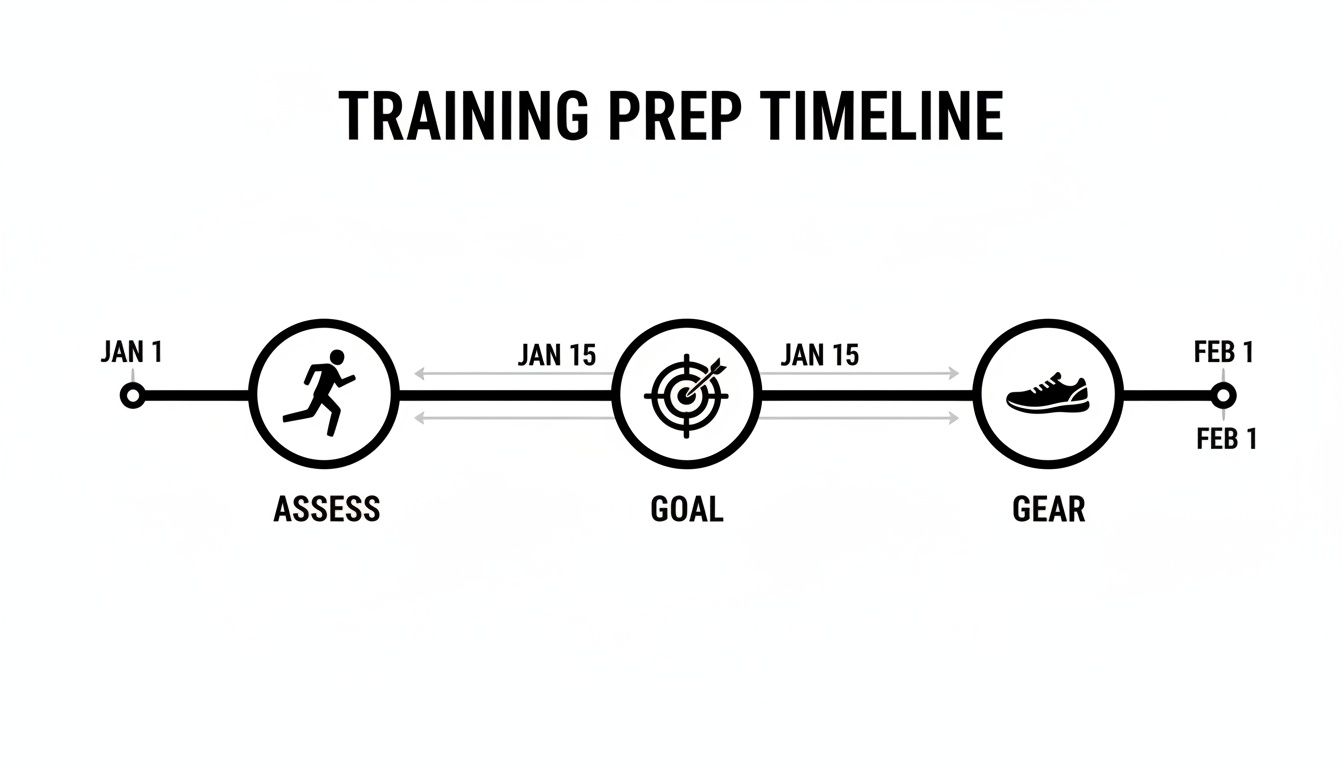
As you can see, a successful race starts long before Day 1. Get your gear, know your "why," and assess your starting point.
Understanding the Structure of Your Training Plan
Every run in these plans has a purpose. We’re not just logging junk miles. Easy runs build your aerobic base. Long runs are all about endurance. Speed work—your tempo and interval runs—is what makes you faster. And rest days are not optional. That’s when the real magic happens. Your muscles repair and rebuild.
Let's talk mileage for a second. How much should you be running? We have a pretty good idea based on data from thousands of runners. Athletes who broke the two-hour mark ran between 248 to 294 total miles. That averages to 20-24 miles per week. This is the sweet spot for our intermediate plan.
To dig deep into building stamina, check out this proven training guide to increase endurance.
The Beginner Runner Schedule
If you're running about 5-10 miles a week, this plan is for you. It's perfect if you can handle a 2-3 mile run. The main goal here isn't about speed. It's about building endurance to finish the race feeling strong.
- Key Focus: Building a solid aerobic base and increasing long run distance.
- Workouts: Mostly easy, conversational-pace runs, with one long run each week.
- Pacing: Keep every run at a pace where you could hold a conversation. If you’re gasping for air, you’re going too hard.
This schedule mixes three running days with two cross-training days. This helps build your overall fitness without constant pounding. This is key to keeping injuries at bay.
The Intermediate Runner Schedule
This one's for you if you're logging 15-25 miles per week. It is for those who have recently tackled a 5 or 6-mile long run. Here, we shift the focus from just finishing to finishing strong. You might even chase a specific time goal.
You’ll start incorporating structured speed work. This improves your lactate threshold. Think of this as a tipping point. Your body can't clear lactic acid as fast as it's producing it. By training to push that threshold higher, you can hold a faster pace. You can do this for a longer time before fatigue sets in.
I see this all the time. Intermediate runners hammer their easy days. Don't do it! Easy runs are for recovery and building your aerobic engine. They are not for proving how fit you are. Save your hard efforts for scheduled days.
So, what does a week actually look like? Here’s a snapshot from the middle of the plan. It gives you an idea of how we balance different workout types.
Sample Week for Intermediate Runner (Week 6)
This table shows a typical weekly structure. Each session has a specific job to do in getting you race-ready.
| Day | Workout Type | Distance / Duration | Purpose |
|---|---|---|---|
| Monday | Rest | N/A | Muscle repair and recovery |
| Tuesday | Easy Run | 3 Miles | Aerobic base building |
| Wednesday | Tempo Run | 5 Miles (incl. 3 at tempo pace) | Improve lactate threshold |
| Thursday | Easy Run | 3 Miles | Active recovery |
| Friday | Cross-Training | 30-45 minutes | Build strength, prevent injury |
| Saturday | Long Run | 8 Miles | Build endurance and mental grit |
| Sunday | Rest or Active Recovery | N/A | Full recovery for the next week |
See the flow? We stress the body, then we let it recover. This rhythm is the key to getting fitter without burning out.
The Advanced Runner Schedule
If you’re a seasoned runner putting in 30+ miles a week, this plan is for you. It's for runners with a half marathon or two under their belt. This plan is designed to help you chase a new personal best. The volume is higher, the intensity is turned up, and the workouts are complex.
- Key Focus: Maximizing your aerobic capacity (VO2 max) and dialing in race pace.
- Workouts: A mix of interval training, tempo runs, and long runs with goal pace miles.
- Pacing: Your workouts will have specific pace targets tied to your goal time.
This advanced 12-week half marathon training schedule is a serious commitment. You need a good feel for your body and be dialed in on recovery. That means sleep, nutrition, and more. Listening to your body isn't just a suggestion here. It's a requirement to stay healthy and hit your peak on race day.
Mastering Your Pacing and Long Run Strategy

You have put in the work for a 12 week half marathon training cycle. The last thing you want is to fall apart on race day. The difference between a great race and a painful shuffle comes down to pacing. It's the art of managing your energy from the very first mile. This helps you finish feeling powerful, not spent.
And your weekly long run? That's your dress rehearsal. It’s about more than just logging miles. It’s where you build physical endurance. And crucially, it's where you find the mental grit to hold a steady effort.
How to Find Your Ideal Race Pace
Your race pace isn't just a number you pull out of thin air. It needs to be grounded in your current fitness. A simple way to find your starting point is to use a race equivalency calculator. Plug in a recent 5K or 10K time. This gives you a realistic goal to work toward.
With that target in mind, your training runs become a laboratory. This doesn't mean you should hit that pace on every run. That's a fast track to burnout. Instead, you'll weave it into specific workouts.
- Tempo Runs: These are your "comfortably hard" efforts. You're pushing, but you're not all-out sprinting. Tempo work trains your body to clear lactate more efficiently. For more on this, read about what is a threshold run.
- Race Pace Miles: As you get deeper into the plan, you'll mix in race pace miles. This happens on your long runs. This is invaluable practice. It teaches your body and mind what race-day effort feels like.
A crucial tip: your long run pace should be slower than your race pace. I'm talking 60 to 90 seconds per mile slower. The goal of the long run is building endurance. It is not about chasing a new personal best.
Executing the Perfect Long Run
Make no mistake: the long run is the cornerstone of any solid half marathon plan. Its main purpose is to build your aerobic engine. It also teaches your body to be a more efficient fat-burning machine. This workout is all about duration, not intensity.
And the research backs this up. A study found that runners who did long runs over 13 miles ran faster. Those who averaged over 20 miles per week also performed better. The long run truly is the most important session of the week.
Avoiding Common Pacing Mistakes
I see it in every race. The gun goes off, and people sprint away. Race day adrenaline is a powerful force. It can trick you into starting out way too fast. This is the single biggest mistake runners make. It almost always leads to a crash-and-burn in the final miles.
The key is control. Think of the first mile as a warm-up. Let others fly past you. You’ll be the one passing them later on. Trust the plan. Trust the paces you've practiced for weeks. Hold back. Master your effort early. You'll set yourself up for the strong finish you've earned.
Fueling Your Body for Peak Performance

Let's be honest. A bulletproof training plan will fall apart without the right fuel. Nutrition isn't just a side note to your 12-week half marathon training. It’s the engine that powers every run. It is also the toolkit that rebuilds you afterward.
Think of it this way. You wouldn't put cheap gas in a performance car. What you eat before, during, and after workouts has a direct impact. It affects your energy, endurance, and recovery. This is your no-nonsense guide to getting it right.
Pre-Run Fueling for Sustained Energy
Running on empty is fine for a quick jog. But for anything over 45 minutes, you're setting yourself up for a struggle. A pre-run snack tops off your glycogen stores. This gives your muscles easily accessible energy.
Try to eat about 60-90 minutes before you head out. This gives you enough time to digest. You won't feel a sloshing stomach or side cramps. The key is to focus on simple, easily digestible carbs. Keep fat, fiber, and protein low.
Here are a few go-to options for experienced runners:
- A small bowl of oatmeal with berries or a sliced banana.
- A piece of toast with a light spread of jam or almond butter.
- A simple energy bar designed for pre-workout fuel.
This is not the time for a massive, greasy breakfast. Keep it simple. Stick to foods you know your stomach can handle.
Fueling During Your Long Runs
Once your runs stretch beyond 75-90 minutes, you must refuel on the move. As you run, your body burns through stored glycogen. When those stores get low, you hit the infamous "wall." This is a sudden, crushing feeling of fatigue.
To prevent this, aim for 30-60 grams of carbohydrates per hour. Do this after the first hour is up. Energy gels, chews, and sports drinks are your best friends here. It is important to experiment with these during training runs. Do not try them for the first time on race day.
The golden rule of racing: Never try anything new on race day. This applies to your shoes, your clothes, and your fuel. Your long runs are the perfect dress rehearsal for your nutrition plan.
Post-Run Recovery Nutrition
What you put into your body after a run is just as critical. There’s a "golden window" of about 30-60 minutes post-workout. Your body is incredibly efficient at absorbing nutrients then. This replenishes energy and kickstarts muscle repair.
You're aiming for a combination of carbs and protein. Carbs will restock glycogen stores. Protein delivers amino acids needed for muscle repair. A 3:1 or 4:1 ratio of carbs to protein is the sweet spot.
Some effective and easy recovery options include:
- A smoothie with fruit, Greek yogurt, and protein powder.
- Chocolate milk is a classic for a reason. It has a near-perfect carb-to-protein ratio.
- A real meal, like grilled chicken with rice or eggs on toast.
Our guide on protein powder after running explains how it can speed up recovery. Don't skip this step. Your body is screaming for these nutrients after a hard effort.
The Power of Sleep and Active Recovery
Fuel is only one piece of the recovery puzzle. Sleep is the most effective performance-enhancing tool you have. When you're in a deep sleep, your body releases growth hormone. This is essential for repairing muscle and adapting to training. Make 7-9 hours of quality sleep a non-negotiable part of your plan.
Don't forget about active recovery, either. Light activities like gentle stretching or a brisk walk get the blood flowing. This helps flush out metabolic waste products. It can seriously reduce soreness. Just 10-15 minutes on your rest days makes a world of difference.
Building Resilience Through Cross-Training and Injury Prevention
Making it to the starting line healthy is your first victory. Running is the core of your 12 week half marathon training. But what you do on non-running days builds a durable body.
Cross-training isn't just about filling time. It’s a strategic tool. It helps you strengthen supporting muscles. It boosts your aerobic fitness without the constant pounding. And it breaks up the mental monotony of logging miles. Ignoring it is a common mistake that leaves runners vulnerable to injury.
The Real Benefits of Cross-Training
Think of cross-training as your secret weapon. It targets muscle groups that running neglects. This creates a more balanced and powerful athletic frame. Low-impact activities are your best friend here. Think swimming, cycling, or using the elliptical.
For instance, swimming is fantastic for cardiovascular endurance. It builds upper body strength with zero impact on your joints. Cycling is a powerhouse for strengthening your quads and glutes. These are the main engines behind your running stride.
"A key component of building resilience is through diversified workouts. Discover the benefits of cross-training for runners to see how it can boost your performance."
Just working these activities in 1-2 times per week makes a huge difference. You keep building that important aerobic base. You also give your running muscles a much-needed break.
Strength Training for a Stronger Stride
When runners want to get stronger, they often just run more. But targeted strength work is one of the most effective ways to ward off common ailments. A solid core, strong glutes, and stable hips hold your form together. This is crucial when fatigue tries to tear it apart late in a race.
You don't need to live in the gym, either. A focused 20-30 minutes twice a week is all it takes.
Here are a few essential, runner-focused exercises:
- Glute Bridges: These wake up and strengthen your glutes. This muscle group is critical for a powerful, stable stride.
- Planks: A strong core is the foundation of good running posture. Planks build the stability you need through your entire torso.
- Clamshells: This exercise hones in on the hip abductors. These are vital for preventing your knees from caving inward.
If you're looking for more ideas, explore this list of cross-training exercises for runners. They are easy to weave into your weekly schedule.
Learning to Listen to Your Body
One of the hardest skills for any runner is telling the difference. You must distinguish between normal fatigue and early warning signs of injury. It's a fine line. Pushing through soreness is part of the process. But ignoring a sharp, localized, or persistent pain is asking for trouble.
Start paying close attention to the signals your body is sending. A bit of muscle soreness that fades once you warm up is normal. Pain that gets worse the longer you run is a major red flag.
Learn to recognize when a rest day will do you more good. Taking one unplanned day off is always better than being forced to take two weeks off.
Your Top Half Marathon Training Questions, Answered
Every runner has questions during a 12-week half marathon training block. You can have the perfect plan laid out. But life has a funny way of getting in the way. Let's tackle some of the most common questions I hear from athletes. This will help you navigate your training with confidence.
Think of this as your go-to troubleshooting guide. We'll cover everything from schedule hiccups to race-day logistics. We'll clear up any doubts so you can focus on your running.
What Should I Do If I Miss a Run?
First, don't panic. Missing a run is not a disaster. It happens to everyone. How you handle it depends on the workout you missed.
If it was an easy or recovery run, the best move is to just let it go. Your body probably appreciated the extra rest more than it needed the miles. Just get back on track with your next scheduled run.
If you missed a key session like a long run, you have options:
- Shuffle the schedule: If you have wiggle room, just bump things by a day. Do Friday's workout on Saturday, and shift your long run to Sunday.
- Let it go: If your week is packed, just forget about the missed run. Trying to cram two hard workouts back-to-back is a fast track to injury.
The absolute worst thing you can do is try to "make up" the mileage. Do not tack it onto another run. This messes with the purpose of your other workouts. It also sends your injury risk through the roof.
How Do I Know If I'm Running My Easy Days Too Hard?
This is a big one. Your easy days are a crucial part of your training. They're also the easiest to get wrong. The point of an easy run is to recover and build your aerobic base. It is not to prove your fitness. Running them too hard sabotages your recovery. You won't be fresh for the workouts that make you faster.
The simplest gut check is the talk test. On an easy run, you should be able to hold a full conversation. If you can only spit out a few words, you’re going too fast. Slow down. A heart rate monitor is also a fantastic tool. Aim to keep easy runs in Zone 2, around 60-70% of your max heart rate.
What Should I Wear on Race Day?
The number one rule of race day is: nothing new. I mean it. Not your shoes, not your socks, not your shorts. Test your entire race day kit on a few of your long runs. This is your chance to discover any potential chafing or blisters. Find issues before they can ruin your race.
In the days before the race, become a weather fanatic. A good rule of thumb is to dress for a temperature 15-20 degrees Fahrenheit warmer. You’ll warm up a ton once you get moving. For a chilly start, layers are your best friend. A cheap, disposable long-sleeve shirt you can toss is a classic move.
When Should I Stop Running Before the Race?
You don't! But you do scale back significantly. The final two weeks are all about the taper. You strategically reduce your mileage and intensity. This lets your body fully recover, repair muscle, and top off energy stores. You arrive at the starting line feeling powerful, not fatigued.
Your plan will have a taper built in. But the general idea is to cut mileage by 20-30% two weeks out. Then cut it by another 40-50% during race week. You'll still be running, but the sessions will be shorter. A short, easy run the day before the race is perfect. It keeps your legs from feeling stiff.
At RunDreamAchieve, we’re all about providing structure and expert coaching. We help you smash your goals. Our training plans are built on proven principles. They get you to the starting line healthy, confident, and ready for a new personal best.
Ready to stop guessing and start training smarter? Explore our plans and coaching options at https://www.rundreamachieve.com.


